Key takeaways
- Connection spacing: Commercial faucets commonly use 8-inch centers, but measure the distance between the center of the hot and cold inlets rather than assuming.
- Inlet size: 1/2-inch connections are common, while some heavy-duty installations use 3/4-inch supplies. Match the faucet to the shutoff valves and supply capacity.
- Wall clearance: A wall-mounted faucet often needs a backsplash opening, a reinforced wall bracket, and enough room for the riser to clear shelves.
- Deck thickness: For a deck-mounted unit, check the maximum ledge thickness and the diameter of each mounting hole.
- Backflow protection: Confirm whether the spray valve or plumbing assembly includes the required vacuum breaker or check-valve arrangement for your jurisdiction.
- Drainboard position: A faucet that swivels toward the drainboard can be more valuable than one with an extra-tall riser.
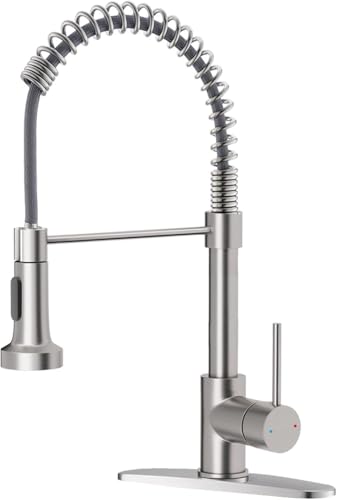
The best commercial kitchen faucets for most busy sinks are pre-rinse models with an 18–24-inch riser, a 44–68-inch flexible hose, a 360-degree swivel spout, and a flow rate of about 1.15–1.42 gallons per minute (GPM); choose a wall-mounted T&S Brass or Fisher faucet for maximum durability, or a deck-mounted commercial-style faucet when existing countertop holes make wall plumbing impractical.
Our top picks


As an Amazon Associate we earn from qualifying purchases at no extra cost to you. Ratings are shown as listed on Amazon.
Best commercial kitchen faucets by situation
| Kitchen situation | Best faucet type | Useful target specification | Why it fits |
|---|---|---|---|
| High-volume dishwashing | Wall-mounted pre-rinse faucet | 44–68-inch hose, 1.15–1.42 GPM, 8-inch center-to-center inlet | Long reach, clear sink space, and easy service access |
| Existing three-compartment sink | Deck-mounted pre-rinse faucet | 8-inch centers, 1/2-inch inlets, 12–14-inch spout reach | Usually installs without opening the wall |
| Small bar or prep sink | Compact commercial-style faucet | 10–14-inch riser, 8–10-inch swivel spout, 1.0–1.5 GPM | Less likely to strike shelves or obstruct a narrow basin |
| Greasy pots and baked-on residue | Pre-rinse spray valve with separate swivel spout | 12–18-inch spray reach, 360-degree spout rotation | Combines concentrated spray with controlled filling |
| Low-flow or water-cost-conscious operation | Low-flow pre-rinse faucet | 0.65–1.28 GPM, preferably with a full-flow replacement spray valve available | Reduces water use without abandoning commercial ergonomics |
Top commercial faucet families to consider
T&S Brass B-0133 and related B-series pre-rinse faucets: best all-around serviceability
T&S Brass is a long-established commercial plumbing brand, and its B-series pre-rinse configurations are common in food-service installations. The appeal is not decorative styling; it is the availability of replacement spray valves, hoses, washers, cartridges, wall brackets, and swivel-spout parts.
A typical B-series setup uses an 8-inch wall or deck connection, a spring-style riser, and a separate spray valve. Confirm the exact configuration because T&S sells versions with different inlet types, spout lengths, flow rates, and mounting arrangements. This is a strong choice when a manager would rather replace a $30–$100 wear part than replace an entire faucet.
Fisher commercial pre-rinse faucets: best for rugged, traditional installations
Fisher faucets are designed around commercial kitchens and are particularly suitable for operators who prioritize heavy brass construction, repairable assemblies, and familiar wall-mounted plumbing. Fisher’s pre-rinse lines include options for different spout lengths and connection arrangements, so they work well with deep pot sinks as well as standard three-compartment sinks.
Choose Fisher when the faucet will be used continuously and the plumbing team already stocks Fisher repair parts. The main caution is configuration: some models are intended for wall mounting, while others require a deck-mounted sink ledge or a specific mounting kit.
Krowne Royal Series pre-rinse faucets: best for a broad range of configurations
Krowne’s Royal Series includes commercial pre-rinse faucets with several combinations of riser height, hose length, spray valve, and mounting style. That makes the brand useful when a replacement must match an unusual sink, backsplash, or existing plumbing layout.
Pay close attention to the selected spray valve’s flow rate. A powerful valve is useful for food debris, but a lower-flow model can be more appropriate where local water rules, splash control, or utility costs matter more than maximum rinsing speed.
Chicago Faucets commercial models: best when metering or institutional controls matter
Chicago Faucets offers commercial and institutional faucet designs, including configurations with metering or specialized control options. These are worth considering in schools, healthcare facilities, public kitchens, and other locations where controlling run time or reducing accidental flow is important.
For a conventional restaurant dish pit, a standard pre-rinse valve is usually faster to operate than a metered control. For handwashing or light prep areas, however, a controlled-flow model may reduce waste and discourage leaving the water running.
Spray reach and swivel range matter more than overall height
A tall spring riser looks commercial, but height alone does not determine usability. Measure from the spray valve to the farthest corner of the sink. A 44-inch hose is adequate for many 24-inch-deep compartments; a 60- to 68-inch hose is more useful when the operator must rinse across multiple compartments or fill a container on an adjacent drainboard.
Look for a swivel spout that rotates at least 180 degrees, with 360 degrees preferable when the sink has two or three compartments. A limited swivel range can force the operator to twist the hose or pull the spray valve sideways, increasing stress on the wall bracket and hose connection.
Do not confuse hose length with spray reach. A long hose may still be awkward if the spring riser is mounted too far behind the sink, the hose is unsupported, or the spray valve has a short trigger handle. The included wall hook or hose guide should hold the valve high enough that it does not drag through the basin.
Mounting requirements: measure before ordering
- Connection spacing: Commercial faucets commonly use 8-inch centers, but measure the distance between the center of the hot and cold inlets rather than assuming.
- Inlet size: 1/2-inch connections are common, while some heavy-duty installations use 3/4-inch supplies. Match the faucet to the shutoff valves and supply capacity.
- Wall clearance: A wall-mounted faucet often needs a backsplash opening, a reinforced wall bracket, and enough room for the riser to clear shelves.
- Deck thickness: For a deck-mounted unit, check the maximum ledge thickness and the diameter of each mounting hole.
- Backflow protection: Confirm whether the spray valve or plumbing assembly includes the required vacuum breaker or check-valve arrangement for your jurisdiction.
- Drainboard position: A faucet that swivels toward the drainboard can be more valuable than one with an extra-tall riser.
A useful fit check is to mark the faucet centerline on the wall and extend the spray hose to each corner of the sink. If the hose must bend sharply at full reach, select a longer hose or relocate the mounting point. A hose should sweep naturally rather than act like a winch cable.
Flow rate: faster is not always better
Many commercial pre-rinse spray valves fall between roughly 0.65 and 1.42 GPM. At 1.28 GPM, a five-minute pre-rinse uses 6.4 gallons. At 1.42 GPM, the same task uses 7.1 gallons. Across 100 daily pre-rinse cycles, that difference is about 70 gallons per day, or more than 25,000 gallons per year.
The lower-flow option only saves time and water if it removes food residue effectively. Very low-flow valves can make staff compensate by spraying longer, eliminating much of the expected saving. Compare the intended flow rating with local code requirements and the kitchen’s incoming pressure. A spray valve that performs well at 60 PSI may feel weak if the building supplies substantially less.
Finishes and materials for demanding kitchens
Polished chrome is usually the easiest finish to clean and is often the best value. Stainless-steel finishes can coordinate with equipment, but the underlying material and plating quality matter more than color. Look for brass or stainless-steel bodies, metal hose connections, a replaceable spray-valve seal, and a reinforced wall bracket.
Brushed finishes hide water spots better than mirror chrome but can trap grease in their texture if wiped irregularly. Avoid abrasive pads and chlorine-heavy cleaners unless the manufacturer specifically permits them. Rinse sanitizer residue from the faucet and dry it at the end of the shift; concentrated chemicals can attack plating, elastomers, and hose jackets.
What wears out first—and how to extend service life
- Spray-valve seals: Drips or a valve that fails to shut off usually indicate worn seals, debris, or a damaged valve seat.
- Hose jacket: Repeated contact with a sink edge can abrade the outer cover. Replace the hose before the inner tube fails.
- Swivel-spout O-rings: A leak at the spout joint often needs an inexpensive seal replacement rather than a new faucet.
- Wall bracket: A loose bracket lets the riser flex and transfers force to the supply connections. Tighten and inspect it routinely.
- Aerators and spray openings: Mineral scale reduces flow and creates an uneven pattern. Remove and soak serviceable parts in an approved descaling solution.
Train staff to pull the spray valve in line with the hose instead of sideways, release it before hanging it, and avoid using the hose as a support for heavy containers. These habits reduce the two commonest preventable failures: stretched hoses and cracked mounting hardware.
Bottom line
For a busy dish pit, start with a repairable wall-mounted pre-rinse faucet from T&S Brass, Fisher, or Krowne, then choose the hose length and spray-valve flow rate around the actual sink dimensions. Select a deck-mounted model when wall plumbing is difficult, a compact faucet when overhead clearance is limited, and a controlled-flow Chicago Faucets configuration when limiting run time is more important than maximum rinsing speed. The right commercial kitchen faucet is the one that reaches every working area without strain, fits the existing connections, and has replacement parts your maintenance team can obtain quickly.