Key takeaways
- Footprint and height: Measure floor space AND overhead clearance. You need at least 84-90 inches of vertical space for full range of motion, plus 24-36 inches in front for the bench to slide.
- Weight stack vs. plate-loaded: Selectorized stacks are faster and quieter but cost more. Plate-loaded machines are compact and expandable if you already own Olympic plates.
- Cable and pulley quality: Smoothness comes from sealed bearing pulleys, cable diameter (typically 5-6mm nylon-coated steel), and guide rod construction. Cheap bushings create stick-slip at the bottom of the pull.
- Assembly and versatility: Standalone towers assemble in 60-90 minutes, while rack-mounted attachments save space but require a compatible power rack. Many home models now include a low row footplate to double as a seated row.
The best lat pulldown machines for home gyms balance a small footprint with a smooth cable system and a weight stack heavy enough to grow with you, with top picks like the REP Fitness Lat Pulldown/Row combo, Body-Solid Pro Lat Machine GLM83, Titan Fitness Wall-Mounted Lat Tower, and Rogue LC-2 Lat Pulldown attachment standing out for different spaces and budgets.
Our top picks


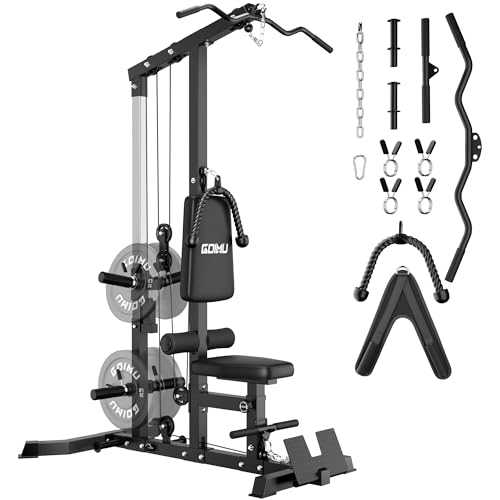

As an Amazon Associate we earn from qualifying purchases at no extra cost to you. Ratings are shown as listed on Amazon.
How to Choose the Right Lat Pulldown Machine for a Home Gym
Unlike commercial pulldown towers, home models have to work inside 8-foot ceilings, spare bedrooms, and garages where every square foot counts. Before comparing brands, filter by four non-negotiable criteria:
- Footprint and height: Measure floor space AND overhead clearance. You need at least 84-90 inches of vertical space for full range of motion, plus 24-36 inches in front for the bench to slide.
- Weight stack vs. plate-loaded: Selectorized stacks are faster and quieter but cost more. Plate-loaded machines are compact and expandable if you already own Olympic plates.
- Cable and pulley quality: Smoothness comes from sealed bearing pulleys, cable diameter (typically 5-6mm nylon-coated steel), and guide rod construction. Cheap bushings create stick-slip at the bottom of the pull.
- Assembly and versatility: Standalone towers assemble in 60-90 minutes, while rack-mounted attachments save space but require a compatible power rack. Many home models now include a low row footplate to double as a seated row.
Spec Comparison: Top Home Lat Pulldown Machines in 2026
These are the most commonly recommended home models from established fitness equipment brands. All are selectorized unless noted, and all exist in plate-loaded variants where noted.
| Model | Type | Footprint (L x W) | Height | Weight Stack / Capacity | Cable & Pulley System | Assembly Time |
|---|---|---|---|---|---|---|
| REP Fitness Lat Pulldown / Low Row | Standalone, selectorized | 54″ x 37″ | 89″ | 250 lb stack (310 lb optional upgrade) | 6mm nylon-coated cable, 3.5″ aluminum pulleys with sealed bearings | 75-90 min, 2 people recommended |
| Body-Solid Pro Lat Machine GLM83 | Standalone, selectorized | 58″ x 32″ | 83″ | 210 lb stack | 2200 lb rated cable, 3.5″ fiberglass reinforced nylon pulleys | 60-75 min |
| Titan Fitness Wall-Mounted Lat Tower V3 | Wall-mounted, plate-loaded | 32″ x 40″ (wall protrusion x width) | 84″ (plate carriage height) | Plate-loaded to 300 lb (500 lb max carriage rating) | 6mm cable, 90mm sealed bearing pulleys, dual 1″ chrome guide rods | 90-120 min, must lag into studs/concrete |
| Rogue LC-2 Monster Lat Pulldown (Rack Attachment) | Rack-mounted, plate-loaded | Uses existing rack footprint + 24″ extension | Uses rack height (requires 90″+ rack) | Plate-loaded to 350 lb | 3/16″ coated aircraft cable, knurled aluminum pulleys with bearings | 45-60 min, bolts to Rogue Monster series |
| Inspire Fitness FTX Functional Trainer / Lat Pulldown Combo | Compact functional trainer | 52″ x 44″ | 82″ | 165 lb per side (dual stacks, 2:1 ratio) | Dual 2000 lb cables, 3″ precision pulleys | 120-150 min |
| XMark XM-7618 Lat Pulldown | Standalone, plate-loaded | 49″ x 38″ | 82.5″ | Plate-loaded to 400 lb | Roller pillow-block bearings on carriage, nylon pulleys | 45-60 min |
For low ceilings under 82 inches, the Body-Solid GLM83, XMark XM-7618, and Inspire FTX are the safest bets. If you already own a full power rack, a rack-mounted option like the Rogue LC-2 saves the most floor space.
Best Picks by Situation
Best Overall for Most Home Gyms: REP Fitness Lat Pulldown / Low Row
The REP tower is the benchmark for home use because it does two jobs without a large footprint. The 250 lb stack is enough for most lifters to progress for years, and the included lat bar and low row bar plus flip-up footplate mean you get vertical and horizontal pulling from one machine. The cable travel is notably smooth for its price tier due to oversized aluminum pulleys, and the guide rods are chrome-plated to resist corrosion in garage gyms. General market range is typically mid-tier standalone pricing. It needs about 90 inches of ceiling height, so measure carefully.
Best for Small Spaces and Low Ceilings: Titan Fitness Wall-Mounted Lat Tower
If floor space is your limiter, a wall-mounted tower cuts the footprint by nearly 40% compared to a standalone. The Titan V3 protrudes only about 32 inches from the wall when not in use and the bench can be stored upright. Because it is plate-loaded, you control the max weight with plates you already own, though you will need to load/unload plates between users. It must be anchored securely into wall studs or masonry – drywall alone will fail. This is the best value if you have a garage wall and do not mind a longer, more technical install.
Best Rack Attachment to Save Space: Rogue LC-2
For anyone who already owns a Rogue Monster or Monster Lite rack, an integrated lat pulldown is the most space-efficient solution. There is no additional footprint beyond the pulldown seat and knee roller that extends from the rack. The trade-off is compatibility – it only fits Rogue spec racks and requires a 90-inch or taller rack for full lat pulldown range. Plate-loaded systems also feel slightly less consistent at very light weights compared to selectorized stacks.
Best Compact Selectorized Option for Smoothness: Body-Solid GLM83
Body-Solid has made lat machines for decades, and the GLM83 is designed specifically for residential 8-foot ceilings at 83 inches tall. The fiberglass reinforced pulleys and no-cable-change design (you do not need to re-thread cables to switch from pulldown to low row) make it one of the easiest to live with. The 210 lb stack is lighter than the REP, but sufficient for most home users focused on hypertrophy and general strength. It also has one of the simplest assembly processes in this category.
Best Budget Plate-Loaded: XMark XM-7618
The XMark is a simple, no-stack machine with a pillow-block bearing carriage that stays smooth even under 300+ lb loads. At 82.5 inches tall and under 50 inches long, it fits basements and spare rooms well. You will need Olympic plates and will give up the convenience of a quick pin selector, but the general market range is typically the lowest among standalone towers.
Decision Matrix: Which Machine Matches Your Situation?
| Your Situation | Best Match | Why |
|---|---|---|
| Limited floor space (apartment, spare bedroom) | Wall-mounted or rack attachment (Titan, Rogue) | Reuses wall/rack, frees floor for other equipment |
| Low ceilings under 84″ | Body-Solid GLM83, XMark XM-7618, Inspire FTX | Sub-84″ height avoids ceiling interference |
| You train heavy / need 250 lb+ resistance | REP with 310 lb upgrade, Titan, XMark | Higher stack or plate capacity for advanced lifters |
| You want fastest workouts / share with family | Selectorized stack (REP, Body-Solid, Inspire) | Pin selection is seconds vs. loading plates |
| You already own Olympic plates and want to save | Plate-loaded (Titan, XMark, Rogue) | Lower upfront cost, uses existing plates |
| You want pulldown + rows + functional training | Inspire FTX or REP with low row | Dual pulleys add cable crossovers and rows |
Cable Smoothness and Weight Stack: What Actually Matters
Cable smoothness is not just feel – it affects joint stress. Jerky cables cause you to yank at the bottom of the movement. Look for:
- Sealed bearings vs. bushings: Bearings maintain smoothness under load and over time. Bushings are cheaper but develop friction as dust builds up.
- Guide rods: Solid chrome or stainless steel rods with linear bearings glide better than hollow rods with plastic bushings. Wipe rods monthly with a dry cloth; avoid WD-40 which attracts dust.
- Weight ratio: Some functional trainers use a 2:1 ratio, meaning 80 lb on the stack equals 40 lb at the handle. This allows lighter increments and faster cable speed but halves the effective max weight. Traditional lat towers are 1:1.
For weight stack capacity, most beginners will not max out 160-180 lb for strict lat pulldowns, but seated rows allow heavier loading. If you can row over 200 lb for reps now, choose a 250 lb+ stack or a plate-loaded machine to avoid outgrowing it in a year. General information only – choose a weight that allows controlled form and consult a qualified trainer if you are new to resistance training.
Quick Fit Calculation: Will It Fit Your Space?
Before ordering, run this check:
1. Height clearance: Machine height + 6 inches = minimum ceiling needed. The extra 6 inches allows the cable to travel fully without hitting joists or lights. Example: An 89-inch REP tower needs a 95-inch ceiling for comfortable use; a low 82-inch ceiling would not work.
2. Floor area with use: Machine footprint + 36 inches in front + 12 inches on each side. Example: A 54″ x 37″ machine needs an active zone of roughly 90″ x 61″ (7.5 ft x 5 ft) to allow the bench and your knees to extend.
3. Cost per expected use: Estimated price range / (workouts per week x 52 weeks x years you plan to keep it). Example: A mid-range machine in the $600-$900 range used 3x per week for 5 years = 780 uses. $750 / 780 = ~$0.96 per use. This helps compare a cheaper plate-loaded option versus a more convenient selectorized stack.
Assembly, Durability and Ownership Realities
Lat pulldown machines are among the simpler home gym installs, but there are common pitfalls:
- Assembly: Expect 12-20 bolts for the main frame plus cable threading. Standalone towers take 60-90 minutes with two people; wall-mounted units take longer due to anchoring. Lay out all hardware first and do not fully tighten frame bolts until the machine is upright and level.
- What wears first: The cable is the consumable. Nylon-coated cables last 3-5 years with home use, but fraying at the pulley contact points or near the end fittings is the first failure sign. Pulleys and guide rod bushings are second. Keep a spare cable from the manufacturer on hand.
- Maintenance: Dust is the enemy. Vacuum around pulleys monthly. Wipe guide rods with isopropyl alcohol, then apply a thin coat of silicone lubricant. Check cable tension after the first month – cables stretch slightly and may need adjustment via the threaded end bolt.
- Common mistakes: Over-tightening the cable creates premature wear. Leaving the weight stack pinned at the top without a rest allows the cable to stay under tension. Dropping the stack instead of guiding it down cracks weight plates and loosens guide rod anchors. On plate-loaded machines, using non-Olympic plates with a large center hole causes wobble and uneven cable pull.
- Floor protection: Place a 3/8-inch rubber mat under the machine. It dampens noise when the stack returns and prevents the bench legs from denting flooring.
A well-maintained home lat machine from a reputable brand typically lasts 10+ years, with only cables and pulley bearings needing occasional replacement.
Final Recommendation
For most home gym owners in 2026 who want one machine that does the most, the REP Fitness Lat Pulldown/Low Row with the standard 250 lb stack covers pulldowns, rows, and future strength gains without dominating a garage. If you are tight on floor space or ceiling height, go wall-mounted with the Titan Fitness Tower or choose the Body-Solid GLM83 for a shorter selectorized footprint. If you already own a compatible power rack, the Rogue LC-2 attachment is the cleanest way to add lat work without adding another footprint.