Key takeaways
- Small bedroom or office: IKEA VINDSTYRKA is a practical low-cost choice for PM2.5, temperature, humidity, and general air-quality indication.
- Living room or open-plan area: Airthings View Plus offers a broader sensor set, including particulate matter, carbon dioxide, radon, VOCs, temperature, humidity, and pressure.
- Apartment where portability matters: Qingping Air Monitor Lite is compact and easy to move between rooms, with PM2.5, PM10, carbon dioxide, temperature, and humidity monitoring.
- Detailed particulate tracking: PurpleAir Zen is suited to users who want PM1, PM2.5, and PM10 data and are comfortable interpreting sensor-network information.
- High-resolution indoor and outdoor comparison: IQAir AirVisual Pro remains useful for particulate and carbon-dioxide trends, especially when its outdoor data connection is relevant to ventilation decisions.
The best home air quality monitors for most households are the Airthings View Plus for a multi-room home, IKEA VINDSTYRKA for a budget bedroom monitor, and the Qingping Air Monitor Lite for a compact living-room display; choose based on the pollutants you need to measure, not the number of readings on the screen.
A monitor measures air conditions, but it does not clean the air or replace a smoke alarm, carbon-monoxide alarm, ventilation system, or professional assessment. The most useful purchase is the one that measures the right pollutants, gives stable readings in your room, and helps you decide when to ventilate, reduce a source, or run a purifier.
Our top picks

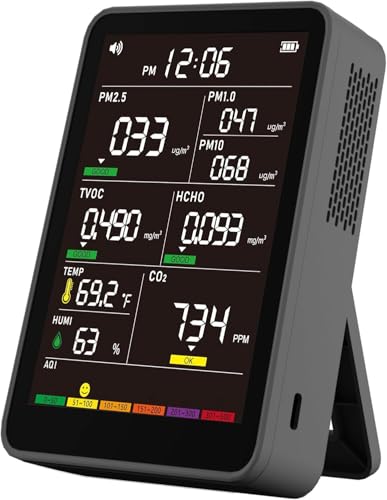

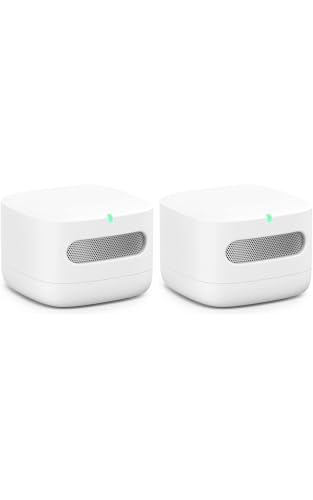
As an Amazon Associate we earn from qualifying purchases at no extra cost to you. Ratings are shown as listed on Amazon.
Quick picks by room and priority
- Small bedroom or office: IKEA VINDSTYRKA is a practical low-cost choice for PM2.5, temperature, humidity, and general air-quality indication.
- Living room or open-plan area: Airthings View Plus offers a broader sensor set, including particulate matter, carbon dioxide, radon, VOCs, temperature, humidity, and pressure.
- Apartment where portability matters: Qingping Air Monitor Lite is compact and easy to move between rooms, with PM2.5, PM10, carbon dioxide, temperature, and humidity monitoring.
- Detailed particulate tracking: PurpleAir Zen is suited to users who want PM1, PM2.5, and PM10 data and are comfortable interpreting sensor-network information.
- High-resolution indoor and outdoor comparison: IQAir AirVisual Pro remains useful for particulate and carbon-dioxide trends, especially when its outdoor data connection is relevant to ventilation decisions.
Best home air quality monitors compared
| Monitor | Approximate size and power | Main measurements | Best room size | Ownership considerations |
|---|---|---|---|---|
| IKEA VINDSTYRKA | Approximately 15 × 15 × 5 cm; mains powered | PM2.5, temperature, humidity, VOC-related air-quality indication | Bedrooms and offices up to about 20 m² | Low purchase cost; no air-cleaning filter; readings are best treated as trends rather than laboratory measurements |
| Qingping Air Monitor Lite | Approximately 63 × 63 × 46 mm; USB-C powered | PM2.5, PM10, carbon dioxide, temperature, humidity | Bedrooms, offices, and living rooms up to about 35 m² | Portable and inexpensive to operate; requires a nearby USB power source |
| Airthings View Plus | Approximately 17 × 20 × 3.5 cm; batteries or USB power depending on use | PM2.5, carbon dioxide, radon, VOCs, temperature, humidity, pressure | Living rooms and homes with several connected rooms | Long battery life is possible with reduced display activity; radon readings need time and correct placement |
| PurpleAir Zen | Approximately 13 × 13 × 5 cm; mains powered | PM1, PM2.5, PM10, temperature, humidity, pressure | Living rooms and larger occupied spaces up to about 50 m² | Strong particulate detail; optical particle sensors can be affected by humidity and need clean airflow paths |
| IQAir AirVisual Pro | Approximately 18 × 18 × 7 cm; rechargeable battery and mains power | PM2.5, carbon dioxide, temperature, humidity, outdoor air-quality data | Living rooms and apartments where indoor/outdoor comparison is useful | Usually costs more than basic monitors; battery runtime varies with screen brightness and network use |
Room-size guidance is not a formal sensing range. Air quality can differ sharply between a kitchen, a bedroom, and a hallway even in a small apartment. A monitor samples the air around its inlet, so placement matters more than a manufacturer’s suggested floor area.
How the leading choices differ
Best for a broad household picture: Airthings View Plus
View Plus is the strongest choice when the question is not simply “Is there dust?” but “Which indoor conditions are changing?” Carbon dioxide can reveal inadequate ventilation during occupancy, while humidity and VOC trends provide additional context. Its radon sensor is a notable advantage for homes where long-term radon monitoring is a priority.
Its limitation is interpretation. Radon is not a reading to judge from a single afternoon, and VOC measurements from consumer sensors are generally an index or trend rather than an identification of a particular chemical. The device is also more expensive than a simple PM2.5 monitor. Place it in a frequently occupied room, not directly beside a window, purifier outlet, cooker, or heating vent.
Best budget bedroom monitor: IKEA VINDSTYRKA
VINDSTYRKA covers the measurements most people want near a bed or desk without adding a complex dashboard. It is a good fit for checking whether cooking, candles, dust, or poor ventilation produces repeatable changes. Its display is easy to understand, which helps occasional users act on trends rather than stare at constantly changing numbers.
It is not the best choice for detailed carbon-dioxide management or radon monitoring. A bedroom user who wants to know whether two people are exhausting the room’s ventilation capacity should choose a monitor with a dedicated carbon-dioxide sensor instead.
Best small portable option: Qingping Air Monitor Lite
The Qingping Air Monitor Lite makes sense in a one-bedroom apartment or for someone who wants to move one monitor from bedroom to living room. Carbon dioxide is useful for occupancy and ventilation decisions, while PM2.5 and PM10 show particle changes from cooking, outdoor pollution, or indoor activities.
Its small enclosure also makes placement easy, but portability can encourage inconsistent comparisons. If you move it from room to room, leave it in the new location for at least 30 minutes before comparing ordinary conditions, and longer after cooking, cleaning, or opening windows.
Best for particulate detail: PurpleAir Zen
PurpleAir’s appeal is its focus on particle-size channels and networked data. It is a strong option for users concerned about wildfire smoke, traffic pollution, or indoor particle events and who are comfortable comparing trends rather than expecting reference-grade measurements.
Optical particle sensors estimate particles by detecting scattered light. High humidity, aerosols, steam, and a dirty inlet can distort readings. This does not make the monitor useless; it means a sudden spike should be checked against the activity in the room and, where possible, a second sensor.
Decision matrix: which monitor fits your situation?
| Your situation | Recommended type | Why | What to avoid |
|---|---|---|---|
| Budget under roughly $100 and one bedroom | Basic PM2.5 and humidity monitor, such as VINDSTYRKA | Simple trend monitoring with low ownership cost | Paying for radon or app features you will not use |
| Several occupants in a closed apartment | Carbon-dioxide plus PM2.5 monitor | Separates ventilation problems from particle events | Using VOC index alone as proof of a specific pollutant |
| Concern about radon over weeks or months | Long-term radon-capable monitor, such as View Plus | Supports sustained measurement rather than one-time snapshots | Making a decision from short-term radon fluctuations |
| Wildfire smoke or outdoor particle concern | PM1/PM2.5/PM10 monitor with a clear trend display | Shows particle changes before and after filtration or ventilation | Trusting a single reading during high humidity or steam |
| Small apartment and frequent room-to-room use | Compact USB-powered monitor, such as Qingping Air Monitor Lite | Easy to relocate and compare spaces | Comparing rooms immediately after moving the device |
Do air quality monitors have filter life?
Usually, no. An air quality monitor is a sensor, not an air purifier, so it normally has no replaceable HEPA or activated-carbon filter. “Filter life” applies to the purifier you use in response to the monitor’s readings.
For a rough purifier-sizing calculation, multiply room length by width by ceiling height. A 4 × 5 metre living room with a 2.5 metre ceiling contains 50 cubic metres of air. If a purifier delivers a verified 250 cubic metres per hour of clean-air delivery, its theoretical air changes per hour are:
250 ÷ 50 = 5 air changes per hour.
Real-world performance is lower when doors are open, the purifier is obstructed, or the room is connected to other spaces. A monitor can show whether PM2.5 falls after the purifier starts, but it cannot determine filter life by itself. Replace the purifier filter according to its indicator or manual, and sooner if airflow drops, the filter is visibly loaded, or the home has experienced prolonged smoke or heavy dust.
Setup and maintenance that improve accuracy
- Choose breathing-zone height: Put the monitor on a shelf or desk, roughly 0.8 to 1.5 metres above the floor, rather than behind furniture.
- Keep airflow clear: Leave the inlets and outlets unobstructed. Do not place the unit inside a bookcase or directly in a purifier’s exhaust stream.
- Allow stabilization: After moving it, wait at least 30 minutes for ordinary comparisons and longer for radon or baseline trends.
- Record events: Note cooking, showering, vacuuming, candle use, window opening, and purifier speed. These events explain spikes better than the number alone.
- Clean gently: Dust the exterior and sensor openings with a soft, dry brush or compressed air used carefully according to the manual. Never spray cleaner into the device.
- Check calibration expectations: Consumer monitors are most valuable for consistent changes over time. If a reading seems implausible, compare it with another monitor and inspect for steam, humidity, blocked vents, or a failing power supply.
What to buy
Choose VINDSTYRKA when you want an affordable bedroom or office monitor, Qingping Air Monitor Lite when portability and carbon dioxide matter, and Airthings View Plus when you want the broadest household view, including long-term radon capability. Pick PurpleAir Zen or IQAir AirVisual Pro when particulate tracking is the central task. Whichever model you choose, use its readings to investigate patterns and improve ventilation or filtration—not as a medical diagnosis or a substitute for professional testing when a serious concern exists.