Key takeaways
- You plan to keep the card for four years or more.
- You play at 1440p or use high-resolution texture packs.
- You multitask with a browser, recording software, or creative applications.
- The price difference is roughly $50 or less.
Best Budget Gaming Graphics Cards and GPUs
The best gaming graphics cards and GPUs on a budget are the Radeon RX 9060 XT 16GB for long-term 1440p value, the GeForce RTX 5060 for efficient 1080p gaming and useful upscaling, and the Intel Arc B580 for buyers who want 12GB of memory at the lowest sensible price.
Prices vary by country, cooler design, and temporary discounts, but these cards generally occupy the roughly $250–$450 market range in 2026. The right choice depends less on peak benchmark numbers than on your monitor resolution, power supply, case clearance, and whether you use ray tracing or content-creation software.
Our top picks


As an Amazon Associate we earn from qualifying purchases at no extra cost to you. Ratings are shown as listed on Amazon.
Quick comparison: affordable GPUs at a glance
| GPU | Video memory | Typical board power | Approx. card length | Best target | Typical market range |
|---|---|---|---|---|---|
| Intel Arc B580 | 12GB GDDR6 | 190W | 270–285mm | 1080p or entry 1440p | $250–$320 |
| Nvidia GeForce RTX 5060 | 8GB GDDR7 | 145W | 220–250mm | Efficient 1080p | $300–$370 |
| AMD Radeon RX 9060 XT 8GB | 8GB GDDR6 | 150W | 240–270mm | High-refresh 1080p | $300–$370 |
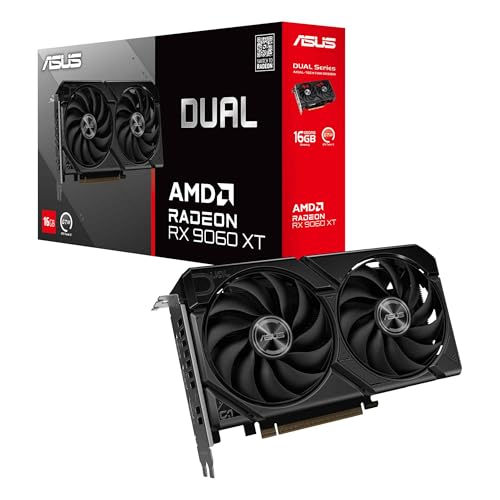
| AMD Radeon RX 9060 XT 16GB | 16GB GDDR6 | 160W | 240–280mm | Value 1440p | $350–$450 |
| Nvidia GeForce RTX 4060 | 8GB GDDR6 | 115W | 200–250mm | Small, low-power PCs | $250–$330 |
Dimensions are approximate because each manufacturer produces different dual-fan, compact, and factory-overclocked versions. Always check the exact model before ordering, including whether its quoted length includes the rear bracket.
Best overall budget pick: Radeon RX 9060 XT 16GB
The RX 9060 XT 16GB is the strongest all-purpose option when its price stays reasonably close to the 8GB version. It has enough memory for modern 1440p textures, large open-world games, and mods that can cause 8GB cards to stutter or reduce texture quality. Rasterized gaming performance is typically strongest among the cards in this comparison, especially at 1440p.
At 1080p, it is suitable for very high frame rates in competitive games and usually has enough headroom for demanding single-player releases. At 1440p, a sensible target is high settings with approximately 60–100 frames per second depending on the game. Ray tracing is usable with upscaling, but Nvidia remains the safer choice if ray-traced effects are a priority.
The main drawback is physical size. Many RX 9060 XT 16GB models use two large fans and occupy about 2.5 slots. Before buying, allow room for airflow and confirm that front-mounted radiators or drive cages do not reduce the available GPU length.
Best efficient choice: GeForce RTX 5060
The RTX 5060 makes the most sense for a compact gaming computer, a modest power supply, or someone who values Nvidia’s software ecosystem. Its approximately 145W power draw is considerably easier to cool than the Arc B580’s 190W requirement, and many board designs are short enough for small cases.
It is primarily a 1080p card. In esports games, it can drive a 144Hz or faster display when paired with a capable processor. In demanding games, high settings and an upscaling mode are more realistic than maximum settings. Its 8GB memory is adequate for current 1080p gaming, but it gives less upgrade headroom than the 12GB or 16GB alternatives.
Nvidia’s frame-generation and upscaling features can improve perceived smoothness in supported games, although they do not replace the need for a reasonable native rendering frame rate. The RTX 5060 is a particularly sensible fit for builders who want lower heat, lower fan noise, and fewer power-supply concerns rather than the highest performance per dollar.
Best low-cost 12GB option: Intel Arc B580
The Arc B580 offers an attractive combination of 12GB memory and competitive 1080p performance at a relatively low price. It can also handle entry-level 1440p gaming better than many older 8GB cards, provided the game has mature driver support.
Its 190W board power is the trade-off. A quality 600W power supply is a prudent pairing, particularly with a power-hungry processor. Card length is also commonly around 280mm, so it is not automatically a small-case solution.
Modern Intel Arc cards work best with Resizable BAR enabled. On a recent motherboard, this is normally easy to configure in firmware. Older platforms may lose performance, and some games can still show more variable results than on Nvidia or AMD. For a new budget system with a recent processor, the B580 is compelling; for an older computer, verify platform support before choosing it.
RX 9060 XT 8GB or 16GB: which version should you buy?
Choose the 8GB model only when the price is substantially lower and you mainly play competitive games or older titles at 1080p. It can deliver strong frame rates, but the smaller memory buffer may require lower texture settings in newer releases.
The 16GB model is preferable when:
- You plan to keep the card for four years or more.
- You play at 1440p or use high-resolution texture packs.
- You multitask with a browser, recording software, or creative applications.
- The price difference is roughly $50 or less.
Extra video memory does not automatically make a GPU faster. It mainly prevents texture streaming problems and gives the card more room as game requirements rise. If the 16GB version costs much more than a faster card in the next performance tier, spending the whole budget on memory is not always the best decision.
Decision matrix for common builds
| Your situation | Recommended choice | Why | Watch out for |
|---|---|---|---|
| $250–$320 budget, recent PC | Arc B580 | 12GB memory and strong value | Resizable BAR and driver maturity |
| Small case or 450–550W power supply | RTX 5060 | Low power draw and compact models | 8GB memory limit |
| 1440p monitor for several years | RX 9060 XT 16GB | Best memory capacity and raster performance | Long, thick card designs |
| Competitive 1080p at 144Hz or higher | RTX 5060 or RX 9060 XT 8GB | Strong high-refresh performance | CPU may become the limiting factor |
| Heavy ray tracing or Nvidia-focused software | RTX 5060 | More mature ray-tracing and creator support | Do not expect maximum 1440p ray tracing |
How to check compatibility before buying
1. Measure the case
Measure from the rear expansion-slot area to the nearest obstruction, not just the manufacturer’s advertised internal depth. Leave at least 25–30mm beyond the listed GPU length for power cables where possible. Also check the card’s thickness: a 2.5-slot card can block an adjacent expansion slot or interfere with a bottom-mounted intake fan.
2. Match the power supply
For an RTX 5060, a good 500W supply is often sufficient in a mainstream system. The RX 9060 XT generally suits a quality 550W–650W unit, while the Arc B580 is more comfortable with 600W or better. These figures assume a normal desktop processor, not an unusually power-hungry overclocked CPU. A newer, reputable power supply is more important than a merely large wattage number.
3. Check the power connector
Depending on the exact board design, the card may use a standard eight-pin connector or a newer compact high-power connector. Avoid sharply bending any high-power cable directly against the side panel. Connectors should be fully seated, with the cable routed so it is not under sideways tension.
4. Enable the useful platform features
Update the motherboard firmware, install the current graphics driver, and enable Resizable BAR or Smart Access Memory where supported. These settings can improve performance and are especially relevant to Arc systems. Use a clean driver installation when replacing a card from another brand if you encounter crashes or unusual frame pacing.
Ownership realities: heat, dust, and memory pressure
Fans and dust filters usually need attention before the GPU itself wears out. Dust buildup raises temperatures, causing the fans to spin faster and potentially increasing noise. Power down the system, hold the fans still, and use short bursts of compressed air rather than allowing the fan blades to spin freely at high speed. Keep the case’s front intake filters clean and avoid pressing a vacuum nozzle directly against circuit boards.
Thermal paste and fan bearings can eventually deteriorate, but opening a graphics card may affect warranty coverage and is rarely worthwhile on a newer budget model. A more common mistake is buying an 8GB card for a long ownership period, then compensating for memory limits by lowering textures while leaving expensive settings enabled. Texture quality is often the first setting to reduce when video memory is full.
Final buying advice
Choose the RX 9060 XT 16GB for the most balanced long-term 1440p system, the RTX 5060 for an efficient and compact 1080p build, and the Arc B580 when 12GB of memory and low purchase cost matter most. The RX 9060 XT 8GB is worthwhile only at a clear discount. Whichever card you select, compare the exact cooler’s length, slot thickness, connector, and power recommendation—not just the GPU name printed on the box.