Key takeaways
- Count simultaneous sources. A stereo keyboard uses two inputs; a mic and guitar recorded at the same time use two as well. Count what you need to capture together, not the total number of instruments you own.
- Use the right input type. Plug a microphone into a mic preamp, a guitar into an instrument input, and a keyboard or external preamp into a line input. An incorrect input can cause noise, distortion, or a weak signal.
- Set gain with headroom. Aim for healthy recording levels that do not clip on loud peaks. Digital clipping is difficult to repair, so leave margin rather than trying to record as close to the maximum level as possible.
- Plan monitoring before tracking. Decide whether performers need direct monitoring, software effects, or separate headphone mixes, then confirm that the interface supports that exact arrangement.
- Protect cables and controls. Keep liquids away, avoid yanking connected cables, and lower monitor and headphone levels before changing connections. Cables and jacks are common wear points in a frequently moved setup.
Best Audio Interfaces for Music Production in 2026
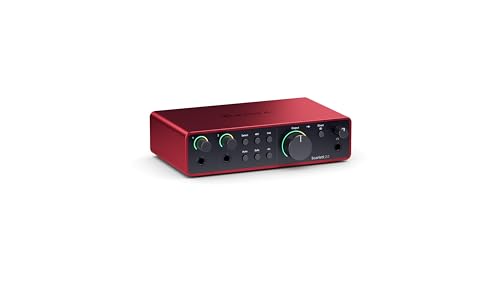
The best audio interface for music production depends on how many sources you record at once: choose a two-input interface for a solo vocal or instrument setup, a four-input model for small sessions, or an expandable interface when you expect to record a full band. For most home studios, the Focusrite Scarlett 2i2 is a capable starting point; the Audient iD14 MKII adds useful monitoring flexibility, while the MOTU UltraLite-mk5 suits studios that need more connections and routing.
Quick comparison
Input counts below distinguish analog inputs from digital expansion. Manufacturers may describe inputs differently, so check whether a stated count includes ADAT or S/PDIF channels and whether all inputs can be used simultaneously at the sample rate you plan to record.
Our top picks


As an Amazon Associate we earn from qualifying purchases at no extra cost to you. Ratings are shown as listed on Amazon.
| Interface | Analog inputs | Analog outputs | Connection | Best fit |
|---|---|---|---|---|
| Focusrite Scarlett 2i2 (4th Gen) | 2 combo inputs, each with a mic preamp | 2 balanced monitor outs; 1 headphone out | USB-C, USB 2.0 protocol | One or two simultaneous sources |
| Audient iD14 MKII | 2 mic/line inputs; 1 instrument input on the front | 2 monitor outs; 2 headphone outputs | USB-C, USB 3.0 protocol | Solo producers who want two headphone feeds and digital expansion |
| Universal Audio Volt 476 | 4 inputs, including 2 mic preamps | 2 monitor outs; 2 headphone outputs | USB-C, USB 2.0 protocol | Small sessions and onboard recording control |
| MOTU UltraLite-mk5 | 2 mic inputs plus 6 line inputs | 10 balanced line outputs; 2 headphone outputs | USB-C, USB 2.0 protocol | Hardware-heavy studios and complex monitoring |
These are hardware connection counts, not a promise that every input is a microphone preamp. A line input is useful for keyboards, synthesizers, and external preamps, but it does not replace a mic input when you need to connect a microphone directly.
Choose by recording situation
| Your situation | Practical choice | Why |
|---|---|---|
| Solo vocals, guitar, or podcasting; limited desk space | Focusrite Scarlett 2i2 (4th Gen) | Two mic-capable inputs cover a typical vocal-and-instrument session without paying for unused channels. |
| One performer, two headphone mixes, or an external preamp later | Audient iD14 MKII | Two headphone outputs help with shared listening; its optical input can add compatible channels through an ADAT preamp. |
| Small group recording or several line-level instruments | Universal Audio Volt 476 | Four simultaneous inputs provide more flexibility than a basic two-input interface, though only two are mic preamps. |
| Multiple synths, outboard gear, or separate monitor destinations | MOTU UltraLite-mk5 | Its many line inputs and outputs make routing more practical than relying on a two-output interface. |
What matters beyond the input count
Preamps and gain
A mic preamp raises a microphone’s low-level signal before conversion. For common condenser microphones and many dynamic microphones, modern interfaces from established manufacturers offer clean, usable preamps. Pay attention to how much gain is available if you use a low-output dynamic or ribbon microphone, and whether the interface provides phantom power for condenser mics. Phantom power should be switched off before connecting gear that is not designed to receive it.
More expensive preamps do not automatically make a recording sound better. Microphone choice, room acoustics, placement, and performance usually have a larger effect. Features such as a pad, high-pass filter, or polarity switch can be useful, but they are not essential if you already handle those tasks in your recording software or with external equipment.
Latency and direct monitoring
Latency is the delay between playing or singing and hearing the signal through the computer. It depends on the interface, driver, computer load, sample rate, and buffer setting—not just the interface’s headline specification. Lower buffer settings usually reduce delay but use more processing power and can cause clicks or dropouts. During tracking, direct monitoring can let you hear an input without sending it through a software round trip.
For a useful test before a session, record at your intended sample rate, lower the buffer until playback becomes unstable, then raise it one step. If the performer needs reverb or amp simulation while tracking, check whether the interface’s mixer can blend a software return with the direct signal. Direct monitoring alone may sound dry unless the interface offers onboard effects or the computer can run the desired processing reliably.
Outputs, headphone feeds, and expansion
Two balanced monitor outputs are enough for one pair of speakers. They are not enough for several independent speaker pairs or extensive outboard routing. Extra line outputs let you send separate mixes to hardware, while multiple headphone outputs can make recording with another person easier. Two headphone jacks do not necessarily mean two independently adjustable mixes, so confirm the routing and volume controls before buying.
Optical ADAT expansion can add inputs when paired with a compatible external preamp, which is helpful if a studio grows from solo work to drum or ensemble recording. Check the number of channels available at your chosen sample rate: digital channel capacity can decrease at higher rates. Expansion also adds cost, cables, and setup complexity, so it makes sense only if you expect to use it.
Match the interface to the way you work
For a first home studio: Focusrite Scarlett 2i2
The Scarlett 2i2 is a sensible choice when you record no more than two sources at once and want a compact interface with two mic preamps. Its main limitation is also its defining trade-off: there is no spare input capacity for a larger session, and two monitor outputs suit a simple speaker setup rather than elaborate routing. If you regularly record drums or several musicians simultaneously, buying a larger interface up front may cost less than replacing it later.
For a flexible solo setup: Audient iD14 MKII
The iD14 MKII fits a producer who records one or two sources but values two headphone outputs, a control knob, and the option to add channels through ADAT. It is not a four-mic-preamp interface on its own. Treat digital expansion as a future pathway, not as inputs included in the box, and check your computer’s port and power requirements before choosing a USB-C interface.
For more inputs or routing: Volt 476 or UltraLite-mk5
The Volt 476 gives a small recording setup more simultaneous input capacity and two headphone outputs. Its two mic preamps mean that a four-source session may still require line-level sources or an external preamp. The MOTU UltraLite-mk5 is a stronger fit when multiple line instruments, external processors, or several output destinations are central to the workflow. Its expanded routing is valuable only if you are comfortable managing a more involved mixer and signal path.
Budget for the whole recording chain
Across these categories, two-input USB interfaces commonly sit in the general market range of about $150–$300, while models with more connections or advanced routing can fall around $300–$700 or higher. These are broad price bands, not current quotes; prices vary by region, sales, and included software. Leave room in the budget for a microphone, headphones, cables, and possibly a stand or acoustic treatment. A larger interface is poor value if the extra inputs force you to skip the microphone or headphones you actually need.
Setup choices that prevent avoidable problems
- Count simultaneous sources. A stereo keyboard uses two inputs; a mic and guitar recorded at the same time use two as well. Count what you need to capture together, not the total number of instruments you own.
- Use the right input type. Plug a microphone into a mic preamp, a guitar into an instrument input, and a keyboard or external preamp into a line input. An incorrect input can cause noise, distortion, or a weak signal.
- Set gain with headroom. Aim for healthy recording levels that do not clip on loud peaks. Digital clipping is difficult to repair, so leave margin rather than trying to record as close to the maximum level as possible.
- Plan monitoring before tracking. Decide whether performers need direct monitoring, software effects, or separate headphone mixes, then confirm that the interface supports that exact arrangement.
- Protect cables and controls. Keep liquids away, avoid yanking connected cables, and lower monitor and headphone levels before changing connections. Cables and jacks are common wear points in a frequently moved setup.
Bottom line
For a straightforward solo home studio, the Focusrite Scarlett 2i2 is a practical starting point. Choose the Audient iD14 MKII if its headphone setup and ADAT expansion suit your plans, the Volt 476 if you need more inputs for a small session, or the MOTU UltraLite-mk5 if extensive line connections and output routing are part of daily work. The right pick is the smallest interface that comfortably handles your real simultaneous recording and monitoring needs—with enough expansion only if you have a clear use for it.