Key takeaways
- Limited space or younger children: Choose a tabletop or compact 4- to 5-foot model. It is easier to store or fit into a multipurpose room, though the shorter playing area makes the game feel less like full-size air hockey.
- Regular family use: A 6- to 7-foot table is usually the best compromise between playability and footprint. Look for a rigid cabinet, a reliable blower, and leg levelers rather than paying extra for decorative lights or sound effects.
- Older teens, adults, or frequent competitive play: Consider a 7- to 8-foot table if the room can accommodate it. A larger table rewards stronger shots and quicker reactions, but its weight and setup make it a poor choice for a room that needs to remain flexible.
- Occasional play on a tight budget: A lighter table can be practical, but budget for simpler materials and potentially more movement during energetic games. A low price is less appealing if the cabinet shifts or the puck repeatedly stalls.
Best Air Hockey Tables for Home Game Rooms
The best air hockey table for a home game room is the one that fits your available floor space, delivers steady airflow across its playing surface, and is sturdy enough for the ages and frequency of play it will see. For most families, a 6- to 7-foot table is the useful middle ground; smaller tabletop and 4-foot models suit tight rooms and younger players, while full-size tables need dedicated space and careful assembly.
Quick comparison: choose by room and player
Dimensions and weight vary by model and configuration. The figures below are practical size ranges, not specifications for every table in a category. Check the manufacturer’s product listing for the exact dimensions and shipping weight before buying.
Our top picks

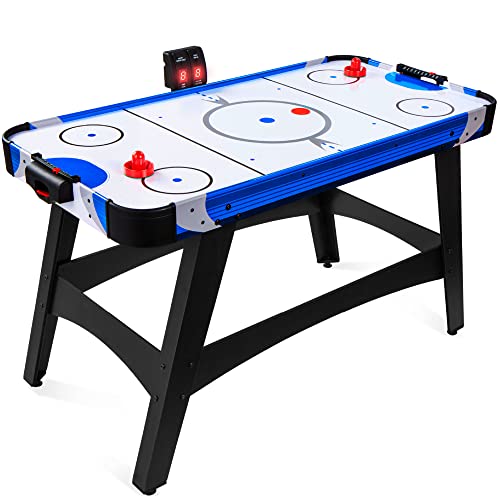
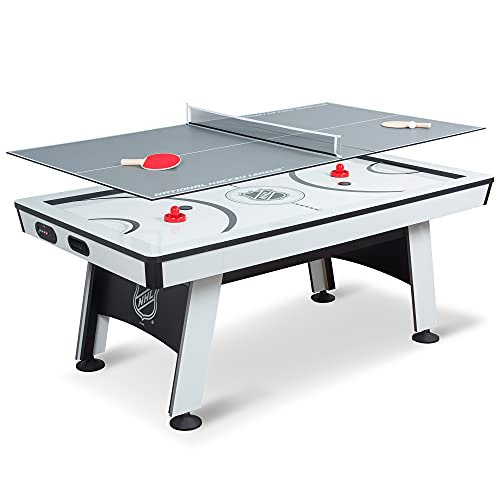
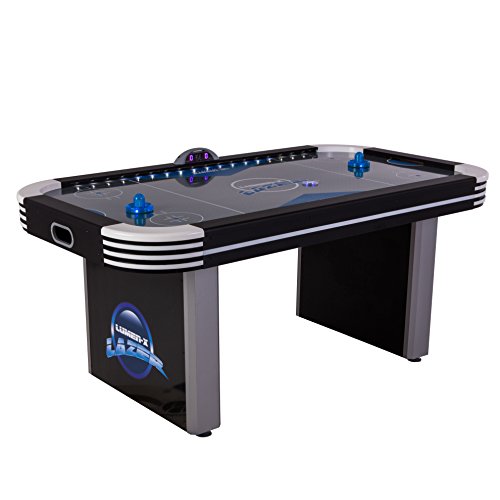
As an Amazon Associate we earn from qualifying purchases at no extra cost to you. Ratings are shown as listed on Amazon.
| Table type | Typical playing-table length | Typical weight | Best fit | What to check |
|---|---|---|---|---|
| Tabletop | 2–4 ft (61–122 cm) | 10–35 lb (5–16 kg) | Young children, occasional play, very limited space | Whether it needs a separate table and how securely it attaches |
| Compact stand-up | 4–5 ft (122–152 cm) | 40–90 lb (18–41 kg) | Children, small rooms, casual family games | Leg stability and whether the blower covers the full surface |
| Mid-size | 6–7 ft (183–213 cm) | 100–200 lb (45–91 kg) | Families and regular home play | Assembly help, motor access, and levelers for uneven floors |
| Full-size | 7–8 ft (213–244 cm) | 200–400+ lb (91–181+ kg) | Dedicated game rooms and older players | Delivery access, room clearance, frame construction, and floor capacity |
Which type suits your situation?
- Limited space or younger children: Choose a tabletop or compact 4- to 5-foot model. It is easier to store or fit into a multipurpose room, though the shorter playing area makes the game feel less like full-size air hockey.
- Regular family use: A 6- to 7-foot table is usually the best compromise between playability and footprint. Look for a rigid cabinet, a reliable blower, and leg levelers rather than paying extra for decorative lights or sound effects.
- Older teens, adults, or frequent competitive play: Consider a 7- to 8-foot table if the room can accommodate it. A larger table rewards stronger shots and quicker reactions, but its weight and setup make it a poor choice for a room that needs to remain flexible.
- Occasional play on a tight budget: A lighter table can be practical, but budget for simpler materials and potentially more movement during energetic games. A low price is less appealing if the cabinet shifts or the puck repeatedly stalls.
Measure the playing space—not just the table
The listed length does not tell you how comfortable the table will be in your room. Measure the table’s full outside dimensions, then leave space at both ends for players to stand and swing their mallets. As a planning rule, allow roughly 3 feet (91 cm) beyond each end and about 2 feet (61 cm) along each side. These are clearance estimates, not official requirements; more room is useful for adults and vigorous play.
For example, a 7-foot table that is about 4 feet wide needs a footprint of roughly 13 by 8 feet (about 4 by 2.4 m) with that clearance. Add extra room if players will move around the ends or if a wall, sofa, or doorway constrains a shot. Also measure the route into the room: a cabinet that fits the final location may not clear a stairwell or narrow turn.
Blower performance: the feature that changes the game
Air hockey depends on a consistent cushion of air, not simply a motor that makes a loud sound. On a well-performing table, the puck glides across the surface without pronounced dead spots. Airflow can be affected by the blower, the number and distribution of holes, the playfield’s flatness, and dust or debris blocking openings.
Manufacturers do not always publish airflow measurements in a consistent way, so advertised motor wattage alone is not a reliable comparison. Look for a blower designed for the table’s size, evenly distributed air holes, and access that makes the motor and playfield easier to clean. If possible, confirm that replacement pucks, mallets, and blower components are available for the model.
For children and casual play, a modest blower may be adequate on a compact table. A larger table used often needs stronger, even coverage so the puck does not slow noticeably in the middle or near the rails. Do not assume a louder motor means better play; noise can be intrusive in a shared living area.
Construction and ownership: what tends to wear first
Table weight offers a useful clue, but it is not a guarantee of quality. A heavy cabinet can still have a weak playfield, while a well-braced mid-size table can be stable without commercial-table mass. Prioritize a flat, rigid playing surface; firm rail attachment; braced legs; and adjustable levelers. Leveling matters because even a slight slope can pull the puck toward one end.
With regular use, the most common maintenance needs are clearing dust from the surface and air holes, tightening hardware that loosens with vibration, and replacing lost or worn pucks and mallets. Follow the manufacturer’s cleaning directions: abrasive cleaners or excess liquid can damage a playfield or seep into the blower. Keep drinks off the table, avoid leaning or sitting on the rails, and switch off the motor when the game is over.
Assembly and setup: plan for the cabinet you buy
Tabletop models may need little more than positioning and plugging in. Stand-up tables generally require leg assembly and leveling; large cabinets may need two adults to lift safely and align the base. Before ordering, check whether the table arrives in one piece, whether tools are included, and whether assembly requires access to the underside. Keep packaging until you have checked the surface and confirmed the blower works.
- Assemble on a flat floor and tighten fasteners evenly rather than fully tightening one side first.
- Use the levelers, if supplied, to prevent the puck from drifting when the blower is off.
- Start the blower and test several areas of the playfield; a persistently sluggish patch may point to blocked holes or an uneven surface.
- Recheck leg and rail fasteners after the first few sessions, when vibration may have loosened them.
Bottom line
For most households, a 6- to 7-foot table is the strongest all-around choice if the room has enough clearance and the budget covers a stable cabinet. Choose a compact model when portability, younger players, or limited space matters more than a full-size feel. Go full-size only when you can accommodate the table, its delivery route, and the extra assembly and maintenance. Across all sizes, prioritize even airflow, a level playfield, and sturdy legs over add-ons that do not improve the puck’s glide.