Key takeaways
- Best 7-String Electric Guitars for Every Budget The best 7-string electric guitar depends chiefly on your preferred tuning and playing style: choose a 26.5-inch or longer scale for clear, firm low strings, a 25.5-inch scale for a familiar feel and…
Best 7-String Electric Guitars for Every Budget
The best 7-string electric guitar depends chiefly on your preferred tuning and playing style: choose a 26.5-inch or longer scale for clear, firm low strings, a 25.5-inch scale for a familiar feel and easier bends, and prioritize a comfortable neck and stable hardware over extra features you may not use. For an affordable first instrument, the Yamaha RGX A2 seven-string is a used-market option; for a versatile mid-priced guitar, look at the Ibanez RG7421; and for more elaborate hardware and finishes, consider the Schecter Reaper-7 or ESP LTD MH-1007.
Prices below are broad U.S. market ranges, not guaranteed current quotes. Models, finishes, and availability vary by year and region; check the exact version’s specifications before buying, especially scale length, bridge type, and pickup model.
Our top picks

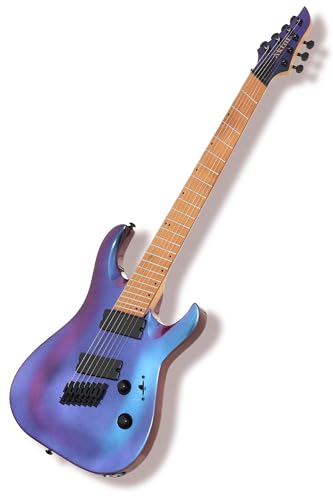
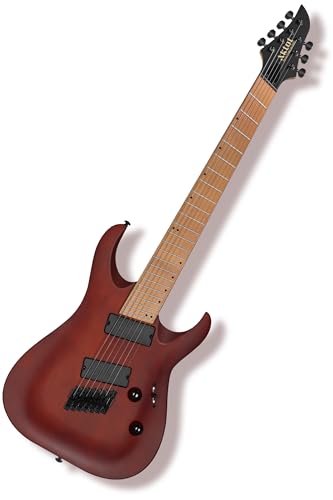
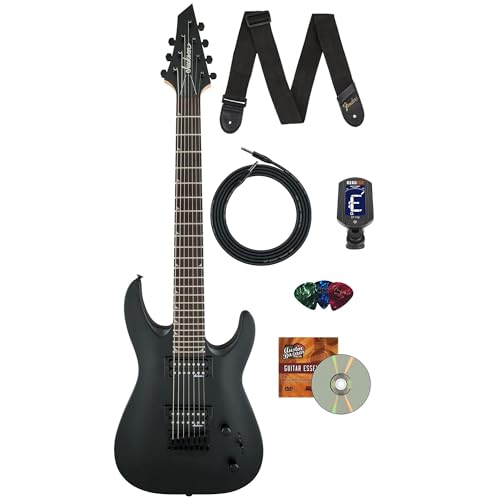
As an Amazon Associate we earn from qualifying purchases at no extra cost to you. Ratings are shown as listed on Amazon.
Quick comparison
| Guitar | Scale length | Bridge and pickups | Typical price range | Best fit |
|---|---|---|---|---|
| Yamaha RGX A2 7-string (used) | 25.5 in | Fixed bridge; passive humbuckers | About $250–$500 used | Lowest-cost entry, if you find a clean example |
| Ibanez RG7421 | 25.5 in | Fixed bridge; passive humbuckers | About $400–$600 | Familiar, straightforward workhorse |
| Jackson JS22-7 Dinky | 26.5 in | Fixed bridge; passive humbuckers | About $200–$350 | Budget-friendly reach and low-tuning support |
| Schecter Reaper-7 | 26.5 in | Fixed bridge; model-dependent Schecter humbuckers | About $700–$1,000 | Modern metal and extended-range playing |
| ESP LTD MH-1007 | 25.5 in | Fixed bridge; model-dependent active or passive pickups | About $1,000–$1,500 | Players wanting upgraded appointments and a set-through design |
| Ibanez RGIXL7 | 27 in | Fixed bridge; passive humbuckers | About $700–$1,000 | Very low tunings and a taut seventh string |
Specifications and pickup configurations can differ across production years. Confirm the precise model suffix and listing details rather than assuming every guitar with the same family name is identical.
Choose by tuning and playing style
For standard B tuning and familiar bends: Ibanez RG7421
The RG7421’s 25.5-inch scale feels close to a conventional six-string, which can make the transition to seven strings less demanding. It suits standard B tuning and players who want to move between rhythm and lead parts without adapting to a particularly long neck. Its fixed bridge keeps string changes and tuning adjustments relatively simple. If you tune down substantially, use an appropriately heavier seventh string and have the nut and setup checked; a shorter scale can feel looser at the same pitch.
For a tight low end on a budget: Jackson JS22-7 Dinky
At 26.5 inches, the JS22-7 provides more string tension than a 25.5-inch guitar with the same string gauge and tuning. That makes it a practical choice for low B or occasional lower tunings, especially for heavy rhythm playing. The trade-off is a slightly longer reach and firmer feel when bending the higher strings. Its passive pickups are a versatile starting point, though players chasing a specific high-output or vintage voice may eventually want different pickups or an amp and effects setup that better fits their sound.
For a more premium modern-metal setup: Schecter Reaper-7
The Reaper-7’s 26.5-inch scale favors clarity and string firmness in lower tunings, while its neck and body are shaped for contemporary extended-range playing. It is a sensible step up for players who regularly use the seventh string rather than treating it as an occasional extra. Pickup details vary by version, so compare the exact configuration: a passive set and an active set can differ in output, compression, and how they respond to picking dynamics.
For very low tunings: Ibanez RGIXL7
A 27-inch scale gives the low string more tension at a given gauge and pitch than a 25.5-inch scale. That can help when tuning below standard B, where a short-scale string may feel floppy or produce indistinct attacks. The longer neck is not automatically better, though: it can make stretches and upper-register bends feel less familiar. Try one seated and standing if possible, and make sure the longer scale suits your fretting hand.
For upgraded appointments without a long scale: ESP LTD MH-1007
The MH-1007 is a strong candidate for players who prefer a 25.5-inch feel but want a more premium instrument. Depending on the particular version, its pickup configuration and hardware may differ, so confirm those details before comparing it with another guitar. If you mainly play standard B or drop A, the scale can work well with a suitable string gauge and professional setup. For consistently lower tunings, a longer scale may be the more direct solution.
How neck feel, pickups, and hardware change the choice
Neck shape is personal, and seven-string necks are wider by necessity. A slim profile may help fast position shifts, but it does not guarantee comfort: string spacing, fretboard radius, fret size, and shoulder shape all affect how the neck feels in your hand. If possible, test first-position chords, thumb-over grips, and bends on both the first and seventh strings. A neck that feels comfortable for a short try is more useful than a spec-sheet claim about speed.
Pickup voicing should match the sound you need, not just the genre label. High-output pickups can give a forceful signal and a controlled attack for dense distortion; lower-output designs may preserve more picking nuance and clean up more readily with the guitar’s volume control. Active pickups require a battery, so check the battery compartment and replace the battery before it runs flat during a session. A pickup swap can change the voice, but it cannot fix an uncomfortable neck or a poorly cut nut.
A fixed bridge is often the practical choice for a first seven-string: changing tunings and strings is simpler, and there are fewer moving parts to maintain. A tremolo can be useful for expressive pitch effects, but changing string gauges or tuning may require balancing the bridge again. Either way, tuning stability depends on more than the bridge. A properly cut nut, stable tuning posts, clean string winding, fresh strings, and a correct setup all matter.
Budget and experience: a practical decision guide
| Your situation | What to prioritize | Shortlist |
|---|---|---|
| First seven-string; standard B; limited budget | Comfortable neck, fixed bridge, reliable setup | Jackson JS22-7 or a clean used Yamaha RGX A2 |
| Experienced six-string player; wants familiar feel | 25.5-inch scale and a straightforward control layout | Ibanez RG7421 or ESP LTD MH-1007 |
| Frequent low tunings; heavy rhythm use | 26.5–27-inch scale and an appropriate string gauge | Jackson JS22-7, Schecter Reaper-7, or Ibanez RGIXL7 |
| Lead playing with frequent bends | Neck comfort and manageable string tension | Try 25.5-inch options before committing to an extended scale |
| Uncertain about seven-string playing | Low purchase cost and easy resale or return options | Entry-level fixed-bridge model or inspected used guitar |
Setup and ownership details that matter
Budget for a setup when buying any extended-range guitar, new or used. The technician should check neck relief, action, intonation, nut slots, and pickup height using the tuning and string gauge you actually intend to use. A guitar set up for standard B may not intonate or feel right in drop G, particularly if you change string gauges. When changing tunings often, decide on one main tuning and set the guitar around it; frequent large changes can mean repeated setup compromises.
Strings are the most regular consumable. Heavier gauges can improve tension at lower pitches, but an overly thick string may not fit the nut slot or tuner cleanly. Do not force it: have the slot cut correctly rather than widening it with improvised tools. Wipe strings and the fretboard after playing, keep the guitar away from excessive heat or humidity swings, and check tuning after restringing as new strings settle. On a used instrument, inspect fret wear—especially under the plain strings—along with the nut, output jack, switches, and bridge posts. Repair costs can erase the apparent savings of a bargain.
Bottom line
For a familiar all-round feel, start with a 25.5-inch model such as the Ibanez RG7421. For a budget guitar aimed at lower tunings, the Jackson JS22-7 offers a longer scale at a lower price point. Choose the Schecter Reaper-7 for a more equipped modern-metal option, or the Ibanez RGIXL7 if your tuning demands the extra reach of a 27-inch scale. The best 7 string electric guitars are the ones whose scale, neck, and pickup response suit your hands and tuning—and whose setup is built around the strings you plan to use.