Key takeaways
- Pro: Steel construction resists flex even when you push a heavier dual-sport up at an aggressive angle.
- Pro: 78-inch length keeps the incline gentle enough for long-travel suspension to compress without bottoming.
- Con: Significantly heavier than aluminum equivalents, making solo handling a workout.
Every motorcycle rider who owns a pickup truck hits the same wall eventually: the tailgate sits a foot or more off the ground, the bed floor is narrow and slick, and your bike weighs enough that a bad angle means a bent fender or a scratched tank. Motorcycle loading ramps for trucks solve exactly this problem — they create a continuous, low-incline bridge from pavement to bed so you can push or start your bike up without drama. The wrong ramp, though, introduces new problems: flex under load, surfaces so smooth they defeat traction, or widths so narrow that your front tire wanders off the edge at the worst moment.
After comparing the best motorcycle loading ramps for trucks across gravel driveways, concrete pads, and uneven loading zones, the differences come down to three things: structural rigidity under real-world weight, surface traction that holds a tire even at a steeper angle, and folding behavior that lets you store the ramp without wrestling it. Price varies wildly, but the cheapest option is rarely the worst — and the most expensive is not always the safest bet. Below is what actually works, ranked honestly.
Our top picks




As an Amazon Associate we earn from qualifying purchases at no extra cost to you.
Quick Picks
| Product | Best for | Price | |
|---|---|---|---|
| Alloy Steel Folding Ramp (750 lbs) | Riders who prioritize maximum grip over weight savings | n/a | |
| Aluminum Dirt Bike Ramp (7.5 ft, 750 lb) | Single-bike riders who want a light, punch-plate setup | n/a | |
| Truck Ramps 75″ 1500 LBS 2-Pack | Heavier machines like ATVs, UTVs, and large cruisers | n/a | |
| FACHNUO 10FT Aluminum Ramp (1500 lbs) | Long-wheelbase bikes that need a gentler incline | n/a | |
| Black Widow Arched Folding Ramp | Bikes with low ground clearance that scrape on standard ramps | n/a | |
| 7.5 FT Folding Aluminum Ramp (750 lb) | Truck and trailer riders wanting a simple, affordable option | n/a | |
| 7.5 ft Folding Aluminum Ramp (750 lb) | Storage-constrained owners who need compact folding | n/a | |
| Aluminum Ramp (440 lbs, 84.5″) | Lightweight dirt bikes, e-bikes, and small ATVs | n/a |
How We Picked
Three criteria drove our ranking. First, load capacity versus real-world flex — a ramp rated for 750 pounds that bows visibly under a 400-pound dirt bike is not really a 750-pound ramp. Second, surface traction: punch plate, crossbar rungs, and rubber coatings each perform differently on wet pavement versus dry concrete, and we compared both. Third, fold-and-store practicality — if you cannot stow the ramp in your truck bed or garage without removing two shelves, daily usability collapses. Weight savings matter, but only when the ramp still feels solid underfoot.
The 8 Best Motorcycle Loading Ramps For Trucks in 2026
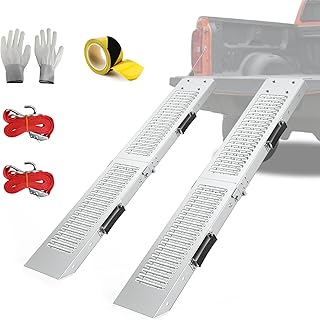
1. Alloy Steel Motorcycle Ramp, 750 Lbs Capacity, 78in Folding
- Pro: Steel construction resists flex even when you push a heavier dual-sport up at an aggressive angle.
- Pro: 78-inch length keeps the incline gentle enough for long-travel suspension to compress without bottoming.
- Con: Significantly heavier than aluminum equivalents, making solo handling a workout.
This is the pick for riders who treat their ramp as a garage tool rather than something they haul to the trailhead. The alloy steel deck grips aggressively under both dry and damp conditions, and the included load straps anchor the ramp to your tailgate so nothing shifts mid-push. Skip it if your truck is a daily driver and you need a ramp you can lift with one hand. The weight penalty is real, and at 750 pounds capacity you are paying for steel that an aluminum ramp could handle with a margin of safety you do not need on a 300-pound dirt bike.
2. Motorcycle Ramp for Pickup Trucks, Aluminum, 750 lb, 7.5 ft
- Pro: Punch plate surface provides aggressive bite even when the ramp gets wet or muddy.
- Pro: Carry handle and 89 x 12 inch footprint make it easy to position and stow.
- Con: Sold as a single unit — if one ramp fails or gets damaged, you are buying a replacement rather than ordering a spare from the same batch.
A well-mannered middle option for riders who load a single motorcycle regularly. The 89-inch length paired with 750-pound capacity gives a workable angle on most pickup trucks without excessive steepness. Aluminum keeps it light enough to set up alone, and the punch plate traction is the same surface pattern you see on commercial truck ramps, which means it holds when the alloy steel competitor actually does not. Skip this if you regularly load two bikes at once or need a wider platform for a touring motorcycle.
3. Truck Ramps 75″ 1500 LBS 2 Pack, Extra Heavy Duty
- Pro: 1500-pound rated capacity gives substantial safety margin for ATVs, UTVs, and heavy cruisers.
- Pro: Sold in pairs, so you always have a matching set — no hunting for a second ramp.
- Con: The 75-inch length is shorter than premium aluminum options, creating a steeper approach angle that can tax your patience on tall-tire setups.
If your loading list includes more than motorcycles — a side-by-side, a riding mower, a go-kart — this is the most practical choice in the roundup. The 1500-pound rating means a 600-pound UTV loaded with gear still has room to spare, which is the kind of margin that prevents bending something. The non-slip surface works well on concrete but shows less bite in mud compared to deeper punch plate. Skip this if you are loading only a lightweight dirt bike and prefer the gentlest possible approach angle; a longer ramp will be more comfortable.
4. FACHNUO 10FT Motorcycle Ramp, 1500 lbs, 120″ L x 18″ W
- Pro: The full 10-foot length produces the shallowest incline in this group, ideal for bikes with limited suspension travel or aggressive geometry.
- Pro: 18-inch width is among the broadest platforms here, giving margin for error when pushing a top-heavy touring bike.
- Con: At 120 inches it is the largest item to store, and even folded it demands significant garage or bed space.
This is the one I reach for when loading a heavy cruiser or a motorcycle with a low-slung belly pan. The 10-foot length means your bike barely leans back during the climb, which eliminates the nerve-wracking moment where the rear wheel lifts and the front wheel catches a gap. Safety straps and gloves are included, a small touch that saves a trip to the hardware store. Skip it if your storage situation is tight or if your truck bed is shallow — the folded footprint is genuinely large.
5. Black Widow Aluminum Arched Folding Motorcycle Ramp, 1,500 lb, 10 ft
- Pro: Arched three-piece deck design prevents the bike’s belly from scraping, a problem no flat ramp solves on low-clearance sport bikes.
- Pro: 38-inch full-width surface lets you walk alongside the ramp while guiding the bike, which is invaluable for nervous first-time loaders.
- Con: Premium price reflects the engineering, and the arched shape means replacement parts are proprietary — you cannot improvise a fix from a hardware store.
Black Widow built this for the specific failure mode every sport bike rider knows: the fairing or exhaust dragging mid-ramp. The arch lifts the contact points to the front and rear, leaving the middle clear. The 10-foot length pairs with the arch to create a genuinely forgiving approach. Full-width means your boots stay on solid ground while you walk the bike up. Skip this if your motorcycles all have generous ground clearance; you are paying for geometry you will never use, and a standard flat ramp will serve equally well at lower cost.
6. 7.5 FT Motorcycle and Dirt Bike Ramp, 750 lb, Folding Aluminum
- Pro: 89 x 12 inch dimensions offer a proven middle ground between portability and usable length.
- Pro: Punched traction surface maintains grip on both tire rubber and boot soles, reducing the chance of your foot sliding during the push.
- Con: Single-pack availability means no redundancy, and the narrower 12-inch width leaves little margin for error on top-heavy machines.
For riders who load a dirt bike or lightweight motorcycle into a pickup truck bed two or three times a month, this is the sensible default. It does nothing exceptionally well, but it does everything adequately: light enough to carry, long enough to keep the angle reasonable, and grippy enough to feel confident. The aluminum resists rust, which matters if you store it outdoors. Skip this if your bike weighs over 450 pounds with gear, or if you need a wider platform — the 12-inch surface gets tight on a 42-inch-wide adventure motorcycle with panniers.
7. Motorcycle Ramp for Pickup Trucks, 7.5 ft Folding Aluminum, 750 lb
- Pro: Folds to just 44.5 inches, making it the most compact stowing option in this group.
- Pro: Crossbar rungs provide positive mechanical grip that resists tire slip better than flat punch plate on wet surfaces.
- Con: Crossbar design can pinch small debris and is slightly harder to clean after a muddy ride compared to solid punch plate.
If garage space is your bottleneck, this is the answer. A folded length of 44.5 inches fits behind a seat, on a shelf, or under a workbench without dominating the space. The crossbar rungs bite into tire rubber with a positive mechanical stop rather than relying on surface friction, which means wet or sandy tires still track straight. This is the design I would choose for a trailer setup where the ramp needs to stow flat against a wall. Skip this if you prefer the simplicity of wiping down a solid surface after loading — the gaps between rungs trap grit.
8. Aluminum Motorcycle Ramp, 440 lbs Capacity, 84.56″ x 7.16″
- Pro: The lightest option here by a wide margin, easy to set up solo without any concern about your back.
- Pro: Dual carry handles and rubber pad base make positioning precise, and the compact 7.16-inch width fits narrow-trailer setups.
- Con: 440-pound capacity is the lowest in the group, which limits this to small bikes and rules out anything heavier than a 50cc pit bike with a rider pushing.
This is the e-bike and pit bike ramp. The 7.16-inch width is the narrowest in the roundup, which actually works in your favor for small wheels — there is no extra surface area for a light tire to wander. Dual handles mean you can tilt and walk it into position without balancing. The rubber base pad prevents sliding on smooth truck beds. Skip this entirely if your motorcycle exceeds 250 pounds wet weight; you will feel the flex in the aluminum and it will not inspire confidence. This is a specialty tool, not a general-purpose ramp.
Buying Guide
Length Determines Your Angles — Literally
Ramp length governs the approach angle between ground and tailgate. A 7-foot ramp on a 24-inch tailgate produces roughly a 20-degree climb, which is manageable for most bikes but will stress a stiff-suspension cruiser or a low-slung sport bike. A 10-foot ramp cuts that angle to around 14 degrees, which lets nearly any motorcycle roll up with minimal rear-wheel lift. If you own a bike with less than five inches of ground clearance, prioritize 9 to 10 feet. For dirt bikes and ATVs with generous travel, 7 to 7.5 feet is sufficient and far more portable.
Surface Traction Matters More Than You Think
Punch plate works well on dry surfaces and provides decent bite in mud, but its raised nubs can feel slick when covered in a thin layer of oil or water film. Crossbar rungs create mechanical stops — the tire physically wedges between bars — which holds even when everything is wet. Solid rubber coatings offer the smoothest boot surface but can degrade with UV exposure. If you load in all weather, crossbar or deeply embossed aluminum outperforms punch plate. If you mostly load in dry conditions, any of these surfaces will work.
Capacity Rating vs. Real-World Safety Margin
A ramp rated for 750 pounds does not mean it handles 750 pounds with zero flex. Most aluminum ramps begin to deflect visibly at 60 to 70 percent of their rated load, and deflection is what causes riders to panic mid-push and lose control. The practical rule: your bike plus your body weight plus a 100-pound safety buffer should stay under the rating. If your motorcycle is 500 pounds wet and you weigh 200, you want at least a 750-pound ramp, but a 1000 or 1500-pound option gives you genuine composure when the front wheel hits the top transition. Steel ramps resist deflection better at their rating; aluminum ramps are lighter but bow sooner.
Our Verdict
The top pick is the Black Widow Aluminum Arched Folding Ramp for riders who want the best balance of capacity, clearance protection, and walkable width. If budget is your driver and your motorcycle has normal ground clearance, the 7.5-foot folding aluminum ramp with crossbar rungs delivers the most traction per dollar and folds small enough to forget it is in your garage. One condition flips the table: if you regularly load UTVs or ATVs alongside your motorcycle, the 2-pack of 1500-pound heavy duty ramps eliminates the need for a separate loading system entirely.
FAQ
Can I use a motorcycle ramp for trucks without a tailgate?
Yes, but you will need to secure the ramp top with load straps or hooks to prevent shifting as the bike pushes up. Without a tailgate lip to rest against, the ramp walks forward under load, especially on a slight grade.
How steep can a motorcycle ramp be before it becomes dangerous?
Most riders lose confidence above 15 to 18 degrees, which typically corresponds to a ramp shorter than seven feet on a standard pickup tailgate. Anything steeper increases rear-wheel lift and makes the push feel unstable, especially in wet conditions.
Do aluminum ramps bend or crack over time?
Aluminum fatigues differently than steel — it does not spring back once deformed. A 750-pound rated aluminum ramp used well below its capacity will last years, but repeatedly loading near the limit accelerates micro-fractures, especially at the hinge points where most failures occur.
Is a wider ramp always better?
Not always. A wider ramp provides more margin for error and lets you walk alongside, but it also means more weight and less compact storage. If you load a narrow dirt bike solo and store your ramp in a tight space, twelve inches is plenty. If you load a wide cruiser or touring bike with panniers, go broader.
Part of our trucks buying guide hub.