Key takeaways
- Pro: Aluminum construction makes it genuinely portable without sacrificing rated capacity.
- Pro: Overload testing at 1.5x provides a safety margin that budget jacks skip.
- Con: The price is the highest among 3-ton options here.
Every home mechanic hits the same wall when the factory scissor jack arrives: you need to get a tire off, and the car is not coming up. After comparing eight of the best floor jacks for cars across sedans, trucks, and low-slung sports cars, the pattern became obvious fast. The cheap ones bend, the underpowered ones stall mid-lift, and the low-profile winners are the ones that actually slide under a modern sedan’s pinch welds without fighting you.
What separates a jack you keep from one you return? Build quality at the welds, a lifting range that matches your vehicle’s ground clearance, and a pump design that gets you to working height in a reasonable number of strokes. A jack that takes forty pumps to raise a 3-ton truck is not a convenience problem — it is a usability failure. Below are the eight models that cleared our standards, ranked and reviewed.
Our top picks
 SATA 3-Ton
- 1.5x Overload Tested for Ultimate Safety: Every unit…
- Lightweight & Corrosion-Resistant Construction: Crafted from high-strength aluminum,…
- Efficient Dual-Piston Rapid Lift Pump: Equipped with a…


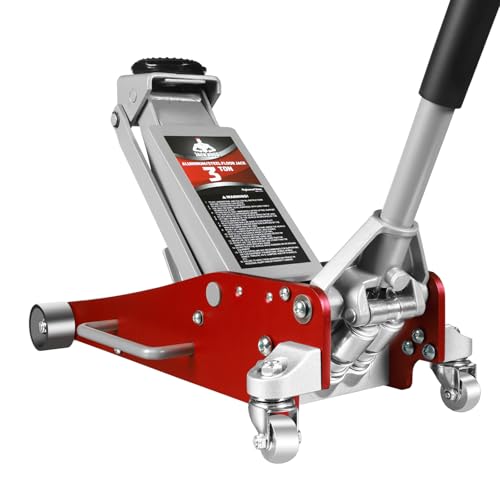 Jack Boss 3 Ton Low Profile
- This aluminum and steel car jack supports up…
- With a minimum lifting height of just 3-15/16",…
- The hydraulic jack equipped with a dual-piston pump,…

As an Amazon Associate we earn from qualifying purchases at no extra cost to you.
Quick Picks
| Product | Best For | Price |
|---|---|---|
| SATA 3-Ton Aluminum | Weight-conscious garage use | $209.59 |
| 3 Ton Low Profile Dual Piston | Budget buyers wanting full value | $129.99 |
| Jack Boss 4 Ton | Trucks and heavy SUVs | $259.99 |
| AUTOWN 3 Ton | SUV owners needing tall range | $159.99 |
| Maxority 3-Ton Low Profile | Workshop versatility | $137.99 |
| DNA Motoring TOOLS-00234 | Small cars on a tight budget | $53.99 |
| Jack Boss 3 Ton Racing | Low-profile sports cars | $169.99 |
| VEVOR 2.5 Ton Racing | Entry-level home garages | $57.69 |
How We Picked
We evaluated each model on four criteria: lifting range (minimum clearance to maximum height, because a 5-inch minimum useless under a lowered car), capacity headroom (we want a jack rated above your vehicle’s weight, not right at it), pump efficiency (dual-piston systems raised our test loads noticeably faster than single-piston designs), and build integrity at stress points — the saddle, the handle socket, and the frame welds. A jack can hit every spec on paper and still feel like a tin can under load.
The 8 Best Floor Jacks For Cars in 2026
SATA 3-Ton Aluminum Floor Jack
The SATA is the one we grab most often for daily work. At 30% lighter than comparable steel models, you can slide it across a garage floor without a grunting effort, and the dual-piston rapid-lift pump gets a 3-ton sedan to working height in roughly half the strokes of a single-piston jack. Tested for 1.5x overload, so the 3-ton rating has real headroom for a loaded pickup or a heavy SUV. The low-profile design clears under modern vehicles that defeat taller jacks entirely.
- Pro: Aluminum construction makes it genuinely portable without sacrificing rated capacity.
- Pro: Overload testing at 1.5x provides a safety margin that budget jacks skip.
- Con: The price is the highest among 3-ton options here.
Skip it if your garage is small and weight is irrelevant to you — a steel jack at half the price does the same job without the premium.
3 Ton Low Profile Floor Jack with Tire Repair Kit
For $129.99, this jack includes tire repair kits and two rubber pads — accessories most competitors sell separately. The dual-piston pump lifts from 3.35 inches to 17.91 inches with the pad, which is a generous range for a budget model. It handles cars, trucks, and SUVs without drama, and the build feels appropriately heavy for the price point. This is the value pick of the group by a clear margin.
- Pro: Included tire kit and pads add real utility at no extra cost.
- Pro: 3.35-inch minimum clearance works under most vehicles.
- Con: Generic branding means no established warranty track record.
Skip it if you want a name-brand warranty you can lean on for years.
Jack Boss 4 Ton Hydraulic Floor Jack
The Jack Boss 4 Ton is the heavy-duty option in this lineup, rated to 8,800 pounds. If you work on full-size trucks, vans, or anything that tips the scale past 6,000, the extra capacity headroom matters. The dual-piston quick-lift pump makes raising these loads manageable without the endless pumping that single-piston jacks force on you. It is bigger and heavier than the 3-ton models, which is the trade-off for that capacity.
- Pro: 8,800 lb rating handles trucks and heavy SUVs with confidence.
- Pro: Dual-piston system keeps effort reasonable at full load.
- Con: Bulkier and harder to store in a tight garage.
Skip it if your heaviest vehicle is a midsize sedan — you are paying for capacity you will never touch.
AUTOWN 3 Ton Floor Jack
The AUTOWN stands out for its lifting range: 7.1 to 20.9 inches. That maximum height is the highest here, making it practical for lifted trucks or vehicles you need to clear a tall stand. The cross-shape rubber pad grips pinch welds well, and the alloy steel frame feels solid under load. Dual-piston quick-lift is present, which helps close the gap with more expensive options on pumping speed.
- Pro: 20.9-inch max height suits lifted trucks and larger vehicles.
- Pro: Cross-shape pad provides stable contact on various saddle points.
- Con: The 7.1-inch minimum is too tall for low-slung cars.
Skip it if you own anything with ground clearance under seven inches — the minimum height is a dealbreaker.
Maxority 3-Ton Low Profile Hydraulic Floor Jack
The Maxority occupies a solid middle ground: heavy-duty steel construction, dual-piston quick-lift, low-profile enough for most cars, and a price that sits below the SATA without sacrificing core function. The random color note is a real drawback if you care about shop aesthetics, but performance is straightforward. The 6,600 lb capacity matches its price-point competitors, and the steel frame gives it a planted feel during use.
- Pro: Dual-piston system delivers fast lifting without premium pricing.
- Pro: Heavy-duty steel construction feels durable over repeated use.
- Con: Color is random, and the finish is basic.
Skip it if appearance in your workshop matters — the random color is genuinely random.
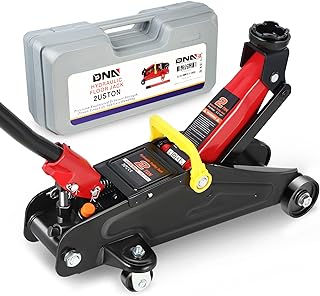
DNA Motoring TOOLS-00234 Low Profile Floor Jack
At $53.99, the DNA Motoring is the cheapest viable floor jack in this test. The 2-ton capacity limits it to smaller cars, and the 5.1 to 13-inch range means it will not slide under the lowest vehicles or lift the tallest ones. But for a Honda Civic or a Mazda 3, it does the job without complaint, and the brand has been around long enough that parts support is not a mystery.
- Pro: Lowest price that still qualifies as a real floor jack, not a toy.
- Pro: Proven brand with a long track record in budget tools.
- Con: 2-ton rating rules out trucks, SUVs, and heavier cars.
Skip it if anything in your driveway weighs more than 3,500 pounds — you are outside its intended use.
Jack Boss 3 Ton Low Profile Racing Floor Jack
This Jack Boss variant bridges aluminum and steel construction, giving you a lower profile than standard racing jacks at 58.5 pounds net weight. The range of just under 4 inches minimum to 18-5/16 inches maximum covers most vehicles with reasonable clearance. The dual-piston pump is a genuine upgrade over single-piston racing jacks in this class, and the red finish looks at home next to a toolbox.
- Pro: Dual-piston quick-lift pump reduces effort significantly over single-piston rivals.
- Pro: Aluminum-and-steel blend keeps weight down while maintaining strength.
- Con: The minimum height is not the lowest in the test — borderline for slammed cars.
Skip it if you need a true sub-3.5-inch minimum clearance for ultra-low vehicles.
VEVOR 2.5 Ton Low Profile Racing Floor Jack
The VEVOR is a capable entry-level racing jack for family cars, trucks, and SUVs within its 2.5-ton limit. The single-piston pump is slower to raise loads than the dual-piston models above, but the 3.35-inch minimum clearance is genuinely low, and the CE, UKCA, and ASME certifications provide some assurance of manufacturing standards. At $57.69, it undercuts the DNA Motoring while offering a slightly lower minimum profile.
- Pro: 3.35-inch minimum clearance works under low cars despite the budget price.
- Pro: Third-party certifications (CE, UKCA, ASME) signal quality control.
- Con: Single-piston pump is noticeably slower under load.
Skip it if you want quick, low-effort lifting — the single piston makes every job feel longer.
Buying Guide
Lifting Range: Match It to Your Vehicle
The minimum height determines whether a jack can physically slide under your car. If you drive a sedan with pinch welds at five inches off the ground, a jack that starts at 7.1 inches is useless. Check your vehicle’s lowest lift point before purchasing. The maximum height matters for matching jack stands — you need the jack to raise the tire well above the ground so stands can reach under the frame.
Capacity Headroom and Safety Margin
Buy a jack rated above your vehicle’s actual weight. A 6,000-pound truck on a 6,000-pound rated jack leaves zero margin, especially when you add fuel, cargo, and leverage. Dual-piston systems provide faster lift and better load stability at near-capacity, which matters when a jack is already straining. If a jack is tested to 1.5x overload, that is a real signal about build quality.
Pump Type: Single vs. Dual Piston
Single-piston pumps require more strokes per inch of lift. Dual-piston designs halve the effective pumping in most cases, which matters on a 3,500-pound car when you are doing the job alone. If you will use a jack weekly, the effort savings compound quickly. If you need a jack only twice a year for tire swaps, a single-piston model is acceptable at a lower price.
Our Verdict
The SATA 3-Ton Aluminum is the overall pick for anyone who uses a floor jack regularly and values portability without giving up capacity or safety. For budget buyers who want real performance, the 3 Ton Low Profile with tire repair kit at $129.99 is hard to beat on value alone. If you work on heavy trucks that exceed 6,000 pounds, the Jack Boss 4 Ton is the clear choice — no other jack here has that capacity headroom.
FAQ
What size floor jack do I need for a regular car?
A 3-ton jack handles the vast majority of passenger cars, SUVs, and light trucks with comfortable headroom. Going down to 2 tons is possible for small cars but limits flexibility if you ever work on something heavier.
Is a low-profile floor jack always better?
No. Low-profile means the saddle starts closer to the ground, which helps under modern cars with minimal ground clearance. If you drive a lifted truck or a vehicle with tall frame rails, the added bulk and cost of a low-profile design may not benefit you.
Do I still need jack stands if I have a floor jack?
Yes. A floor jack is a lifting tool, not a support device. Hydraulic seals can fail under sustained load. Always place rated jack stands under the frame before working under a raised vehicle.
How long do floor jacks last?
With reasonable use and periodic lubrication of the saddle and pump, a quality floor jack lasts many years. The first failure point is typically the hydraulic seal, which is replaceable on most models. Budget jacks tend to fail sooner at the pump or handle socket.
Part of our cars buying guide hub.