Our Short List of 3

- Best for: Campers who charge at a sunny base camp and want the listing itself to name their iPhone.
- 28W solar panel
- Dual USB-C and USB-A ports, 5V/4.8A maximum total as listed
- Conversion efficiency up to 25.4 percent as listed
- IP44 waterproof as listed; junction box not waterproof
- Best for: Anyone who needs stored power after dark or on the move, with solar as a genuine last-resort top-up.
- 10,000mAh lithium-cobalt battery as listed
- 20W USB-C input and output; listing claims an iPhone 15 reaches 65 percent in 30 minutes
- Qi wireless output 5W/7.5W/10W as listed
- USB-A output and an iOS (Lightning) input port as listed

- Best for: Wet-weather and water-adjacent trips where the strongest listed weather rating matters most.
- 30W maximum power as listed
- QC3.0 18W USB-A and USB-C outputs
- ETFE foldable panel
- IP67 waterproof as listed
All 3 Picks at a Glance
| Product | Specs | Action |
|---|---|---|
| BigBlue 28W Solar Panel Charger |
| Check price on Amazon |
| BLAVOR Solar Power Bank 10,000mAh (PN-W05) |
| Check price on Amazon |
| FlexSolar 30W Portable Solar Charger (E30) |
| Check price on Amazon |
Key takeaways
- Three solar chargers whose listings state iPhone compatibility, from two fold-out panels to a 10,000mAh power bank, with honest notes on trickle charging.
Charging an iPhone from the sun sounds simple until you separate the two jobs involved: making power and storing it. A fold-out panel makes power only while sunlight hits it, and a power bank stores power but refills from its own small solar cell very slowly. The honest buying decision is which of those limits fits your trip — direct charging at camp, or a stored reserve that sunlight can only top up in an emergency.
This guide is for campers, hikers and anyone building an emergency kit around an iPhone, and every pick was chosen because its Amazon listing states iPhone or Apple-device compatibility in its own text. Two picks are panels that charge your phone directly in sunlight and store nothing; the third is a battery bank that carries its charge with it. Output figures, port lists and weather ratings below come from those listings, not from category averages.
Quick Picks
As an Amazon Associate we earn from qualifying purchases
| Product | Best for | Key spec from title |
|---|---|---|
| BigBlue 28W Solar Panel Charger | Direct charging at a sunny camp | 28W panel, dual USB-C and USB-A, iPhone named in title |
| BLAVOR Solar Power Bank 10,000mAh (PN-W05) | A stored reserve with emergency solar top-up | 10,000mAh bank, 20W USB-C, solar input 5V/0.3A as listed |
| FlexSolar 30W Portable Solar Charger (E30) | Wet-weather trips and higher panel output | 30W ETFE panel, IP67 waterproof as listed |
How to Choose
Decide first whether anything needs to store power
Panels and power banks solve different problems, and mixing them up is the most common disappointment in this category. The two panels in this roundup have no battery at all: they convert sunlight into USB power while the sun is out, and the moment clouds or dusk arrive, charging stops. The power bank works the other way — it carries a stored charge you fill before leaving, works after dark and on the move, and treats sunlight as a backup input. If your phone must work at night, only the bank qualifies. If you sit at a sunny camp for hours, a panel feeds the phone directly and never runs down.
Read the solar input figure, not just the battery size
Capacity numbers flatter solar power banks. What decides how useful the solar side really is sits in the input line: the bank here lists its solar charging at a maximum of 5V/0.3A, which its own listing frames as an emergency trickle. That is a keep-the-phone-alive input, not a refill strategy, and the article treats it that way throughout. Panels state the opposite side of the equation — a maximum wattage produced in strong sun. Compare a panel’s listed wattage against a bank’s listed solar input and the category’s honest shape appears: sunlight is a primary source for panels and a last resort for banks.
Match the ports to the cables you actually carry
An iPhone on a trip usually means a USB-C cable, sometimes a Lightning one, and the three picks cover those differently. The BigBlue panel lists dual USB-C and USB-A ports with a combined maximum output, the FlexSolar lists USB-A and USB-C with a QC3.0 18W rating, and the BLAVOR bank adds something the panels cannot: a Lightning input port as listed, plus Qi wireless output for charging without a cable at all. Count the devices you charge at once, check the port list in each listing against your cables, and remember that a panel’s combined output is shared across its ports, not delivered to each one.
Weigh the weather rating against where the charger will live
All three picks publish an ingress rating, but the numbers and the fine print differ. The BigBlue lists IP44 and states that its junction box is not waterproof — splash resistance for the panel, care needed at the connection point. The BLAVOR bank lists IPX5 alongside dustproof and shockproof claims, a rating about the sealed unit you carry in a pack. The FlexSolar lists IP67, the strongest figure here, on an ETFE foldable panel. Match the rating to the trip: a fair-weather camp, a rainy trail, or a bag that gets dropped. Then check packed size and weight, because the best-rated charger is the one you actually bring.
The 3 Best Options
BigBlue 28W Solar Panel Charger
- Best for: Campers who charge at a sunny base camp and want the listing itself to name their iPhone.
- 28W solar panel
- Dual USB-C and USB-A ports, 5V/4.8A maximum total as listed
- Conversion efficiency up to 25.4 percent as listed
- IP44 waterproof as listed; junction box not waterproof
Campers who charge at a sunny base camp and want the listing itself to name their iPhone.
It stores nothing, so charging stops when the light goes; and the listing’s IP44 note excludes the junction box, which needs to stay dry.
BigBlue’s 28W panel is the reference pick for direct solar charging, and its listing names the iPhone in its own title, which settles the compatibility question without guesswork. Open it at camp and it feeds a phone through dual USB-C and USB-A ports with a listed maximum total output of 5V/4.8A, shared between whatever is plugged in. The listing states a conversion efficiency of up to 25.4 percent, and the panel folds down to 11 by 6 by 1.4 inches at 1.5 pounds, small enough to strap to a pack. There is deliberately no battery inside: this is a sunlight appliance, strongest at a bright base camp where the phone can sit connected for a long, sunny stretch.
Watch out for: It stores nothing, so charging stops when the light goes; and the listing’s IP44 note excludes the junction box, which needs to stay dry.
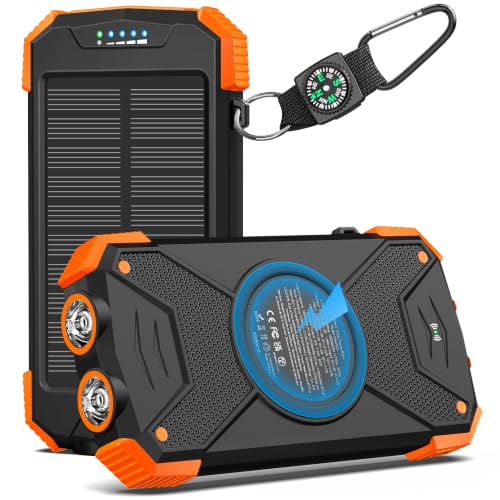
BLAVOR Solar Power Bank 10,000mAh (PN-W05)
- Best for: Anyone who needs stored power after dark or on the move, with solar as a genuine last-resort top-up.
- 10,000mAh lithium-cobalt battery as listed
- 20W USB-C input and output; listing claims an iPhone 15 reaches 65 percent in 30 minutes
- Qi wireless output 5W/7.5W/10W as listed
- USB-A output and an iOS (Lightning) input port as listed
Anyone who needs stored power after dark or on the move, with solar as a genuine last-resort top-up.
Two checks before ordering. Confirm this exact listing shows a live new offer, since a sibling listing has shown none; and wall-charge the bank before any trip, because the listed solar input cannot refill it in useful time.
The BLAVOR is the only pick that carries power with it: a 10,000mAh lithium-cobalt bank whose listing states a 20W USB-C input and output — with the listing’s own claim that this charges an iPhone 15 to 65 percent in 30 minutes — plus Qi wireless output at 5W, 7.5W and 10W, a USB-A output, and a Lightning input port for recharging the bank with an iPhone cable. The solar panel on its face is the honest weak point: the listing states a maximum solar input of 5V/0.3A and frames it as emergency backup, so treat sunlight here as a trickle that stretches a stored charge, never as the way you refill it. Dual flashlights and an IPX5 rating round out a kit built for packs and glove boxes.
Watch out for: Two checks before ordering. Confirm this exact listing shows a live new offer, since a sibling listing has shown none; and wall-charge the bank before any trip, because the listed solar input cannot refill it in useful time.
FlexSolar 30W Portable Solar Charger (E30)
- Best for: Wet-weather and water-adjacent trips where the strongest listed weather rating matters most.
- 30W maximum power as listed
- QC3.0 18W USB-A and USB-C outputs
- ETFE foldable panel
- IP67 waterproof as listed
Wet-weather and water-adjacent trips where the strongest listed weather rating matters most.
It stores no power, so it cannot charge anything after sunset; and its output figures are maximums that assume strong, direct sun.
The FlexSolar E30 is the panel for trips where weather is the worry. Its listing states a 30W maximum output — the highest panel figure in this roundup — delivered through QC3.0 18W USB-A and USB-C outputs, on an ETFE foldable panel rated IP67 as listed, the strongest weather figure here. Compatibility is stated in the listing’s own copy: it charges cell phones, Android and Apple, and lists iPhone models among its compatible devices. The listing states conversion of up to 24 percent. Like the BigBlue, it holds no battery, so it earns its place on bright days at camp, on a boat, or laid across a dashboard — anywhere the panel can sit in open sun while devices charge beside it.
Watch out for: It stores no power, so it cannot charge anything after sunset; and its output figures are maximums that assume strong, direct sun.
Which One Fits Your Situation
You charge phones at a sunny base camp
Take a panel. The BigBlue is the lighter, proven option at 1.5 pounds folded, and its title names the iPhone directly. The FlexSolar answers with a higher listed maximum output and the IP67 rating if your camp sits near water. Either way, plan charging around midday sun: park the panel in the open, connect the phone, and let the long bright hours do the work while you are in camp rather than hoping for a quick top-up at dusk.
You need power after dark and on the move
Only the BLAVOR qualifies, because it is the only pick with a battery. Charge it from a wall before you leave and its stored 10,000mAh works on the trail, in a tent, or during an outage at home, with wired 20W USB-C speed and a wireless option when cables are buried in a pack. Its solar face then serves its real purpose: stretching that reserve in an emergency at the listed trickle rate, not replacing the wall charge you started with.
Your trips run wet
The FlexSolar E30 is built for this: an IP67 figure as listed on an ETFE panel that folds flat, so rain, spray and wet grass are within its stated limits rather than at their edge. The BLAVOR’s IPX5 listing also tolerates splashes if you need stored power in the same weather. The BigBlue is the cautious choice here — its listing rates the panel IP44 but warns the junction box is not waterproof, which makes it a fair-weather panel by its own text.
You are building a home emergency kit
Start with the BLAVOR: stored power, a dual flashlight and a solar face that can keep a phone reachable across a long outage if you ration it. Add a panel only if your home gets a reliably sunny spot during the day — the BigBlue is the simpler addition, the FlexSolar the tougher one. Either panel also recharges the bank’s rivals in your kit, power banks and lanterns, through plain USB, which makes the pair more useful together than apart.
Common Mistakes
- Expecting a power bank’s solar face to refill it between days of a trip, when the listed input is a 5V/0.3A emergency trickle.
- Buying a fold-out panel and expecting it to charge a phone overnight, when the panels here have no battery and store nothing.
- Ignoring the fine print in a weather rating — one listing here rates the panel but states its junction box is not waterproof.
- Assuming any USB solar panel suits an iPhone without checking that the listing states Apple or iPhone compatibility.
- Leaving home with an empty power bank and a plan to rely on sunlight alone from the first morning.
Frequently Asked Questions
Can a solar panel charge an iPhone directly?
Yes — that is exactly what the two panels here do, through ordinary USB ports while sunlight falls on them. The BigBlue’s title names the iPhone itself, and the FlexSolar’s listing states Apple phones among its compatible devices. Output is at its best in strong midday sun and falls away in shade or cloud, and nothing is stored: unplug at dusk and charging ends. For direct charging, a panel in open sun is the fastest solar route to a phone in this roundup.
How long does the BLAVOR bank take to recharge from its own solar panel?
Longer than any trip allows, and the listing is honest about why: its solar input is stated at a maximum of 5V/0.3A and framed as emergency charging. That trickle can stretch a stored charge or keep a nearly flat phone reachable, but it will not refill a 10,000mAh bank in a day of sun. The right routine is to fill the bank from its USB-C or Lightning input before you leave, and let the solar face serve as the backup it is sold as.
Do these chargers still work on cloudy days?
Panels keep producing in bright overcast, but well below their listed maximums, which are strong-sun figures; heavy cloud and shade cut output sharply, and a phone may charge slowly or pause. The power bank is indifferent to weather while its stored charge lasts, which is why the two types pair well. If your trip forecast is mostly grey, weight your choice toward stored capacity and treat any solar input, panel or bank, as a bonus rather than the plan.
Will any of these charge an iPhone wirelessly?
Only the BLAVOR lists wireless output: Qi at 5W, 7.5W and 10W as stated in its listing, so an iPhone can sit on the bank without a cable. Neither panel offers wireless charging — panels feed devices through their USB ports only. Note that none of the three listings claims magnetic snap-on alignment, so with the bank you place the phone on the pad and leave it still; for the fastest listed speed, the bank’s 20W USB-C cable connection remains the better route.
FAQ
Can a solar panel charge an iPhone directly?
How long does the BLAVOR bank take to recharge from its own solar panel?
Do these chargers still work on cloudy days?
Will any of these charge an iPhone wirelessly?
More from Amazon
Programs that pair well with the guide above. Offers and eligibility are set by Amazon and may change.
Free shipping on eligible items, Prime Video and more. Eligible new members can start with a free trial.
Start a Prime free trialA Prime membership for ages 18-24 with a trial period. Eligibility is set by Amazon.
See Prime for Young AdultsAudiobooks and podcasts to listen to on the go. Eligible new members can start with a free trial.
Try Audible freeAd-free music streaming. Eligible new subscribers can start with a free trial.
Try Music Unlimited freeAs an Amazon Associate we earn from qualifying purchases.