Our Short List of 3

- Best for: Film shooters who want a new, warrantied camera with real focus and exposure input.
- Format: Half-frame 35mm, 17 × 24 mm frames
- Frames per roll: Up to 72 on a 36-exposure roll
- Lens: 25mm F3.5 fixed lens, 37mm equivalent
- Focus: Zone focus with six zone marks

- Best for: Beginners who want simple operation plus bulb mode and a star filter for night shots.
- Format: Half-frame 35mm, reusable
- Focus: Focus-free
- Lens: Coated improved lens
- Exposure: Bulb function for long exposures

- Best for: First-time film shooters who want the lightest, simplest reusable camera.
- Format: Half-frame 35mm, 72 shots per 36-exposure roll
- Lens: 22mm F9.5, two-element acrylic
- Shutter: 1/100s
- Focus: Focus-free
All 4 Picks at a Glance
| Product | Specs | Action |
|---|---|---|
| Pentax 17 |
| Check price on Amazon |
| Kodak EKTAR H35N |
| Check price on Amazon |
| Kodak EKTAR H35 |
| Check price on Amazon |
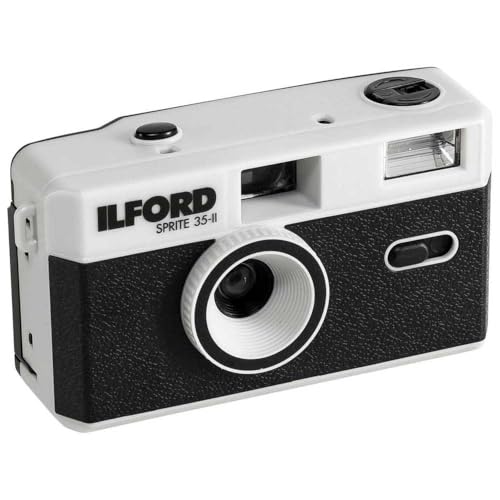 Ilford Sprite 35-II |
| Check price on Amazon |
Key takeaways
- The best new 35mm film cameras still in production, from the half-frame Pentax 17 to reusable Kodak Ektar and Ilford Sprite models, compared on listing specs.
Buying a 35mm film camera new in 2026 means accepting a short shortlist. The famous SLRs of the film era survive only as used listings, so the real decision is which of the few cameras still in production fits how you shoot: a half-frame model that doubles the frames on every roll, or a basic reusable point-and-shoot you can hand to anyone. Get that choice wrong and you end up with a camera whose fixed settings fight your subjects, or one with controls you never use.
This roundup is for first-time film shooters, returning photographers who want a camera with a warranty, and gift buyers who need something that works out of the box. Every pick below is current production, sold new, and chosen from the format, lens and feature details printed on its Amazon listing, so the specifications here match what you would actually receive rather than a reviewer’s memory of a decades-old classic.
Quick Picks
As an Amazon Associate we earn from qualifying purchases.
| Product | Best for | Key spec from title |
|---|---|---|
| Pentax 17 | Shooters who want real controls on a new camera | Half frame, up to 72 images per roll |
| Kodak EKTAR H35N | Beginners ready for bulb mode and effects | Bulb function with built-in star filter |
| Kodak EKTAR H35 | First-time film shooters | Focus-free, lightweight and reusable |
| Ilford Sprite 35-II | Gifts and knockabout everyday carry | Reusable 35mm with built-in flash |
How to Choose
Half Frame Versus a Standard Frame
Half frame is the first decision, because three of these four cameras split every standard frame in two. Each exposure uses half the film area, the native image is vertical, and a 36-exposure roll delivers up to 72 shots instead of 36. That stretches each roll twice as far and suits phone-style vertical sharing. The trade is negative size: smaller frames show grain sooner when you print big or crop hard. If you mostly scan and share, half frame is a gift. If you dream of large prints, a standard-frame camera deserves more of your attention.
Focus and Exposure Control
Control is the second dividing line. The Pentax 17 uses zone focus: you estimate the distance to your subject and select one of six marked zones, and its seven shooting modes manage exposure with varying amounts of your input. The Kodak and Ilford cameras are focus-free, with fixed focus set by the maker, so everything from a few feet away to the horizon is acceptably sharp and there is nothing to set wrong. Focus-free is freedom for snapshots and a ceiling for portraits. The H35N splits the difference with a bulb mode that hands exposure time back to you for night scenes.
The Lens and the Built-In Flash
Every camera here has a fixed lens, so the lens figures decide where the camera works. An aperture like the H35’s F9.5 gathers little light, which is why its single 1/100s shutter speed and built-in flash matter: outdoors it is happy, indoors the flash does the heavy lifting. The Pentax 17’s F3.5 lens gathers far more light and copes better at dusk. All four cameras carry a built-in flash, and on the simple models that flash is not a creative extra but the thing that makes indoor birthdays and evenings out possible at all.
Film, Batteries and What Is Not in the Box
Check what the box leaves out before you order. The Kodak listings state plainly that film and the AAA battery are not included, and the Kodak models and the Sprite each run on a single AAA cell, so your first order needs a roll of 35mm film and a battery alongside the camera. Half-frame models stretch that roll to 72 frames, which matters while you are learning and wasting frames. Also confirm you are looking at the standalone camera listing, because popular models are also sold in seller bundles with film and accessories under separate listings.
The 4 Best Options
Pentax 17
- Best for: Film shooters who want a new, warrantied camera with real focus and exposure input.
- Format: Half-frame 35mm, 17 × 24 mm frames
- Frames per roll: Up to 72 on a 36-exposure roll
- Lens: 25mm F3.5 fixed lens, 37mm equivalent
- Focus: Zone focus with six zone marks
Film shooters who want a new, warrantied camera with real focus and exposure input.
Half-frame negatives are smaller, so very large prints show grain sooner; seller bundles of this camera sit on separate listings, so check you are on the standalone camera.
The Pentax 17 is the one camera in this roundup built for people who already know they enjoy film. Its zone-focus system asks you to pick one of six distance marks instead of relying on autofocus, and seven shooting modes give you more say over exposure than any simple point-and-shoot. The half-frame format records vertical images that suit how photos are shared now, and doubles a roll to as many as 72 frames. Because it is current production, you get a new camera with a warranty rather than a forty-year-old mechanism of unknown history.
Kodak EKTAR H35N
- Best for: Beginners who want simple operation plus bulb mode and a star filter for night shots.
- Format: Half-frame 35mm, reusable
- Focus: Focus-free
- Lens: Coated improved lens
- Exposure: Bulb function for long exposures
Beginners who want simple operation plus bulb mode and a star filter for night shots.
Film and an AAA battery are not included, and the focus-free lens keeps very close subjects soft, so add a roll of film and a battery to the same order.
Think of the EKTAR H35N as the H35’s more playful sibling. It keeps the same reusable half-frame idea and focus-free simplicity, then adds a coated, improved lens, a bulb setting that holds the shutter open for long exposures, and a built-in star filter that turns street lights and candles into starbursts. There is still no focusing to learn and no screen to manage: load a roll, wind on, and shoot. It suits beginners who want one or two creative tricks to grow into without moving to a fully manual camera.
Kodak EKTAR H35
- Best for: First-time film shooters who want the lightest, simplest reusable camera.
- Format: Half-frame 35mm, 72 shots per 36-exposure roll
- Lens: 22mm F9.5, two-element acrylic
- Shutter: 1/100s
- Focus: Focus-free
First-time film shooters who want the lightest, simplest reusable camera.
The single 1/100s shutter speed and F9.5 lens lean on the flash indoors, and film and a battery are not included.
The EKTAR H35 is the easiest starting point in film photography right now. It is a reusable half-frame camera with a focus-free lens, one shutter speed and a built-in flash, so the whole learning curve is loading the film correctly and remembering to wind on. At 100 g it disappears into a jacket pocket, and the half-frame format stretches a 36-exposure roll to 72 shots, which softens the cost of the frames every beginner wastes while learning. Pick the black version listed here; the other colours are sold as separate listings.
Ilford Sprite 35-II
- Best for: Gifts, and a knockabout second camera for Ilford film fans.
- Format: Reusable and reloadable 35mm
- Lens: Fixed-focus wide-angle
- Flash: Built-in
- Viewfinder: Optical
Gifts, and a knockabout second camera for Ilford film fans.
Codes for this model vary by colour and region, so confirm on the live Amazon US listing that this is the standalone Sprite 35-II before ordering, and do not substitute a colour-variant listing.
The Sprite 35-II is Ilford’s answer to the disposable camera: a reloadable 35mm body with a fixed-focus wide-angle lens, a built-in flash and a proper optical viewfinder, built to be loaded again and again instead of thrown away. Operation is as simple as this class gets, which makes it a natural gift for someone curious about film and a knockabout second camera for people who already own something precious. It comes from the company behind some of the most widely used black-and-white films, which appeals to shooters who plan to live on Ilford emulsions.
Which One Fits Your Situation
You Share Photos Vertically, Straight From the Scan
The Pentax 17 was designed around this habit. Its half-frame negatives are vertical by default, a roll lasts up to 72 frames, and zone focus plus seven shooting modes give you more control over the result than any point-and-shoot here. If your film photography lives on a phone screen, this is the camera that meets it there.
This Is Your First Roll of Film
Start with the Kodak EKTAR H35. There is nothing to set beyond loading the film and winding on, it weighs 100 g, and the half-frame format forgives the wasted frames every beginner produces. Once the habit sticks, the H35N or the Pentax 17 is a natural next step.
You Want Night Shots and Light Trails
The Kodak EKTAR H35N is the only simple camera here with a bulb mode, which holds the shutter open for long exposures of traffic, fairgrounds and night streets. Its built-in star filter turns point lights into starbursts, and the flash covers ordinary indoor shots. Keep the camera still during bulb exposures, because it has no other help to offer.
You Are Buying a Gift, or a Camera You Will Not Baby
The Ilford Sprite 35-II asks nothing of its owner: load, shoot through the optical viewfinder, and let the flash handle dim rooms. It is reloadable rather than disposable, so the gift keeps working after the first roll. Just confirm the live Amazon US listing for the standalone camera before you order it.
Common Mistakes
- Buying a used classic SLR and expecting new-camera reliability or a warranty.
- Ordering a Kodak and forgetting that the listing excludes film and the AAA battery.
- Expecting close-up portraits from a focus-free lens that is set for middle distances.
- Choosing half frame, then ordering large prints and being surprised by visible grain.
- Landing on a seller bundle listing when you wanted the standalone camera.
Frequently Asked Questions
Can I Still Buy a Classic SLR Like the Canon AE-1 or Pentax K1000 New?
No. Those cameras, and the other famous SLRs of the film era, are used-market purchases on Amazon today, sold by third parties in varying condition. This roundup deliberately covers only cameras in current production, so every pick arrives new with the maker’s warranty behind it.
What Does Half Frame Actually Change?
A half-frame camera records two smaller vertical frames in the space of one standard 35mm frame. A 36-exposure roll therefore gives up to 72 shots, which stretches your film further and suits vertical sharing. The cost is negative size: grain becomes visible sooner in large prints or heavy crops.
Do These Cameras Come With Film and Batteries?
Generally not. The Kodak listings state that film and the AAA battery are not included, and the simple cameras here each run on a single AAA cell. Add a roll of 35mm film and a battery to your first order so the camera can be used the day it arrives.
Reusable or Disposable: Which Is Better for a Beginner?
A reusable camera like the H35 or the Sprite 35-II is the better buy for anyone shooting more than one roll. It loads the same 35mm films, keeps working roll after roll, and produces less waste. Disposables only make sense as a one-off novelty for a single event.
FAQ
Can I Still Buy a Classic SLR Like the Canon AE-1 or Pentax K1000 New?
What Does Half Frame Actually Change?
Do These Cameras Come With Film and Batteries?
Reusable or Disposable: Which Is Better for a Beginner?
More from Amazon
Programs that pair well with the guide above. Offers and eligibility are set by Amazon and may change.
Free shipping on eligible items, Prime Video and more. Eligible new members can start with a free trial.
Start a Prime free trialA Prime membership for ages 18-24 with a trial period. Eligibility is set by Amazon.
See Prime for Young AdultsAudiobooks and podcasts to listen to on the go. Eligible new members can start with a free trial.
Try Audible freeAd-free music streaming. Eligible new subscribers can start with a free trial.
Try Music Unlimited freeAs an Amazon Associate we earn from qualifying purchases.