Key takeaways
- A maximum pressure of 150 PSI or more with no CFM, liters-per-minute, or inflation-time information.
- Airflow listed only at zero pressure, with no explanation of how the rating was measured.
- A very short duty cycle, such as 5 minutes, without clear cooling instructions.
- A thin hose, loose valve connector, or plastic fitting that flexes under pressure.
- A battery-powered model that does not state battery capacity, charging time, or replacement-battery availability.
- A gauge that differs noticeably from a trusted tire-pressure gauge.
- Accessories with unclear fitting sizes or no compatibility information.
- Reviews or packaging that focus on LED lights and accessories while avoiding airflow and run-time details.
What's inside
- Decide These 3 Things First
- Size: Match the Air Chamber to the Job
- Material: Look for Heat-Resistant Parts
- Construction: Airflow Is Only as Good as the Seal
- Comfort and Performance: Read Airflow in Context
- Price Tiers: Pay for Capacity, Not Just PSI
- Warranty: Protect the Motor and Battery
- Delivery and Assembly: Check the Fittings Before You Need Them
- Spec Checklist
- Red Flags
- FAQ
Shopping for a tire inflator can look simple until you compare airflow ratings, maximum pressure, hose fittings, battery size, and run time. One of the most common mistakes is choosing the highest advertised PSI and assuming it will inflate tires fastest. Maximum PSI describes the pressure the pump can reach, not how much air it moves. A small inflator may claim 150 PSI yet take several minutes to top off a car tire.
- Decide These 3 Things First
- Size: Match the Air Chamber to the Job
- Material: Look for Heat-Resistant Parts
- Construction: Airflow Is Only as Good as the Seal
- Comfort and Performance: Read Airflow in Context
- Price Tiers: Pay for Capacity, Not Just PSI
- Warranty: Protect the Motor and Battery
- Delivery and Assembly: Check the Fittings Before You Need Them
- Spec Checklist
- Red Flags
- FAQ
Another mistake is comparing CFM numbers without checking the test conditions. Airflow measured at zero pressure is not the same as airflow delivered through a tire valve at 35 PSI. Buyers also overlook the connector. A slow screw-on chuck, leaky hose, or awkward valve adapter can waste more time than a modest difference in motor output.
As an Amazon Associate we earn from qualifying purchases at no extra cost to you. Product prices and availability are accurate as of the date shown and are subject to change.


The right choice depends on whether you need emergency roadside use, routine pressure adjustments, bicycle and sports equipment support, or frequent service for several vehicles. Here is how to evaluate tire inflator airflow and the details that determine real-world performance.
Decide These 3 Things First
- What will you inflate? A bicycle tire or basketball needs little air volume but may require 60 to 120 PSI. A passenger-car tire needs substantially more air volume at roughly 30 to 40 PSI. Light-truck tires can require even more time and cooling capacity.
- How quickly must it work? For occasional top-offs, a compact cordless pump producing about 0.5 to 1.0 CFM can be adequate. For repeated use or a nearly flat car tire, look for approximately 1.0 to 2.0 CFM at useful pressure, or choose a 12-volt compressor with a larger motor.
- Where will you use it? A cordless inflator is convenient for a driveway or roadside stop, while a 12-volt or 120-volt unit can provide longer operating time. Check whether your vehicle has a suitable power socket and whether the cord reaches all four tires.
Size: Match the Air Chamber to the Job
Physical size gives you a rough indication of motor, cooling, and air-volume capacity, although it is not a substitute for a useful airflow specification. Pocket-size inflators measuring about 6 to 10 inches long and weighing 1 to 2 pounds are easy to store in a glove box. They are best for topping off one or two tires rather than filling multiple nearly flat tires.
A more capable portable compressor is often 10 to 15 inches long and weighs 3 to 6 pounds. These models may include a larger battery, a longer hose, and a wider cylinder or motor housing. A 12-volt compressor with a 10- to 15-foot power cable is less compact but can run longer without relying on a small internal battery.
For regular work on SUVs, light trucks, trailers, or several vehicles, consider a unit weighing 6 to 12 pounds with a 1/4-inch hose connection and a cooling fan. More mass does not automatically mean more airflow, but extremely small housings have less room for heat management.
Material: Look for Heat-Resistant Parts
Airflow creates heat, especially when the pump is working against a tire at 35 PSI or higher. A housing made from impact-resistant ABS plastic is normal for compact inflators, but the motor area should not feel flimsy or rattle when handled. Rubber feet or a rubberized base help keep the unit stable while the compressor runs.
The hose is another important material choice. A flexible rubber or reinforced PVC hose usually handles repeated bending better than a thin, stiff plastic tube. Look for a hose at least 18 to 24 inches long on a cordless inflator and 24 to 60 inches on a larger compressor. A braided or reinforced hose is preferable when the unit will be used frequently.
Metal chucks and threaded fittings generally tolerate more wear than inexpensive all-plastic connectors. A locking tire chuck, such as a twist-on adapter converted to a lock-on connection, can reduce hand fatigue and help maintain a seal. Brass or plated-metal fittings are useful in high-contact areas, while plastic is acceptable for low-stress accessory adapters.
Construction: Airflow Is Only as Good as the Seal
Check how the inflator connects to the valve. A screw-on fitting can create a dependable seal but may take several turns to install. A lever-lock chuck is faster and convenient when you are checking all four tires. Quick-connect accessories can also save time, provided the coupler matches the inflator and the valve-side adapter does not leak.
Connection size matters. Many general-purpose tire inflators use a standard 1/4-inch quick-connect fitting, but fittings are not universally interchangeable. Confirm whether the included hose uses an industrial, automotive, or proprietary coupler before buying an accessory. A $14.99 quick-connect accessory is only useful if its plug and socket match your equipment.
Look for a pressure gauge that is easy to read and positioned away from the hottest part of the motor. Digital gauges commonly display increments of 0.5 or 1 PSI; analog gauges may be easier to read in bright sunlight. An auto-shutoff feature is helpful, but treat it as a convenience rather than a substitute for checking pressure with a separate gauge.
Comfort and Performance: Read Airflow in Context
Airflow is usually listed in CFM, liters per minute, or liters per second. To compare them, 1 CFM is approximately 28.3 liters per minute. The crucial question is whether the rating is specified at zero pressure or at a working pressure. A pump rated at 1.5 CFM with no back pressure may deliver much less through a tire valve.
For occasional car-tire top-offs, a practical target is roughly 0.7 to 1.2 CFM at operating pressure. A larger 12-volt compressor in the 1.5- to 2.5-CFM range can be a better choice for repeated inflation, but verify the duty cycle. A 10-minute run time followed by a 20-minute cooling period may be perfectly reasonable for an emergency unit, yet inconvenient for servicing several tires.
Motor power is another clue. Compact cordless models commonly use motors rated around 60 to 120 watts, while larger 12-volt compressors may draw 10 to 20 amps, equivalent to roughly 120 to 240 watts before accounting for electrical losses. Higher power can improve speed, but it also increases heat, noise, and battery or vehicle-socket demands.
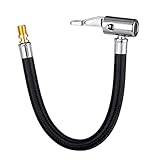
Comfort features include a readable display, a 6- to 12-foot cord, a built-in light, and controls that can be operated while wearing gloves. A pressure gauge such as the AstroAI 25.6-inch heavy-duty inflator gauge can be useful when you want a longer hose and direct pressure control instead of relying entirely on a small digital pump display.
Price Tiers: Pay for Capacity, Not Just PSI
Budget, $15 to $35: Expect compact cordless inflators, basic gauges, short hoses, and modest airflow. A $15 portable air pump may include a digital gauge, LED light, and auto-shutoff, but it is best suited to topping off tires. Check battery capacity, charging method, and cooling instructions carefully.
Midrange, $40 to $100: This range typically offers sturdier housings, better hoses, larger batteries, improved displays, or stronger 12-volt motors. It is the sensible tier for drivers who check tire pressure monthly and want dependable roadside backup.
Premium, $100 to $250 or more: These compressors may provide higher sustained airflow, longer-duty motors, heavy-duty clamps, larger cylinders, and better storage cases. They make sense for frequent use, multiple vehicles, trailers, or off-road tires. Do not pay premium pricing for a high PSI number alone.
Warranty: Protect the Motor and Battery
A one-year warranty is common on budget inflators. Two years is a stronger baseline for a midrange product, while premium compressors may offer two to five years on the pump and separate coverage for the battery. Read the exclusions: batteries, hoses, gauges, and accessories may have shorter coverage than the motor.
Keep the receipt and record the model number. A warranty is more valuable when the manufacturer provides replacement hoses, chucks, seals, or batteries instead of requiring the purchase of an entirely new unit. Also check whether commercial or high-frequency use voids coverage.
Delivery and Assembly: Check the Fittings Before You Need Them
Most portable inflators require no assembly beyond charging the battery or attaching the hose. Allow 10 to 20 minutes to inspect the connector, install any included adapters, and test the auto-shutoff. Larger compressors may require a hose, air filter, or power leads to be attached, which can take 15 to 30 minutes.
Before storing the unit in your vehicle, confirm that the hose reaches each valve and that the power cable reaches the outlet without stretching. If you are adding a locking chuck, hose adapter, or quick-connect fitting, test for leaks with soapy water. Tiny bubbles around a connection indicate that airflow is being lost before it reaches the tire.
Spec Checklist
| Spec | Budget | Mid | Premium |
|---|---|---|---|
| Useful airflow target | 0.5–1.0 CFM | 0.7–1.5 CFM | 1.5–2.5+ CFM |
| Motor or electrical demand | 60–120 watts | 100–180 watts | 150–300+ watts |
| Typical weight | 1–3 pounds | 3–6 pounds | 6–12 pounds |
| Hose length | 18–30 inches | 24–48 inches | 48–60 inches |
| Connector | Basic screw-on or lever chuck | Metal chuck or 1/4-inch quick-connect | Heavy-duty locking chuck and reinforced hose |
| Warranty goal | 1 year | 2 years | 2–5 years |
Red Flags
- A maximum pressure of 150 PSI or more with no CFM, liters-per-minute, or inflation-time information.
- Airflow listed only at zero pressure, with no explanation of how the rating was measured.
- A very short duty cycle, such as 5 minutes, without clear cooling instructions.
- A thin hose, loose valve connector, or plastic fitting that flexes under pressure.
- A battery-powered model that does not state battery capacity, charging time, or replacement-battery availability.
- A gauge that differs noticeably from a trusted tire-pressure gauge.
- Accessories with unclear fitting sizes or no compatibility information.
- Reviews or packaging that focus on LED lights and accessories while avoiding airflow and run-time details.
FAQ
Is higher CFM always better for a tire inflator?
No. Higher CFM generally means faster inflation, but only when measured at a comparable pressure. A pump with slightly lower advertised airflow may perform better if its rating is taken at 35 PSI rather than at zero pressure. Duty cycle, valve-seal quality, and hose size also affect the result.
What airflow do I need for a car tire?
For routine pressure adjustments, approximately 0.7 to 1.2 CFM at working pressure is a reasonable target. Choose closer to 1.5 CFM or more if you regularly inflate several tires or need to recover from a very low pressure. Always follow the vehicle manufacturer’s recommended tire pressure.
Should I choose cordless or 12-volt?
Choose cordless for convenience, compact storage, and occasional use. Choose 12-volt when you want longer operating time and do not mind managing a power cable. A cordless model is only useful when its battery is charged, while a vehicle-powered model can continue running as long as the vehicle and socket support it.
Do I need a separate chuck or hose adapter?
Not necessarily. The included chuck may be sufficient for occasional use. A locking chuck can improve sealing and comfort, and a quick-connect adapter can speed up repeated tire checks. Confirm thread size and coupler style first; accessories priced around $8 to $15 are inexpensive, but the wrong fitting will not improve airflow.