Key takeaways
- By hand: Best for spot repairs and small panels. Slower and less consistent, but zero risk of burning through an edge.
- Dual-action polisher: Far faster and more uniform across a full hood or door. The random orbit motion makes it hard to damage paint even for beginners.
- Rotary polisher: Fastest cutting power but reserved for experienced users because heat builds quickly.
What's inside
Swirl marks are the fine, spiderweb-like scratches that show up in direct sunlight and make an otherwise clean car look tired. They come almost entirely from bad wash technique: dragging grit across the clear coat with a dirty sponge or an automatic car wash brush. The good news is that light swirls live in the top few microns of clear coat, which means a polishing compound and a little patience can erase most of them at home.
This guide covers how to assess swirl depth, choose the right product, and work the paint safely by hand or with a machine. A budget kit like the Car Scratch Remover Kit for multiple paint colors handles occasional touch-ups, while a dedicated system such as the 3D One Car Scratch and Swirl Remover Hybrid Rubbing Compound gives you true paint correction on a full panel.
As an Amazon Associate we earn from qualifying purchases.


⚡ Save on Your Next PC — Amazon Prime
Prime members get fast free shipping on the systems above, plus early access to Prime Day & Black Friday PC deals. New members get a 30-day free trial.
Watch: How to Buff Out Swirl Marks on Car Paint — Video Review
Understanding What Causes Swirls
Swirls are shallow abrasions in the clear coat, not the color layer beneath it. Because clear coat is typically only 40 to 50 microns thick, and a light polish removes just 1 to 3 microns, you can safely correct swirls a few times over the life of a car. If you can catch a scratch with a fingernail, it is too deep for polishing alone and needs touch-up paint first.
Choosing Your Compound
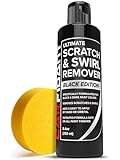
All-in-one products like the Carfidant Scratch and Swirl Remover combine a mild abrasive with a filling glaze, which is forgiving for beginners. The Turtle Wax Scratch Repair and Renew works the same way in a smaller, cheaper package. For deeper correction, a two-step approach using a cutting compound followed by a finishing polish, like the ExoForma Car Scratch Remover Kit with its drill attachment, removes more defect in less passes.
Hand Application Versus Machine
- By hand: Best for spot repairs and small panels. Slower and less consistent, but zero risk of burning through an edge.
- Dual-action polisher: Far faster and more uniform across a full hood or door. The random orbit motion makes it hard to damage paint even for beginners.
- Rotary polisher: Fastest cutting power but reserved for experienced users because heat builds quickly.
Step-by-Step Correction
Wash and dry the panel first so no grit remains. Apply three or four pea-sized dots of compound to a clean foam pad. Spread the product at low speed, then work a two-by-two-foot section with moderate pressure using overlapping passes for 60 to 90 seconds. Wipe the residue with a clean microfiber towel and inspect under bright light. The Scratch Out Liquid one-step compound is convenient here because it polishes and refines in a single stage.
Sealing Your Work
Polishing strips away any existing wax, so the corrected paint is temporarily unprotected. Follow up with a spray sealant or wax within the same session. Many correction kits, including the Carfidant Scratch Repair and Swirl Remover Kit, bundle a finishing pad that doubles for applying protection.
Tips
- Work in the shade; compound dries too fast on a hot panel and becomes hard to buff off.
- Switch to a clean section of towel often so you are not re-scratching with dried product.
- Do a small test spot first to confirm the compound clears your swirls before doing a whole panel.
- Keep pads clean; a clogged pad stops cutting and just smears product around.
Frequently Asked Questions
Can I remove swirls by hand?
Yes, for light swirls and small areas. A machine polisher is faster and more even for full panels, but hand application with a quality compound clears most surface swirling.
Will polishing damage my clear coat?
Light polishing removes only a couple of microns and can be safely repeated a handful of times over a car’s life. Aggressive rotary work in inexperienced hands is where risk appears.
How often can I do this?
For maintenance, once or twice a year is plenty. Correcting the same panel dozens of times would eventually thin the clear coat, but normal use never approaches that.
Do fillers hide swirls permanently?
Some all-in-one products fill fine swirls with glaze that can wash out over a few months. Products that actually abrade the defect deliver a more permanent result.
Conclusion
Swirl removal is one of the most satisfying detailing jobs because the before-and-after is instantly visible. Match the product to the damage, work small sections in the shade, and seal your results the same day. Prevent new swirls with a two-bucket wash and soft microfiber towels, and your paint will hold its gloss far longer between corrections.