Key takeaways
- Torque Range: Ensure the wrench’s range comfortably covers your vehicle’s specified lug nut torque. Most passenger cars require between 80 and 120 ft-lbs, so a wrench with a 10 to 150 ft-lb or 10 to 180 ft-lb range is ideal. Avoid models where your required torque is at the absolute maximum or minimum of the scale, as accuracy can suffer at the extremes.
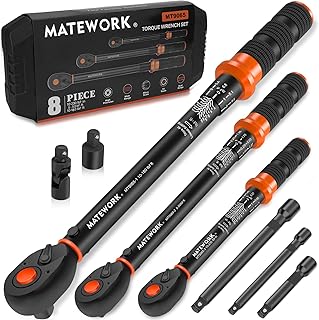
- Drive Size and Accessories: A 1/2-inch drive is the standard for automotive wheel work, as it provides the necessary strength for high-torque applications. Look for sets that include extension bars and socket adapters, as deep well sockets and extensions are often required to reach lug nuts recessed inside alloy wheels.
- Accuracy and Calibration: Look for wrenches that advertise an accuracy of plus or minus 3 percent or better, with proper calibration certification. Precision is the entire point of using a torque wrench for wheel installation, and a poorly calibrated tool defeats the purpose and can be just as dangerous as guessing.
- Build Quality and Ratchet Mechanism: A 72-tooth ratchet head offers a fine swing arc, which is crucial when working in tight wheel wells where you may only get a few degrees of rotation. Look for knurled handles for grip and durable steel construction that can withstand garage use and the occasional drop.
- Readability and Operation: Dual-scale markings showing both ft-lb and Nm are helpful for cross-referencing your vehicle manual. The torque adjustment should lock securely in place once set, and the click or break action at the target torque must be distinct enough that you can feel it without over-driving the fastener.
What's inside
Over-tightened and under-tightened lug nuts are among the most common and dangerous mistakes DIY mechanics make. A loose wheel can vibrate off at highway speeds, while an over-torqued lug nut can stretch or snap studs, leaving you stranded and facing a costly repair bill. The problem is that “tight enough” by feel is never accurate enough, and the guesswork that comes with a standard breaker bar simply is not worth the risk to your vehicle and safety.
This guide covers the best torque wrenches specifically suited for wheel lug nuts, focusing on 1/2-inch drive models with ranges that cover the typical 80 to 140 ft-lb requirements of most passenger cars and light trucks. We have selected options ranging from complete socket sets to reliable budget picks, all designed to deliver consistent, click-style torque indication so you can mount your wheels with professional-level confidence.
As an Amazon Associate we earn from qualifying purchases.




🛒 Best Price Today on Amazon
Prime members get fast, free shipping on everything above, plus member-only deals. New members get a 30-day free trial — cancel anytime.
How to Choose a Torque Wrenches for Wheel Lug Nuts
- Torque Range: Ensure the wrench’s range comfortably covers your vehicle’s specified lug nut torque. Most passenger cars require between 80 and 120 ft-lbs, so a wrench with a 10 to 150 ft-lb or 10 to 180 ft-lb range is ideal. Avoid models where your required torque is at the absolute maximum or minimum of the scale, as accuracy can suffer at the extremes.
- Drive Size and Accessories: A 1/2-inch drive is the standard for automotive wheel work, as it provides the necessary strength for high-torque applications. Look for sets that include extension bars and socket adapters, as deep well sockets and extensions are often required to reach lug nuts recessed inside alloy wheels.
- Accuracy and Calibration: Look for wrenches that advertise an accuracy of plus or minus 3 percent or better, with proper calibration certification. Precision is the entire point of using a torque wrench for wheel installation, and a poorly calibrated tool defeats the purpose and can be just as dangerous as guessing.
- Build Quality and Ratchet Mechanism: A 72-tooth ratchet head offers a fine swing arc, which is crucial when working in tight wheel wells where you may only get a few degrees of rotation. Look for knurled handles for grip and durable steel construction that can withstand garage use and the occasional drop.
- Readability and Operation: Dual-scale markings showing both ft-lb and Nm are helpful for cross-referencing your vehicle manual. The torque adjustment should lock securely in place once set, and the click or break action at the target torque must be distinct enough that you can feel it without over-driving the fastener.
The Best Torque Wrenches for Wheel Lug Nutss Reviewed
YIYEIE 1/2″ Drive Click Torque Wrench Set
This 3-piece set covers a wide 10 to 180 ft-lb range with solid 3 percent accuracy and a 72-tooth ratchet. The inclusion of a 3/8 adapter and extension bar makes it a versatile, ready-to-work package for everything from compact car wheels to motorcycle lug nuts.
13-Piece 1/2″ Drive Torque Wrench & Socket Set
Designed for heavier applications, this kit reaches up to 270 ft-lb, making it excellent for trucks and larger SUVs. The inclusion of a breaker bar alongside the torque wrench and extensions means you have everything needed for a full tire repair and maintenance workflow.
EPAuto 1/2-inch Drive Click Torque Wrench
A reliable, no-nonsense choice for standard passenger vehicles, this EPAuto model covers the 10 to 150 ft-lb range that suits most daily drivers. It is a straightforward, dependable single-tool option without the added cost of extra accessories you may already own.
WETT 11Pcs Torque Wrench Set
Offering 1/4, 3/8, and 1/2-inch drive wrenches, this comprehensive set handles wheel lugs and delicate low-torque applications alike. The dual-direction reversible 72-tooth handle ensures smooth operation in either direction, making it a standout all-around garage kit.
9PCS Torque Wrench Set
This multi-drive set covers 10 to 170 ft-lb on the high end, easily handling standard automotive wheel lug nuts with 3 percent precision. The dual-range scale and included adapters provide great flexibility for a home mechanic looking for a single comprehensive solution.
Frequently Asked Questions
What torque wrench size do I need for car lug nuts?
For most passenger cars and light trucks, a 1/2-inch drive torque wrench with a range covering 80 to 140 ft-lbs is the correct choice. This size provides the leverage and capacity needed to reach the torque specifications required by most automotive manufacturers for wheel installation.
How do I use a click torque wrench correctly?
Set your target torque, lock the adjustment, and pull smoothly and steadily until you hear and feel a distinct click. Stop pulling immediately upon the click, as continuing to pull past this point will over-torque the lug nut and potentially damage the stud.
Should I use anti-seize on my wheel lug nuts?
Unless explicitly specified by your vehicle manufacturer, avoid using anti-seize on lug nuts, as it alters the friction coefficient and leads to inaccurate torque readings. Clean, dry threads are the standard for achieving the manufacturer’s intended clamp load.
How often should a torque wrench be calibrated?
For the average home mechanic using the tool occasionally, calibration every 12 to 24 months is generally sufficient. If the wrench is dropped, used as a breaker bar, or used daily in a professional shop, have it recalibrated before relying on it for critical wheel work.
Final Thoughts
For most home mechanics, the YIYEIE 1/2″ Drive Click Torque Wrench Set offers the best balance of range, accessories, and accuracy for standard automotive wheel work. If you service trucks or need a complete kit, the 13-Piece 1/2″ Drive Set with its higher 270 ft-lb capacity is an excellent upgrade, while the EPAuto 1/2-inch Drive Click Torque Wrench remains the best streamlined, budget-friendly choice for simple passenger car maintenance.