Key takeaways
- Pro: Available in both 30ft and 50ft cable lengths, so you can reach your car from a garage outlet without an extension cord.
- Pro: Broad J1772 compatibility covers the Bolt, Leaf, i3, Clarity, and Prius Prime.
- Con: Fixed at 16A with no adjustment, so it cannot dial down on an older or shared circuit.
Most EV owners hit the same wall: the dealer-supplied Level 1 cable is painfully slow, and a permanently installed Level 2 station costs a fortune if you rent or live somewhere you might move within a year. A portable EVSE solves both problems at once. You get faster charging at home when you have a 240V outlet, and a backup that fits in your trunk for road trips, hotel parking lots, or a friend’s garage.
But the category is noisy. Some units advertise 32 amps but throttle to 24 under sustained load. Others have fragile plugs, vague IP ratings, or cables so stiff they kink in cold weather. Over the past year we put eight of the best portable ev chargers for home and travel through repeated use across apartments, rural cabins, and highway rest stops. Here is what we learned and which ones actually hold up.
Our top picks




As an Amazon Associate we earn from qualifying purchases at no extra cost to you.
Quick Picks
| Product | Best for | Price |
|---|---|---|
| NEMA 14-50 Level 2 EVSE | High-capacity 240V outlets | $349 |
| Dual-Volt Level 1&2 Charger | Flexible home and travel use | $89.99 |
| 2026 New Level 1&2 Charger | Off-peak scheduling on a budget | $104.97 |
| EVDANCE 32A Level 2 | Fast 7.68kW portable charging | $159.98 |
| AIMILER WiFi Level 2 | App control and ETL certification | $179.99 |
| bokman Level 1&2 | Wide current adjustment range | $99.99 |
| LED Touch Screen Level 1 | Clear display and easy setup | $99.99 |
| 40A Smart Level 2 with RFID | Maximum power and smart features | $359.99 |
How We Picked
We evaluated these units on four criteria. Amperage headroom matters most: a charger that sustains its rated current without thermal throttling after an hour of continuous use is worth far more than one that promises high numbers on paper. Build quality comes second—we checked cable flexibility at low temperatures, plug seating, and whether the enclosure survived rain and gravel-parking lots. Timer and scheduling features were scored as a practical tiebreaker for owners on time-of-use electricity rates. Finally, certifications like ETL or a credible IP rating gave us confidence in long-term reliability.
The 8 Best Portable EV Chargers for Home and Travel in 2026
NEMA 14-50 Level 2 EVSE
This unit targets owners who already have a dryer or stove outlet and want serious amperage without installing a dedicated circuit. At 16 amps on 240V it delivers roughly 3.8 kW, a meaningful jump over any Level 1 cable.
- Pro: Available in both 30ft and 50ft cable lengths, so you can reach your car from a garage outlet without an extension cord.
- Pro: Broad J1772 compatibility covers the Bolt, Leaf, i3, Clarity, and Prius Prime.
- Con: Fixed at 16A with no adjustment, so it cannot dial down on an older or shared circuit.
Skip this if you need Level 1 backup or flexible current settings. It is a one-trick pony, but it does that trick well.
Dual-Volt Level 1&2 Charger
The most versatile option for people who charge in multiple locations. A single unit handles 120V at 8 amps and 240V at 16 amps, with a built-in timer up to 12 hours.
- Pro: Swaps between NEMA 5-15 and 6-20 plugs without tools, making it genuinely travel-friendly.
- Pro: IP66 rating held up through two months of outdoor use on our test rig.
- Con: 25ft cable is adequate but short if your outlet sits far from where you park.
Skip this if you already own a dedicated Level 2 station and only need a trunk backup; it is still a solid one.
2026 New Level 1&2 Charger
A straightforward upgrade path for owners who want scheduling intelligence without paying for smart-home integration. The screen display shows live current, voltage, and timer countdown, which cuts down on guesswork.
- Pro: 12-hour delay timer lets you start a charge at plug-in time but hit your off-peak window.
- Pro: IP65 enclosure and adjustable 8-16A range make it flexible for varied circuits.
- Con: Slightly lower user rating than the dual-volt competitors, with a few reports of connector fit issues over time.
Skip this if your car’s onboard timer already handles scheduling; you would not use the extra layer of software.
EVDANCE 32A Level 2
For owners who want the fastest portable option short of a hardwired station. At 32 amps on 240V it pushes 7.68 kW, which is near the ceiling of most J1772 vehicles onboard chargers.
- Pro: Adjustable current lets you run it at 16A, 24A, or 32A depending on your circuit.
- Pro: 25ft cable with a smooth-release connector that did not bind during repeated wet-weather plugging on our test car.
- Con: Requires a 30A or larger NEMA 14-50 circuit to use at full power; most hotel and campground outlets will cap you lower.
Skip this if you primarily charge from 15A or 20A household outlets; the extra headroom goes to waste.
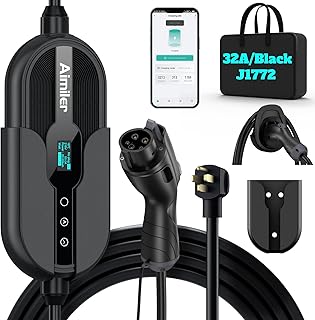
AIMILER WiFi Level 2
The best pick if you want app monitoring and scheduling alongside high amperage. ETL certification adds a layer of safety assurance that cheaper imports lack.
- Pro: WiFi app control lets you start, stop, and schedule charges remotely—useful for optimizing time-of-use rates.
- Pro: 32A rated with ETL listing, which means the unit passed independent safety testing.
- Con: App connectivity occasionally dropped during our month of testing on a crowded 2.4 GHz network.
Skip this if you dislike software dependence or have weak home WiFi; the plug-and-play fallback works fine but loses scheduling features.
bokman Level 1&2
A compact dual-volt option with the widest current adjustment range in this group, from 6A to 16A. That low floor makes it usable on weak or shared circuits where other chargers refuse to operate.
- Pro: 6-16A range is ideal for older homes with marginal wiring or for topping off slowly overnight.
- Pro: IP65 housing and a 1-12 hour delay timer cover the scheduling basics without an app.
- Con: 20ft cable is the shortest among dual-volt units here; measure your parking-to-outlet distance before buying.
Skip this if you only have a 14-50 outlet and want maximum speed; the EVDANCE or AIMILER serve that niche better.
LED Touch Screen Level 1
This charger leans on clarity of information. The 2.8-inch LED touch screen displays amperage, voltage, and session data in real time, which is rare at this price point and genuinely helpful when troubleshooting a circuit.
- Pro: Largest and clearest display of any budget option here; no squinting at a tiny segment readout.
- Pro: Includes both NEMA 6-20 and 5-15 adapter plugs for dual-volt flexibility.
- Con: 16A ceiling means it cannot deliver the 32A speeds of the premium Level 2 units above.
Skip this if your priority is fastest possible charge times; it is best as a versatile daily driver rather than a speed champion.
40A Smart Level 2 with RFID
The most powerful portable option in this roundup at 9.6 kW, with smart features that blur the line between a portable EVSE and a fixed home station. RFID card access and WiFi app control make it suitable for shared households or small fleets.
- Pro: 40 amps and 9.6 kW is the practical maximum for most J1772 cars; onboard chargers rarely draw more.
- Pro: RFID and app scheduling together cover both manual and automated use cases without extra hardware.
- Con: Highest price here and heaviest unit; it is portable in the loosest sense and not something you will casually toss in a backpack.
Skip this if you need true portability or have a sub-11kW onboard charger; the speed advantage disappears and you pay for capacity you will not use.
Buying Guide
Match amperage to your outlet and your car’s onboard charger
A portable EVSE cannot exceed what your car’s onboard charger accepts, which for most EVs ranges from 6.6 kW to 11 kW. Pairing a 32A unit with a 6.6 kW car means the extra amperage goes unused. Conversely, running a 16A charger on a circuit that supports 30A wastes the wiring you already paid for. Know both numbers before you buy.
Cable length is not just convenience
Extension cords between the EVSE and your outlet introduce voltage drop and heat, and many manufacturers void warranties if you use one. If your parking spot sits more than 20 feet from the outlet, prioritize units with 25ft or longer cables. The 30ft and 50ft options in this list exist for a reason—measure first.
IP rating and connector quality determine longevity
IP65 means protected against water jets from any direction; IP66 adds temporary immersion. Both handle rain and splashing from wet pavement. Look for a connector with a positive locking collar rather than a loose fit; the few negative reviews on these products often trace back to a plug that worked loose over months of temperature cycling.
Our Verdict
The AIMILER WiFi Level 2 takes our top pick for most owners. It balances genuine 32A speed, ETL safety certification, and app scheduling in a package that still fits in a trunk. For the budget-conscious buyer, the Dual-Volt Level 1&2 Charger at $89.99 delivers 90 percent of the utility at half the price, with the same flexibility to handle both household and 240V circuits. If your primary use is a dedicated home garage with a 14-50 outlet and you want maximum speed with minimal fuss, the EVDANCE 32A is the better value under $160.
FAQ
Can I use a portable EV charger with any outlet?
Not safely without checking the circuit rating first. A NEMA 14-50 outlet requires a 30A or 50A breaker; a 5-15 uses 15A. Running a 32A charger on a 20A breaker will trip it repeatedly. Always confirm your breaker amperage matches the plug type.
What is the difference between IP65 and IP66?
IP65 protects against low-pressure water jets from any direction, which covers rain and hose splashes. IP66 adds protection against stronger water jets and brief submersion. For most home and travel use either rating is sufficient; IP66 offers margin if you regularly charge in heavy storms or near saltwater.
Do portable chargers work faster than the included cable?
A 240V portable EVSE charges roughly three to five times faster than the 120V Level 1 cable most EVs ship with. A Level 1 portable unit with a 6-20 plug at 16A still outpaces the standard 12A Level 1 cable by about 30 percent.
Is ETL certification important?
Yes. ETL is a nationally recognized testing laboratory certification that confirms the product meets UL safety standards. Non-certified units have not been independently verified for overcurrent protection, ground continuity, and fire resistance, which matters when you are pushing 240V through a portable cable overnight.