Our Short List of 3
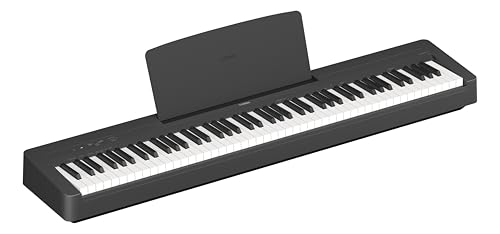
- Best for: app-guided self-learners who want play-along streaming and a light cabinet.
- 88 weighted, touch-sensitive keys with Graded Hammer Compact (GHC) action
- Yamaha grand piano voice; 10 voices total
- 64-note polyphony
- Bluetooth audio for play-along streaming through the piano’s speakers

- Best for: lesson students and returning players who prioritise realistic key feel.
- 88 keys with PHA-4 Standard hammer action, escapement and ivory-feel keys
- SuperNATURAL piano tones
- 96-voice polyphony
- Twin Piano mode for teacher and student side by side

- Best for: first-time buyers who want a complete, ready-to-play starter package.
- 88 fully weighted keys with Graded Hammer Standard (GHS) action
- 10 voices including Yamaha grand piano
- Sustain pedal and power supply included
- Headphone jack for silent practice
All 3 Picks at a Glance
| Product | Specs | Action |
|---|---|---|
| Yamaha P-145BT |
| Check price on Amazon |
| Roland FP-10 |
| Check price on Amazon |
| Yamaha P71 |
| Check price on Amazon |
Key takeaways
- Three weighted 88-key digital pianos for beginners compared: hammer actions, included pedals, headphone practice and lesson modes explained simply.
A first piano shapes the habits a learner keeps for years, which is why the keyboard action matters more than the length of the voice list. Keys that are too light teach fingers to skim across the surface, and that technique has to be unlearned the moment the student sits down at an acoustic piano. Every instrument below uses a fully weighted, graded hammer action across all 88 keys, so the bass notes feel heavier under the hand than the treble ones, as they do on a grand piano.
The three picks suit three common starting points. Self-taught learners who practise along with apps get Bluetooth streaming and app support; students in weekly lessons get a keybed built for developing touch, plus a split mode for sitting beside a teacher; cautious first-time buyers get a complete box with the pedal and power supply already inside. Each model earned its place from its specifications — action type, polyphony, speaker setup and included accessories — rather than from brand reputation alone.
Quick Picks
As an Amazon Associate we earn from qualifying purchases
| Product | Best for | Key spec |
|---|---|---|
| Yamaha P-145BT | App-guided self-learners | 88 GHC weighted keys, Bluetooth audio |
| Roland FP-10 | Lesson students building touch | PHA-4 hammer action, Twin Piano mode |
| Yamaha P71 | First piano, complete starter box | 88 GHS weighted keys, pedal and power supply included |
How to Choose
Weighted action comes first
A beginner piano should resist the fingers the way an acoustic instrument does. Graded hammer actions place heavier weighting in the bass and lighter weighting in the treble, training even finger strength from the first lesson. Yamaha fits its Graded Hammer Compact action to the P-145BT and the older Graded Hammer Standard to the P71, while Roland’s PHA-4 Standard adds escapement, the small notch felt as a key bottoms out on a real piano. Unweighted 61-key boards feel like organ keys and build the wrong muscle memory, so they are absent here.
Polyphony and the sound engine
Polyphony is the number of notes a piano can sound at once before older notes get cut off. Simple pieces use few notes, but sustained chords with the pedal down stack up quickly, especially in slow practice pieces. The P-145BT offers 64-note polyphony, the P71 sits in the same entry class, and the FP-10 stretches to 96 voices behind its SuperNATURAL piano tones, which model string resonance instead of replaying flat samples. Ten voices on either Yamaha cover the essentials — grand piano, electric piano, organ and strings — without burying a beginner in menus.
Practice features: headphones, split modes and apps
Quiet practice decides whether a piano survives in a shared home, so a headphone jack matters as much as the speakers. All three models provide one for wired headphones. Roland’s Twin Piano mode splits the FP-10 into two identical middle ranges, letting a teacher and student play side by side in the same octave — genuinely useful in lessons. Yamaha’s Smart Pianist app turns a phone into a larger control screen for the P-145BT. Read Bluetooth claims carefully, though: on the P-145BT it carries audio into the piano, while on the FP-10 it carries MIDI data only.
What arrives in the box, and what does not
Starter value hides in the accessory list. Each piano here includes a sustain pedal — a foot switch on the Yamahas, Roland’s DP-2 on the FP-10 — and a music rest for sheet music. The P71 goes further and bundles its power supply, removing the classic first-day surprise of a piano that cannot be switched on. What none of the three includes is furniture: a stand and a bench are separate purchases across the board, so budget for them alongside the instrument rather than discovering the gap when the box is opened.
The 3 Best Options
Yamaha P-145BT
- Best for: app-guided self-learners who want play-along streaming and a light cabinet.
- 88 weighted, touch-sensitive keys with Graded Hammer Compact (GHC) action
- Yamaha grand piano voice; 10 voices total
- 64-note polyphony
- Bluetooth audio for play-along streaming through the piano’s speakers
app-guided self-learners who want play-along streaming and a light cabinet.
the Bluetooth connection is audio-in only — it cannot send sound to Bluetooth headphones, so silent practice still needs a wired set. Check the listing carefully too, because the plainer P-145 without Bluetooth is a separate model.
The P-145BT is the most modern-feeling starter of the three. Its Graded Hammer Compact action keeps the cabinet slim at roughly 11.1 kg, light enough to move between rooms, while Bluetooth audio lets a learner stream songs, backing tracks or lesson videos through the piano’s own speakers and play along. Yamaha’s grand piano voice leads a set of ten, the Smart Pianist app gives the controls a proper screen, and a sustain foot switch is included in the box. For self-directed beginners who learn from a phone or tablet, this is the natural first choice.
Watch out for: the Bluetooth connection is audio-in only — it cannot send sound to Bluetooth headphones, so silent practice still needs a wired set. Check the listing carefully too, because the plainer P-145 without Bluetooth is a separate model.
Roland FP-10
- Best for: lesson students and returning players who prioritise realistic key feel.
- 88 keys with PHA-4 Standard hammer action, escapement and ivory-feel keys
- SuperNATURAL piano tones
- 96-voice polyphony
- Twin Piano mode for teacher and student side by side
lesson students and returning players who prioritise realistic key feel.
Bluetooth here is MIDI only, so it talks to apps but cannot stream music through the speakers. Confirm the listing is the piano itself — bundle versions packaged with furniture circulate separately — and remember no stand or bench is included.
Learners who care most about touch should start here. The PHA-4 Standard action pairs hammer weighting with escapement and ivory-feel key surfaces, giving the FP-10 the most piano-like finger response in this group, and the SuperNATURAL sound engine backs it with 96-voice polyphony for pedalled passages. Twin Piano mode supports lessons directly, Bluetooth MIDI connects to learning apps without cables, and the onboard speakers are the strongest of the three. It is the heaviest pick at about 12.6 kg, a fair trade for the keybed serious students will grow into rather than out of.
Watch out for: Bluetooth here is MIDI only, so it talks to apps but cannot stream music through the speakers. Confirm the listing is the piano itself — bundle versions packaged with furniture circulate separately — and remember no stand or bench is included.
Yamaha P71
- Best for: first-time buyers who want a complete, ready-to-play starter package.
- 88 fully weighted keys with Graded Hammer Standard (GHS) action
- 10 voices including Yamaha grand piano
- Sustain pedal and power supply included
- Headphone jack for silent practice
first-time buyers who want a complete, ready-to-play starter package.
Yamaha publishes this instrument as identical to the P-45 under an Amazon-exclusive model number, so treat the two names as one piano. There is no Bluetooth in any form, and the speakers are modest for a large room.
The P71 is the low-risk default for a household buying its first piano. The Graded Hammer Standard action is fully weighted across 88 keys, ten voices include Yamaha’s grand piano, and the box contains the two extras beginners most often forget: a sustain pedal and the power supply. A headphone jack covers evening practice, USB to host connects a computer for lesson software, and the music rest is included. At roughly 25 lb and just over 52 inches long it asks for a permanent spot, but nothing else needs ordering before the first practice session.
Watch out for: Yamaha publishes this instrument as identical to the P-45 under an Amazon-exclusive model number, so treat the two names as one piano. There is no Bluetooth in any form, and the speakers are modest for a large room.
Which One Fits Your Situation
You are teaching yourself with an app
Choose the Yamaha P-145BT. Bluetooth audio streams lesson videos and backing tracks through the piano’s speakers so you hear your playing and the guide track together, while the Smart Pianist app replaces fiddly button combinations with a clear phone screen. Its lighter cabinet also suits learners who set up and pack away each day.
You take weekly lessons with a teacher
Choose the Roland FP-10. Twin Piano mode divides the keyboard into two matching ranges, so your teacher can demonstrate a passage in the same octave without swapping seats. The PHA-4 action rewards the finger control lessons are meant to build, and Bluetooth MIDI links practice apps for homework between sessions without a cable in the way.
This is a first piano for a child
Choose the Yamaha P71. Everything needed on day one is in the box — weighted keys, a sustain pedal and the power supply — so there is no second order and no disappointed first evening. The ten voices keep early practice varied, the headphone jack protects the rest of the household, and the action will not hold a young player back as pieces grow harder.
You practise late in a shared home
Any of the three works with wired headphones plugged into the headphone jack, which is the reliable route to silent practice. Pick the P-145BT if you also want streamed audio during the day, but do not count on wireless headphones at night: its Bluetooth only receives audio, and the FP-10’s Bluetooth carries MIDI data rather than sound.
Common Mistakes
- Buying an unweighted 61-key keyboard to learn piano, then having to replace it once a teacher insists on weighted keys.
- Assuming Bluetooth means wireless headphone practice — on these models it carries audio into the piano or MIDI to an app, never sound out to headphones.
- Forgetting that no pick includes a stand or bench, so the piano ends up on a wobbly table at the wrong height.
- Shopping for the Yamaha P71 and P-45 as though they were rival models, when they are the same instrument under different model numbers.
- Practising for months without a sustain pedal because it was treated as an optional extra rather than part of the instrument.
Frequently Asked Questions
Do beginners really need all 88 keys?
For piano lessons, yes. Method books move beyond the middle octaves within the first year or two, and exam pieces assume a full range. A weighted 88-key action also teaches correct finger strength from the start. Smaller boards suit keyboard and synth playing, but a learner aiming at piano technique will outgrow one quickly and have to buy twice.
Can I practise silently with headphones on these pianos?
Yes, with a wired pair. All three models have a headphone jack that mutes the speakers, which is the dependable option for evening practice. Wireless headphones are not supported: the P-145BT’s Bluetooth only receives audio for play-along, and the FP-10’s Bluetooth sends MIDI to apps. Plan on a cable and you will never be caught out mid-session.
Is the Yamaha P71 different from the Yamaha P-45?
No. Yamaha publishes the P71 as the same instrument as the P-45, sold under an Amazon-exclusive model number. The action, voices and layout match, so a buyer comparing the two listings is looking at one piano wearing two badges. Choose whichever listing is current, and never count them as two separate options in a shortlist.
Do I need to buy a stand and bench separately?
Yes. None of the three pianos includes furniture, so a stand and bench are extra purchases. Correct playing height matters for posture and technique, especially for children, so factor both into the budget from the start rather than improvising with a dining chair. The good news is that any standard keyboard stand fits all three models.
FAQ
Do beginners really need all 88 keys?
Can I practise silently with headphones on these pianos?
Is the Yamaha P71 different from the Yamaha P-45?
Do I need to buy a stand and bench separately?
More from Amazon
Programs that pair well with the guide above. Offers and eligibility are set by Amazon and may change.
Free shipping on eligible items, Prime Video and more. Eligible new members can start with a free trial.
Start a Prime free trialA Prime membership for ages 18-24 with a trial period. Eligibility is set by Amazon.
See Prime for Young AdultsAudiobooks and podcasts to listen to on the go. Eligible new members can start with a free trial.
Try Audible freeAd-free music streaming. Eligible new subscribers can start with a free trial.
Try Music Unlimited freeAs an Amazon Associate we earn from qualifying purchases.