Key takeaways
- Two kayaks at 75 pounds each: 150 pounds
- Two seats and pedal-drive systems: approximately 50 pounds total
- Paddles, batteries, tackle, and safety equipment: approximately 40 pounds
- Two transport carts and tie-down equipment: approximately 20 pounds
- Total cargo: 260 pounds
The best kayak trailers are lightweight, corrosion-resistant trailers with enough capacity for your boats, adjustable cradles that fit your hull shape, and a hitch size that matches your vehicle; for most paddlers, a two-kayak trailer rated for at least 200 pounds offers the best balance of price, stability, and storage.
Our top picks


As an Amazon Associate we earn from qualifying purchases at no extra cost to you. Ratings are shown as listed on Amazon.
Best kayak trailers by paddling situation
| Situation | Best trailer type | Target specifications | Why it fits |
|---|---|---|---|
| One recreational kayak and limited storage | Compact folding or kit-style trailer | 100–200 lb capacity, 45–75 lb trailer weight, 12–16 inch wheels | Easier to move by hand and store vertically or in a garage corner |
| Two kayaks used several times a month | Two-kayak utility trailer | 200–350 lb capacity, adjustable bunks or cradles, 4.5–6 ft tongue | Provides useful capacity without the size and cost of a large cargo trailer |
| Three or more boats, or kayaks plus a canoe | Modular multi-boat trailer | 350–800 lb capacity, 6–8 ft tongue, removable upper racks | Offers more loading flexibility and better separation between boats |
| Frequent highway travel | Full-size steel or aluminum trailer | 12–14 inch road tires, fenders, lights, 2-inch coupler, spare-tire provision | Improves stability and serviceability at sustained road speeds |
| Apartment, condo, or small garage | Folding-frame trailer | Hinged tongue or frame, folded length under 6 ft, under 100 lb if possible | Storage dimensions matter more than maximum carrying capacity |
Our top kayak trailer picks
Best overall: a two-kayak adjustable utility trailer
For the widest range of owners, choose a two-kayak trailer with adjustable padded cradles, a galvanized or powder-coated steel frame, and a capacity of 250–350 pounds. This configuration can carry two recreational kayaks, fishing kayaks, or one larger touring kayak without becoming unnecessarily difficult to store.
Look for independent cradle adjustment rather than fixed V-shaped supports. Independent cradles let you move the supports outward for a wide fishing kayak or inward for a narrow touring hull. They also make it easier to distribute weight evenly over the axle.
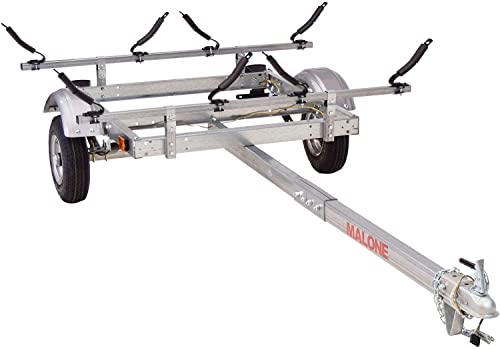
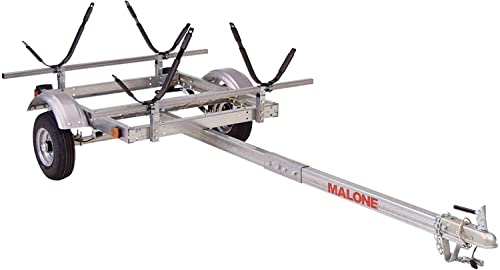
Malone’s MicroSport family is a well-known example of this general design, while similar two-boat trailers are sold by several marine and utility-trailer manufacturers. Check the current configuration carefully: some packages include kayak carriers, spare tires, or higher racks, while others require those parts separately.
Best for small spaces: a compact folding trailer
A folding trailer is the better choice when the trailer must live in a garage, shed, or shared storage area. A useful target is a folded length of about 5–6 feet and a folded width narrow enough to pass through a standard doorway. A trailer weighing 75 pounds or less is much easier to stand on end or reposition without a vehicle.
Compact models are usually best for one or two lightweight recreational kayaks. Before buying, measure the storage location with the tongue folded, not just the trailer’s operating dimensions. Confirm whether the wheels, lights, and cradle bars remain attached during folding; removable parts can turn a supposedly quick storage process into a longer setup.
Best for frequent highway use: a full-size multi-boat trailer
If you drive long distances to launch sites, prioritize road manners over the lowest purchase price. A longer tongue, wider axle track, properly sized road tires, and a rigid frame reduce twitching and improve backing control. Trailers designed for multiple boats can also carry paddles, carts, or dry bags, but do not treat unused rack space as extra legal payload unless the manufacturer specifies it.
The Yakima Rack and Roll is a recognizable lightweight trailer platform that can be configured for watercraft and other recreational equipment. Its advantage is low trailer weight and a rack-style layout; its limitation is that buyers must pay close attention to the selected accessories and the platform’s payload rating. A conventional galvanized utility trailer may be the better value for heavy fishing kayaks or frequent rough-road travel.
Best for heavy fishing kayaks: a high-capacity utility trailer
Fishing kayaks commonly weigh 60–100 pounds before adding a seat, pedal drive, battery, anchor, and tackle. For two fully equipped boats, a 350-pound rating can disappear quickly. Choose a trailer with at least 500 pounds of usable payload when the loaded boats and equipment approach that range.
Do not calculate capacity from hull weight alone. For example:
- Two kayaks at 75 pounds each: 150 pounds
- Two seats and pedal-drive systems: approximately 50 pounds total
- Paddles, batteries, tackle, and safety equipment: approximately 40 pounds
- Two transport carts and tie-down equipment: approximately 20 pounds
- Total cargo: 260 pounds
A trailer rated at 300 pounds technically carries that load, but leaves little margin for wet gear or inaccurate estimates. A 500-pound-rated trailer gives a more practical buffer.
Features that matter more than the product name
Capacity and weight distribution
Separate the trailer’s empty weight, payload capacity, and gross vehicle weight rating. If the trailer weighs 100 pounds and has a 350-pound payload rating, the loaded trailer weighs as much as 450 pounds before considering any items placed in a storage box.
Keep heavier boats low and centered over the axle. A tongue weight around 10–15 percent of the loaded trailer weight is a useful general target. Too little tongue weight can cause sway; too much can overload the vehicle’s hitch or make the trailer difficult to lift from the coupler.
Frame materials
- Galvanized steel: Usually the best value and highly suitable for regular freshwater use. Rinse it after saltwater exposure because galvanizing is protective, not indestructible.
- Powder-coated steel: Strong and affordable, but scratches and chips need prompt touch-up to prevent rust.
- Aluminum: Lighter and naturally resistant to many corrosion problems, though it can cost more and may flex differently under heavy loads.
Weld quality, axle design, hardware, and replacement-part availability often matter more than the frame material printed on the brochure.
Adjustable cradles and bunk length
Wide, padded bunks support sit-on-top and fishing kayaks well, while contour cradles can better protect narrower touring hulls. The supports should contact strong parts of the hull rather than pressing against rudders, hatches, pedal-drive openings, or delicate deck fittings.
Measure each kayak’s length, maximum width, hull shape, and carrying points. A trailer that accommodates a 36-inch fishing kayak may not position a 24-inch touring kayak securely without moving the cradles inward.
Tongue length
A short tongue makes storage easier but can cause the rear kayak to contact the vehicle during tight turns. For two boats, a tongue around 5–6 feet from the axle to the coupler is a practical starting point. Longer tongues improve turning clearance and backing stability but increase the trailer’s storage footprint.
Wheels, lights, and hitch requirements
Small utility wheels are acceptable for short, slow trips, but 12-inch or larger road tires are preferable for regular highway use. Check the tire load rating, maximum speed marking, and age before each season.
Most lightweight trailers use a 1-7/8-inch or 2-inch coupler. The coupler must match the vehicle’s hitch ball exactly; a physically attachable combination is not necessarily a safe one. Also verify:
- Vehicle tongue-weight and towing limits
- Required trailer-light connector, commonly 4-flat on small trailers
- Safety-chain attachment points
- License-plate and registration rules in your jurisdiction
- Whether the hitch receiver needs a ball mount with a rise or drop
Ownership realities: what wears first
Kayak trailers spend much of their lives near water, so rinsing is the most valuable maintenance habit. Flush the axle, hubs, coupler, springs, and light connectors with fresh water after saltwater use. Dry the trailer before covering it, since trapped moisture accelerates corrosion.
The parts most likely to require attention are tires, wheel bearings, bunk padding, tie-down straps, light connectors, and coupler hardware. Inspect straps for fading or fraying rather than waiting for a failure. Replace any strap that has been cut by a sharp hull edge.
Greaseable hubs still need periodic inspection. If a hub becomes hot to the touch after a short drive, stop and investigate; the cause may be insufficient grease, a failing bearing, or incorrect adjustment. Store the trailer with the kayaks removed when possible, and support the frame if it will sit unused for months.
Common buying mistakes
- Choosing capacity based only on empty kayak weight
- Ignoring the folded dimensions until after delivery
- Using fixed cradles that do not match the hull shape
- Assuming a lightweight trailer needs no wheel-bearing maintenance
- Leaving removable racks loose while driving
- Overtightening straps until the hull deforms
- Skipping a test turn and brake check after loading
Bottom line
For most owners, the best kayak trailers are two-kayak adjustable models with a 250–350-pound payload rating, corrosion-resistant frames, road-rated tires, and a folding tongue. Choose a compact folding design when storage is the main constraint, a longer full-size trailer for frequent highway travel, and a 500-pound-or-higher utility trailer for loaded fishing kayaks. The right trailer is the one that fits your hulls, vehicle, storage space, and real cargo weight—not simply the one with the highest advertised capacity.