Our Short List of 3

- Front-firing port allows placement close to a wall
- Keyhole slot on the back for wall mounting
- Works as front, rear or surround speakers in a home theater set
- Five-year limited warranty stated on the listing

- Built-in amplification, so no separate amplifier or receiver is needed
- Two RCA inputs for two sources at once
- Remote included for volume control
- Bass and treble trim controls on the active cabinet

- Largest woofer in this group, with the lowest stated bass reach
- Aramid-fiber cone and cloth dome tweeter with a waveguide
- Five-way metal binding posts for bare wire or banana plugs
- Suits larger rooms and stereo listening at distance
All 4 Picks at a Glance
| Product | Specs | Action |
|---|---|---|
| 1. Polk Audio T15 — Best Overall |
| Check price on Amazon |
| 2. Edifier R1280T — Best Powered Pair |
| Check price on Amazon |
| 3. ELAC Debut 2.0 B6.2 — Best for Larger Rooms |
| Check price on Amazon |
 4. Klipsch R-41M — Best Compact Passive Pair |
| Check price on Amazon |
Key takeaways
- The best home audio speakers compared: four bookshelf pairs for music, TV and everyday listening, covering powered and passive designs and placement.
As an Amazon Associate I earn from qualifying purchases.
The Short Answer
The best home audio speakers for most listeners are the Polk Audio T15. They are a passive bookshelf pair with a front-firing bass port, a 5.25 inch woofer and a 0.75 inch silk dome tweeter, and they work as front speakers for music, as part of a home theater set, or as wall-mounted surrounds. If you want speakers that work the moment they arrive with no separate amplifier, the Edifier R1280T is the pick: it is a powered pair with its own amplification, two RCA inputs and a remote. For larger rooms and deeper bass from a bookshelf cabinet, the ELAC Debut 2.0 B6.2 pairs a 6.5 inch aramid-fiber woofer with a 1 inch cloth dome tweeter. The Klipsch R-41M rounds out the group as the compact horn-loaded option for small rooms and modest amplifiers.
Every pick in this guide is a bookshelf speaker sold as a pair. That matters, because home audio speakers are sometimes listed one cabinet at a time, and a single-cabinet listing can look like a pair until the box arrives. All four pairs below are built for the same job: clear stereo sound in a living room, a den or a home office, from music, television and movies.
Our Top Picks
Best overall: Polk Audio T15. A placement-friendly passive pair with a front port, wall-mount keyholes and a 5.25 inch woofer. It suits the widest range of rooms and systems in this guide.
Best powered pair: Edifier R1280T. Built-in amplification, two RCA inputs, a remote and bass and treble controls. It connects directly to a phone, computer or turntable with no receiver in between.
Best for larger rooms: ELAC Debut 2.0 B6.2. The largest cabinet here, with a 6.5 inch aramid-fiber woofer and the lowest stated bass reach of the group. It needs shelf depth, though its two front-firing ports make it more forgiving about space behind the cabinet than a rear-ported design.
Best compact passive pair: Klipsch R-41M. A small horn-loaded bookshelf pair with a 4 inch spun-copper woofer and the highest stated sensitivity in this group, which suits modest amplifiers.
Quick Comparison
| Pick | Type | Woofer | Tweeter | Stated frequency response | Best for |
|---|---|---|---|---|---|
| Edifier R1280T | Powered | 4 inch | 13 mm silk dome | 75 Hz to 18 kHz | Desks and simple setups |
| Polk Audio T15 | Passive | 5.25 inch | 0.75 inch silk dome | 60 Hz to 24 kHz | Most rooms and systems |
| ELAC Debut 2.0 B6.2 | Passive | 6.5 inch aramid fiber | 1 inch cloth dome | 44 Hz to 35,000 Hz | Larger rooms, deeper bass |
| Klipsch R-41M | Passive | 4 inch spun-copper IMG | 1 inch aluminum LTS in Tractrix horn | 68 Hz to 21 kHz, plus or minus 3 dB | Small rooms, low-power amplifiers |
How to Choose
Powered or passive comes first. This is the decision that shapes everything else. A powered pair such as the Edifier R1280T carries its own amplifier inside one cabinet, so it connects directly to a source and plays. A passive pair such as the Polk T15, the ELAC B6.2 and the Klipsch R-41M contains no amplification at all and needs a separate stereo amplifier or home theater receiver. If you already own a receiver, a passive pair gives you more choice and an easier upgrade path, since the amplifier and the speakers can be changed independently. If you own no amplifier and do not want one, a powered pair is the only pick here that works on its own.
Match the amplifier to the maker figures. For passive speakers, check two maker-stated numbers before anything else: nominal impedance and the recommended or maximum power range. The Polk T15 is an 8 ohm design with a stated maximum output power of 100 watts. An amplifier comfortable inside the maker power range and stable at the speaker impedance is the correct pairing.
Read sensitivity and frequency figures as maker data. Sensitivity describes how loud a speaker plays at a stated distance with a stated input, but makers use different methods, and Klipsch, for example, states its figure in-room. Frequency response ranges are likewise maker-attributed and measured under each maker own conditions. A wider printed range does not by itself prove deeper or better sound in your room. Driver size, cabinet volume and placement all shape the result.
Plan placement around the port. The Klipsch R-41M vents through a rear port, and Klipsch advises leaving open space behind the cabinet rather than pushing it flat against a wall. The ELAC B6.2 and the Polk T15 vent at the front, so they are more forgiving about placement close to a wall, and Polk adds a keyhole slot on the back for wall mounting. The Edifier R1280T is a compact desktop pair, though it is rear-ported and also benefits from some space behind it. Follow each maker own placement guidance for distance from walls and listening height.
Measure your shelf. These four designs range from compact desktop cabinets to the ELAC B6.2, which is nearly fifteen inches tall and over ten inches deep. Check the maker stated dimensions against your shelf depth before ordering, and leave room for speaker cable to bend behind the cabinet.
Think about the system you will grow into. A pair of passive bookshelf speakers can become the front left and right channels of a home theater set, with a matching center speaker and a subwoofer added later. The Polk T15 is the most flexible pick for that path, since Polk builds matching center and surround models in the same line and the T15 itself can move to surround duty when a larger pair takes over the front. A powered pair is a finished system rather than a starting point: it does what it does well, but it does not grow into a surround set.
The Picks in Detail
1. Polk Audio T15 — Best Overall
- Front-firing port allows placement close to a wall
- Keyhole slot on the back for wall mounting
- Works as front, rear or surround speakers in a home theater set
- Five-year limited warranty stated on the listing
The T15 is the most placement-friendly passive pick in this group. Its bass port fires forward, so the cabinet can sit closer to a wall than the rear-ported designs, and Polk adds a keyhole slot on the back for wall mounting as a surround speaker. The 5.25 inch Dynamic Balance composite woofer and 0.75 inch silk dome tweeter are part of Polk driver line, and Polk publishes both an overall response figure of 60 Hz to 24 kHz and narrower minus-3 dB limits of 65 Hz to 20 kHz, which is a more conservative way of stating the same specification. The listing states a maximum output power of 100 watts at 8 ohms, and the cabinets measure 7.3 by 6.5 by 10.7 inches at 8.25 pounds for the pair. Polk covers the speakers with a five-year limited warranty, according to the listing.
What makes the T15 the overall pick is range of use rather than any single specification. It works as a front stereo pair for music, as front or rear speakers in a home theater layout, and as a wall-mounted surround pair.
Pros:
Cons:
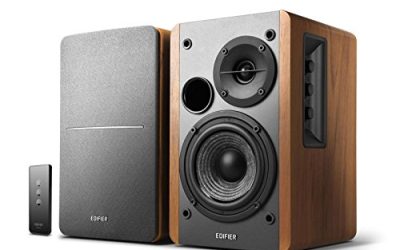
2. Edifier R1280T — Best Powered Pair
- Built-in amplification, so no separate amplifier or receiver is needed
- Two RCA inputs for two sources at once
- Remote included for volume control
- Bass and treble trim controls on the active cabinet
The R1280T is the only powered design in this guide. One cabinet houses the amplifier and controls, and a speaker cable links it to its passive partner, so the pair connects to sources directly with no receiver in between. Edifier states a total power output of 42 watts RMS, split evenly between the two cabinets, with a 4 inch woofer and a 13 mm silk dome tweeter in each cabinet. The stated frequency response is 75 Hz to 18 kHz, and the signal-to-noise ratio is 85 dBA or higher, per Edifier.
Edifier fits two separate RCA inputs, which lets a computer and a turntable stay connected at the same time, and includes a small remote for volume. Bass and treble trim controls sit on the side of the active cabinet for quick adjustment.
Pros:
Cons:
3. ELAC Debut 2.0 B6.2 — Best for Larger Rooms
- Largest woofer in this group, with the lowest stated bass reach
- Aramid-fiber cone and cloth dome tweeter with a waveguide
- Five-way metal binding posts for bare wire or banana plugs
- Suits larger rooms and stereo listening at distance
The B6.2 is the largest speaker in this guide and the one built around the biggest woofer. ELAC uses a 6.5 inch woven aramid-fiber cone, a material the maker chooses for stiffness at this size, paired with a 1 inch cloth dome tweeter behind a wide-dispersion waveguide. The stated frequency response is 44 Hz to 35,000 Hz, per ELAC, which is the lowest stated bass reach in this group. ELAC states sensitivity at 87 dB.
The cabinet is substantially deeper than the others here, at nearly fifteen inches tall and over ten inches deep, and its two front-firing ports mean it can sit closer to a wall than a rear-ported design, though the deep cabinet still needs shelf depth. Five-way metal binding posts give a secure connection for bare wire or banana plugs.
Pros:
Cons:
4. Klipsch R-41M — Best Compact Passive Pair
- Highest stated sensitivity in this group, suiting low-power amplifiers
- Compact cabinets fit small rooms, desks and crowded shelves
- Horn-loaded tweeter with controlled dispersion, per Klipsch
- Spun-copper woofer gives the pair a distinct look
The R-41M is the compact horn-loaded entry. Klipsch loads its 1 inch aluminum LTS tweeter into a square 90 by 90 degree Tractrix horn, a design the maker uses across the Reference line to control dispersion, and pairs it with a 4 inch spun-copper IMG woofer. The stated frequency response is 68 Hz to 21 kHz, plus or minus 3 dB, per Klipsch. Its maker-stated sensitivity is 90 dB using Klipsch own in-room method, the highest figure in this group, which in practical terms means a modest amplifier can drive it to a given volume with power to spare.
The rear Tractrix port needs some clearance from the wall, per Klipsch placement guidance, so this pair suits a shelf or a stand with open space behind it rather than a cabinet pushed flat against a wall.
Pros:
Cons:
Who Should Choose What
Choose the Polk Audio T15 if you want the most flexible pair in this guide: a front stereo pair today that can move to surround duty later, with placement that forgives a shelf close to a wall. It is the pick for a first home audio system built around a receiver, and for a home theater set that will grow one piece at a time.
Choose the Edifier R1280T if you want the simplest possible setup. If you own no amplifier, do not want one, and listen at a desk or in a small room, the powered design removes the matching question entirely.
Choose the ELAC Debut 2.0 B6.2 if your room is larger and your shelf is deep. The bigger cabinet and 6.5 inch woofer suit listeners who sit farther from the speakers and want more low-end weight without adding a subwoofer. Confirm the shelf depth before ordering, since the cabinet is over ten inches deep.
Choose the Klipsch R-41M if your amplifier is modest and your space is tight. The high stated sensitivity makes it the easiest passive pair here to drive, and the compact cabinets fit where the ELAC cannot. It suits a bedroom, a small living room or a desktop system with a small amplifier.
Common Mistakes
Buying one cabinet when you need a pair. Some bookshelf models are listed one speaker at a time, and the listing title does not always make that plain. All four picks in this guide are sold as pairs, but confirm the unit count on the listing before ordering any speaker, since a single-cabinet listing can look like a pair until the box arrives.
Skipping the amplifier question. Passive speakers contain no amplification and will not play from a phone or computer output on their own. Only the Edifier R1280T in this guide is powered. If you buy a passive pair, budget and shelf space for the amplifier or receiver as well.
Pushing rear-ported speakers against the wall. The Klipsch R-41M vents through a rear port. Placing it flat against a wall chokes the port and muddies the bass. Leave the open space the maker guidance asks for, or pick a front-ported design such as the Polk T15 or the ELAC B6.2 instead.
Ignoring shelf depth. The ELAC B6.2 is over ten inches deep, and speaker cable needs room to bend behind the cabinet. Measure the shelf before ordering, and remember that the rear-ported Klipsch also needs open space behind it as well as depth under it.
Expecting deep subwoofer bass from a bookshelf pair. Bookshelf speakers are built for clear mids and highs with useful bass, not for the lowest octave. If movies and bass-heavy music are the main use, plan to add a subwoofer later rather than judging a bookshelf pair against a subwoofer.
FAQ
Do passive bookshelf speakers need a separate amplifier?
Yes. The Polk T15, the ELAC B6.2 and the Klipsch R-41M have no built-in amplification and will not play from a phone or computer output on their own. Match the amplifier to each maker stated impedance and power range. Only the Edifier R1280T is powered and connects directly to a source.
Are all four of these sold as pairs?
Yes. Each listing covered here is for a pair of speakers, not a single cabinet. That is worth confirming on any speaker listing before ordering, because some bookshelf models from other lines are listed individually, but all four picks in this guide are pairs.
Can bookshelf speakers work with a television?
Yes. A powered pair such as the Edifier R1280T connects directly to a television with an analog output. A passive pair connects through a stereo amplifier or an AV receiver, which also lets the pair grow into a surround set with a matching center speaker later.
How much space do rear-ported speakers need from a wall?
Follow the maker guidance packed with the speaker. The Klipsch R-41M vents at the rear, and Klipsch advises open space behind the cabinet so the port can work as designed. The front-ported Polk T15 and ELAC B6.2 are more forgiving about placement close to a wall.
Do I need a subwoofer with bookshelf speakers?
Not to start. All four pairs here are built to sound complete on their own for music and television. A subwoofer adds weight below the range a bookshelf cabinet covers, and it is an easy addition later if movies and bass-heavy music are the main use.
Which pick is best for a turntable?
The Edifier R1280T is the simplest route, since it connects directly to a turntable with a built-in phono stage or a separate phono preamp, with no amplifier in between. If you already own a receiver with a phono input, any of the three passive pairs works, and the Polk T15 is the most flexible choice for a system that will grow.
Conclusion
The best home audio speakers are the ones that fit your room, your amplifier and the way you listen, not the ones with the widest specification sheet. For most listeners, the Polk Audio T15 covers the most ground: a front-ported passive pair that works for music, television and home theater, and that can move to surround duty as the system grows. The Edifier R1280T is the pick when simplicity matters most, with amplification built in and two sources connected at once. The ELAC Debut 2.0 B6.2 suits larger rooms and deeper shelves, with the biggest woofer and the lowest stated bass reach in this group. The Klipsch R-41M fits small rooms and modest amplifiers, with the highest stated sensitivity here. Measure the shelf, check the amplifier match, leave room behind any rear port, and confirm the listing is for a pair before ordering.
More from Amazon
Programs that pair well with the guide above. Offers and eligibility are set by Amazon and may change.
Free shipping on eligible items, Prime Video and more. Eligible new members can start with a free trial.
Start a Prime free trialA Prime membership for ages 18-24 with a trial period. Eligibility is set by Amazon.
See Prime for Young AdultsAudiobooks and podcasts to listen to on the go. Eligible new members can start with a free trial.
Try Audible freeAd-free music streaming. Eligible new subscribers can start with a free trial.
Try Music Unlimited freeAs an Amazon Associate we earn from qualifying purchases.