Key takeaways
- Five electric garage heaters compared by circuit, wattage and mounting, from hardwired 240V ceiling units to a plug-in pick for one cold workbench bay.
Buying an electric garage heater starts with your breaker panel, not with the heater itself. A hardwired 240 volt ceiling unit and a plug-in heater that runs off an ordinary outlet are different purchases with different installation work behind them, and neither one helps if its wattage is wrong for the space. A well-insulated one-car garage and a drafty two-car garage with a tall ceiling can differ by thousands of watts, so circuit, insulation and sizing must be settled together before any model makes sense.
This guide is for homeowners heating a one or two-car garage, hobbyists who work at a bench through winter, and anyone converting a garage into a gym or workshop. Every pick below was chosen from the wattage, voltage, mounting style and thermostat details stated in its Amazon product title and listing, and the five models deliberately span hardwired ceiling units, a plug-in 240 volt heater and one small 120 volt option.
Quick Picks
As an Amazon Associate we earn from qualifying purchases
| Product | Best for | Key spec from title |
|---|---|---|
| Comfort Zone CZ230ERBK 7,500W Ceiling Mount Heater | Two-car garages and workshops that need remote control | 7,500 watt, 240 volt, digital thermostat with remote |
| Comfort Zone CZ220 5,000W Ceiling Mount Heater | One-car garages getting a permanent ceiling install | 5,000 watt, 240 volt, hard-wired |
| Dr. Infrared Heater DR-988 | Garages that already have a 240 volt 30 amp receptacle | 5,600 watt, NEMA 6-30P plug, no hardwiring |
| Fahrenheat FUH54 | Buyers who want the output set once at installation | 2,500 to 5,000 watt adjustable, 240 volt |
| Comfort Zone CZ798 Milkhouse Utility Heater | Spot heat at a workbench in a small insulated garage | 1,500 watt, 120 volt plug-in |
How to Choose
Match the Heater to Your Circuit First
Voltage decides what installation you are really buying. Hardwired 240 volt units like the Comfort Zone ceiling models connect directly to a dedicated circuit and never plug in at all, which usually means an electrician visit before the first warm day. The Dr. Infrared DR-988 keeps a plug, but it is a NEMA 6-30P that only fits a 240 volt 30 amp receptacle, not a household outlet. Only the small milkhouse heater in this guide runs on ordinary 120 volt power. Check your panel capacity and existing receptacles before falling for any wattage figure.
Size the Wattage to the Garage and Its Insulation
Manufacturers state coverage alongside output, and the two figures only hold together when insulation cooperates. The 7,500 watt Comfort Zone lists coverage up to 1,250 square feet, while the 1,500 watt milkhouse heater lists 300 square feet, and both assume enclosed spaces that hold heat reasonably well. Bare stud walls, an uninsulated door and a high ceiling all push you up a size. A useful habit is to treat the listed coverage as the insulated case: if your garage leaks heat, choose the next wattage step rather than hoping a smaller unit will catch up on cold mornings.
Pick a Mounting Style That Fits How You Work
Ceiling mounting keeps the heater out of the way of vehicles, benches and storage, and adjustable louvers let you aim the airflow at a workstation or a drafty door. That permanence is the trade: once a hardwired unit is up, repositioning it means more wiring work. A floor-standing plug-in model like the DR-988 can be pointed where you stand and moved between bays, but it gives up floor space and needs its own clear zone. Portable 120 volt heaters sit at the far end of that scale, useful beside a bench and nowhere else.
Choose Thermostat and Fan Controls You Will Actually Use
Control style changes how a heater behaves day to day. Digital models such as the CZ230ERBK pair a thermostat with a remote and a 12-hour timer, so the garage can be warm before you walk out to it and shut itself down afterwards. The CZ220 uses a simpler dual knob thermostat with no timer, which suits owners who switch heat on when they arrive. A wide thermostat range matters for freeze protection too: the DR-988 adjusts from 37 to 113 degrees Fahrenheit, letting it hold a garage just above freezing for stored paint, plants or plumbing.
Heater Safety Checks
- Run every heater on the circuit its listing requires: hardwired 240 volt models need a dedicated circuit sized for their draw, and the plug-in DR-988 belongs only in a matching NEMA 6-30R receptacle, never adapted into a standard outlet.
- Keep the clearance the listing states. Comfort Zone instructs that its ceiling heaters stay at least 3 feet away from combustible materials such as furniture and curtains, and stored fuel, paint and solvents deserve the same distance in any garage.
- Have hardwired units installed by a licensed electrician. These heaters connect inside your panel with no plug to pull, so correct breaker sizing and wire gauge are installation work, not setup steps.
- Treat listed safety features as a backstop, not permission: overheat protection, thermal cut-out switches and the milkhouse heater’s tip-over switch shut a unit down in a fault, but they do not make a blocked or crowded heater safe.
- Never run a garage heater on an extension cord, and keep cords and the heater clear of vehicle paths and standing water.
The 5 Best Options
Comfort Zone CZ230ERBK 7,500W Ceiling Mount Heater

This is the heavy end of the range, aimed at two-car garages and workshops that get used daily through winter. Its 7,500 watts and listed coverage of up to 1,250 square feet suit larger, reasonably insulated spaces, and the digital thermostat, remote control and 12-hour timer mean the room can be warm before you open the door and can shut down on schedule after you leave. Ceiling mounting keeps the floor completely clear for vehicles and benches. The commitment is electrical: at 31.3 amps it needs a properly sized dedicated hardwired circuit.
Specs
- Power: 7,500 watts, 240 volts, 31.3 amps
- Heat output: 25,600 BTU
- Heating coverage: up to 1,250 sq. ft.
- Mounting: hard-wired ceiling mount, fan-forced
- Controls: digital thermostat, remote control, 12-hour timer
- Temperature range: 45 to 95 degrees Fahrenheit
- Safety: overheat protection
Best for: Two-car garages and workshops heated every day in winter
Watch out for: It is hardwired with no cord included in the purchase plan, so budget for an electrician and confirm your panel can carry the load before ordering
ASIN: B09H3KWR1B
Comfort Zone CZ220 5,000W Ceiling Mount Heater

The CZ220 covers the same permanent-install idea in a smaller, simpler package for one-car garages and compact shops. At 5,000 watts with a dual knob thermostat, it skips digital extras in favour of controls you set by hand when you walk in. Adjustable louvers and a variable mounting angle let you point the fan-forced air toward a bench or a cold corner rather than heating the whole room evenly. Overheat protection and a thermal cut-out switch are built in, and the ceiling-mount design keeps it clear of floor clutter and passing car doors.
Specs
- Power: 5,000 watts, 208 to 240 volts
- Heat output: 17,065 BTU
- Mounting: hard-wired ceiling mount, fan-forced
- Controls: dual knob manual thermostat
- Airflow: adjustable louvers and variable mounting angle
- Safety: overheat protection, thermal cut-out switch
- Listing note: ETL compliant
Best for: One-car garages and small workshops wanting a fixed, simple heater
Watch out for: There is no remote or timer, so the garage only warms up once you are there to switch it on
ASIN: B009F1SWH8
Dr. Infrared Heater DR-988

The DR-988 is the shortcut to serious heat when the wiring already exists. It delivers 5,600 watts at 240 volts yet plugs into a NEMA 6-30 receptacle, the style many garages already have for a welder or large compressor, so there is no hardwiring to schedule. The thermostat spans 37 to 113 degrees Fahrenheit, which covers everything from holding a garage just above freezing to warming a working space properly. As a portable floor unit it can be aimed at the bay you are using and stored out of the way in summer.
Specs
- Power: 5,600 watts at 240 volts
- Plug: NEMA 6-30P cord and plug connection
- Thermostat range: 37 to 113 degrees Fahrenheit
- Form: portable floor unit for garage and workshop use
- Safety: automatic overheat cut-off protection
Best for: Garages with an existing 240 volt 30 amp receptacle and no appetite for wiring work
Watch out for: It will not run from a standard household outlet, and its floor placement needs a clear, level spot away from vehicles and stored materials
ASIN: B003XOZN7A
Fahrenheat FUH54
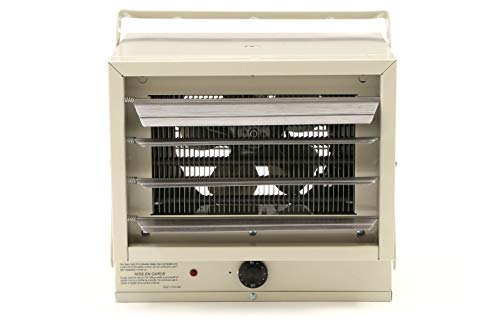
The FUH54 takes a different approach to sizing: its output is selected at installation, adjustable between 2,500 and 5,000 watts on a 240 volt supply, so the same model can be set conservatively for a tight, insulated garage or at full output for a larger one. It mounts to the ceiling with a built-in bracket, has a built-in thermostat, and shuts down automatically on overheating. This is a long-running industrial-style design with no remote or digital display, aimed at owners who want a fixed heater configured once by the installer and then largely forgotten.
Specs
- Power: 2,500 to 5,000 watts, adjustable at installation, 240 volts
- Heat output: up to 17,065 BTU
- Mounting: ceiling mount with built-in bracket, wall mounting also supported
- Controls: built-in thermostat
- Safety: automatic shutdown on overheating
- Connection: hardwired, no plug
Best for: Owners who want output matched to their exact garage during a one-time install
Watch out for: The wattage is set by the wiring configuration during installation, so decide the output with your electrician before the job is finished
ASIN: B0000AXEZV
Comfort Zone CZ798 Milkhouse Utility Heater

Not every garage problem needs a new circuit. This 1,500 watt milkhouse-style heater plugs into a standard 120 volt outlet and is built for targeted warmth: beside a workbench, inside a small insulated one-car garage, or in an outbuilding corner where you stand in one place. The listing gives coverage of 300 square feet, an adjustable rotary thermostat and two heat settings plus a fan mode. It also carries the safety pairing that matters in a portable unit: overheat protection and a tip-over switch that cuts power if it gets knocked over.
Specs
- Power: 1,500 watts, 120 volts, 12.5 amps
- Heat output: 5,120 BTU
- Heating coverage: 300 sq. ft.
- Controls: adjustable rotary thermostat, low and high heat settings, fan mode
- Plug: 3-prong plug, corded
- Safety: overheat protection, tip-over switch
Best for: Spot heat at a bench or in a small, insulated single bay with no spare panel capacity
Watch out for: At 12.5 amps it takes most of a household circuit, so avoid sharing the outlet with large power tools, and do not expect it to heat a whole uninsulated two-car garage
ASIN: B08174Q7KY
Which One Fits Your Situation
Your Two-Car Garage Doubles as a Daily Workshop
Pick the Comfort Zone CZ230ERBK. Its 7,500 watts and listed 1,250 square foot coverage match the space, and the remote plus 12-hour timer fit a routine: warm the garage before the first job, let it switch off afterwards. The hardwired ceiling install is a one-time project that keeps every bay usable.
You Are Adding One 240 Volt Circuit to a One-Car Garage
Choose between the CZ220 and the Fahrenheat FUH54. Both are hardwired ceiling units at the 5,000 watt level, right for a single bay. Take the CZ220 for straightforward knob control and adjustable louvers; take the FUH54 if your electrician would rather set the output between 2,500 and 5,000 watts during installation to match your insulation exactly.
Your Garage Already Has a Welder-Style 240 Volt Outlet
The Dr. Infrared DR-988 was made for this situation. It plugs straight into a NEMA 6-30 receptacle and delivers 5,600 watts with no electrician visit and no permanent mounting. Its wide thermostat range also makes it the natural freeze-protection pick, holding the garage just above freezing for stored liquids and plumbing, then turning up properly when you want to work out there.
You Only Need One Cold Corner Warmed
Use the Comfort Zone CZ798 milkhouse heater. A full circuit upgrade makes no sense for warming your hands at a bench, and this 1,500 watt plug-in unit covers a listed 300 square feet around where you stand. Its tip-over switch suits a crowded corner, and in summer it moves to a shelf instead of hanging over the garage all year.
Common Mistakes
- Ordering a 240 volt heater before checking panel capacity, then discovering the installation quote dwarfs the heater itself.
- Sizing by floor area alone and ignoring insulation, ceiling height and a leaky overhead door, which together decide how much heat escapes.
- Assuming a plug-in 240 volt heater fits a normal outlet, or adapting plugs and using extension cords to make it fit.
- Mounting a ceiling heater too close to stored fuel, paint, cardboard or curtains instead of keeping the clearance its listing states.
- Expecting a 1,500 watt portable to raise a whole uninsulated two-car garage to working temperature in deep winter.
Frequently Asked Questions
Do I need an electrician to install an electric garage heater?
For hardwired models, yes. Ceiling units like the Comfort Zone CZ220 and CZ230ERBK and the Fahrenheat FUH54 connect directly to a dedicated circuit with no plug, so breaker sizing and wiring belong to a licensed electrician. Plug-in models are different: the DR-988 needs only a matching 240 volt receptacle, and the milkhouse heater uses a standard outlet.
How many watts does a two-car garage actually need?
It depends on insulation more than on the floor plan. In this guide the 7,500 watt CZ230ERBK lists coverage up to 1,250 square feet, spanning a typical two-car footprint in an insulated garage. The same space with bare walls and an uninsulated door loses heat fast enough that even a large unit runs constantly, so insulating first often beats buying more watts.
Can I plug a 240 volt garage heater into my dryer outlet?
Only if the plug, receptacle and circuit all match what the heater’s listing specifies. The DR-988 uses a NEMA 6-30P plug for a 30 amp 240 volt receptacle; many dryer outlets use a different receptacle pattern and may be shared with laundry loads. If the patterns differ, the answer is no: have the correct receptacle installed instead of using adapters.
Will an electric heater keep an uninsulated garage warm?
It will take the edge off, but expectations need adjusting. Electric heat output is fixed by wattage, and an uninsulated garage sheds that heat through the door and walls continuously. A 5,000 to 7,500 watt unit can make an uninsulated two-car garage workable in layers for short jobs, yet holding it at room temperature all day is a job for insulation first and wattage second.
FAQ
Do I need an electrician to install an electric garage heater?
How many watts does a two-car garage actually need?
Can I plug a 240 volt garage heater into my dryer outlet?
Will an electric heater keep an uninsulated garage warm?
More from Amazon
Programs that pair well with the guide above. Offers and eligibility are set by Amazon and may change.
Free shipping on eligible items, Prime Video and more. Eligible new members can start with a free trial.
Start a Prime free trialA Prime membership for ages 18-24 with a trial period. Eligibility is set by Amazon.
See Prime for Young AdultsAudiobooks and podcasts to listen to on the go. Eligible new members can start with a free trial.
Try Audible freeAd-free music streaming. Eligible new subscribers can start with a free trial.
Try Music Unlimited freeAs an Amazon Associate we earn from qualifying purchases.