Key takeaways
- Find the best DIY electronics starter kit for your first build: compare five beginner kits by board, parts, tutorials, soldering needs and age guidance.
Buying a DIY electronics starter kit is really a decision about what you want to build first. A kit built around a microcontroller board, a breadboard and a set of sensors suits someone who wants to learn coding and circuits together, while a kit with more motors and displays suits a builder who wants moving projects right away. The parts list, the tools in the box and the quality of the guide matter far more than the size of the box, because a kit that does not match your first project will sit unused.
This guide is for complete beginners, students, parents buying for a teenager, and hobbyists returning to electronics after a long break. Every kit below was chosen from the names and specifications shown on its Amazon product page, with the board type, included components, tutorial format and solderless setup checked against the listing before it was included.
Quick Picks
As an Amazon Associate we earn from qualifying purchases
| Product | Best for | Key spec from title |
|---|---|---|
| ELEGOO UNO R3 Project Super Starter Kit | First-time builders learning circuits and code | UNO R3 board with LCD1602 module |
| ELEGOO UNO R3 Project Most Complete Starter Kit | Builders who want the widest parts collection | 200+ components across 63 types |
| Official Arduino Starter Kit K000007 | Learners who want a printed project book | Original Arduino Uno R3 with English projects book |
| Arduino Starter Kit R4 K000007_R4 | Beginners interested in Wi-Fi and connected projects | UNO R4 WiFi board with 13 guided projects |
| SunFounder Project Complete Starter Kit | Self-paced learners who like online video lessons | 250+ components with 42 online tutorials |
How to Choose
Check what components and tools are included
Open the component list before you buy anything, and compare it with the projects you actually want to try. A useful starter kit includes a microcontroller board, a solderless breadboard, jumper wires, LEDs, resistors, buttons and at least one sensor, such as an ultrasonic distance sensor or a temperature and humidity module. Kits that add a servo motor, a stepper motor, an LCD display and a remote control open up far more project ideas than a box of resistors alone. Also look for a USB cable, a power supply module and a storage case, because buying those separately adds hassle. If the listing hides the full parts list, treat that as a warning sign.
Judge the quality of the guide and tutorials
A good guide turns a box of parts into a learning path, and a weak one leaves you guessing at wiring diagrams. Look for step-by-step lessons that explain what each component does, show a clear wiring diagram, and provide working example code you can load and modify. Printed project books work well for readers who like to follow along away from a screen, while online tutorials suit learners who prefer video and searchable text. Check how many projects the guide covers and whether it starts with simple LED circuits before moving to sensors, motors and displays. A kit with a clear progression from easy to advanced keeps a beginner motivated far longer than a random pile of parts.
Decide between solderless and soldering kits
Most beginners should start with a solderless kit, where components plug into a breadboard and modules arrive pre-soldered. Solderless building lets you assemble, test, change and rebuild a circuit in minutes, and it avoids burns, fumes and damaged parts while you are still learning. Soldering kits suit builders who already know basic circuit safety and want permanent, compact projects, such as a finished gadget in a small enclosure. If a kit mentions soldering anywhere in its description, check whether a soldering iron is included or must be bought separately, and whether the guide explains safe technique. For a first kit, solderless is the safer and more forgiving choice.
Match the kit to age and skill level
Age guidance and skill level shape which kit will actually get used. Kits aimed at younger learners should have chunky, pre-soldered modules, large-print or video instructions, and projects that produce a visible result quickly, like a blinking light or a moving servo arm. Teenagers and adults with some coding experience can handle kits with more components, denser wiring and projects that combine several sensors at once. If you are buying for a classroom or a family, check whether the tutorial supports the coding language the learners already know, and whether spare parts such as extra LEDs and resistors are easy to replace. A kit pitched slightly below the builder’s ability beats one that overwhelms them on day one.
The 5 Best Options
ELEGOO UNO R3 Project Super Starter Kit

This is the classic first kit for someone who wants to learn Arduino-style electronics without spending a fortune on parts they may never use. The UNO R3 board sits at the centre of every project, and the included LCD1602 display, servo motor, stepper motor, joystick module and ultrasonic sensor give a beginner enough variety to build lights, alarms, simple robots and measuring gadgets. The tutorial walks through the basics in a sensible order, and the solderless breadboard means every circuit can be pulled apart and rebuilt. It suits a patient beginner who wants a broad introduction rather than one narrow project.
Specs
- Board: ELEGOO UNO R3 controller board, compatible with Arduino IDE
- Model number: EL-KIT-003
- Display: LCD1602 module with pin header
- Motors: SG90 servo motor and stepper motor with ULN2003 driver board
- Sensors: Ultrasonic sensor and DHT11 temperature and humidity module
- Wiring: 65 jumper wires, breadboard and breadboard power supply module
- Dimensions: 8.3 x 5.5 x 1.97 inches; item weight 1.2 pounds
Best for: A complete beginner who wants a broad, well-guided introduction to circuits and coding.
Watch out for: The power supply module warns against using a voltage higher than 9V, so check the power source before every build.
ELEGOO UNO R3 Project Most Complete Starter Kit

Builders who already know they enjoy electronics will get more from this larger kit, which packs in far more parts than the Super Starter Kit. The headline draw is the sheer range: more than 200 components across 63 types, including an RC522 RFID module, a real-time clock module, a PIR motion sensor and a keypad, so projects can grow from blinking LEDs into access control, clocks and motion alarms. The included tutorial covers 33 projects, giving a clear path from the first circuit to genuinely useful gadgets. It is a strong choice for a learner who wants one box to last through months of experimenting.
Specs
- Board: ELEGOO UNO R3 controller board, compatible with Arduino IDE
- Model number: EL-KIT-001
- Components: 200+ components across 63 types
- Modules: RC522 RFID module, RTC module, HC-SR501 PIR motion sensor and keypad module
- Display: LCD1602 module and MAX7219 dot matrix module
- Tutorial: 33 projects with PDF tutorial and example code
- Power: 9V 1A power supply, 9V battery with DC connector and USB cable
Best for: A keen learner who wants the widest parts collection in a single box.
Watch out for: The larger parts count means more small pieces to organise, so keep the storage case sorted from the start.
Official Arduino Starter Kit K000007
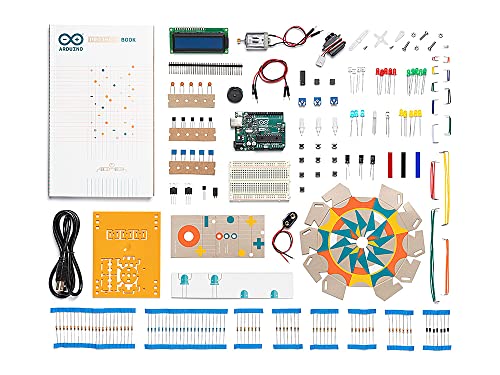
This is the kit Arduino itself designed for learning, and its main strength is the printed English projects book that guides you through 12 DIY projects. Unlike kits built around a clone board, it includes an original Arduino Uno R3, a wooden base, and a curated set of parts chosen to match the book, including a DC motor, a servo motor, a tilt sensor and a temperature sensor. The projects build understanding, from a spaceship interface panel to a love-o-meter, and the book explains the electronics ideas behind each one. It suits a learner who values a polished, book-led course over a bigger pile of parts.
Specs
- Board: Original Arduino Uno R3 board
- Model number: K000007
- Projects: 12 DIY projects with printed English projects book
- Components: DC motor, servo motor, tilt sensor, LEDs and temperature sensor
- Base: Easy-to-assemble wooden base for mounting projects
- Power: 5 volts; 9V battery snap included
- Dimensions: 6.3 x 9.06 x 1.77 inches; item weight 1.8 pounds
Best for: A learner who wants an official, book-led introduction with a genuine Arduino board.
Watch out for: The parts set is curated for the book projects, so you may need extra components for builds beyond the book.
Arduino Starter Kit R4 K000007_R4

The R4 edition updates the official kit for builders who want to explore connected projects, thanks to its UNO R4 WiFi board with Bluetooth and Wi-Fi. The kit includes 13 guided projects in a printed book, plus online resources, and it carries an official certification voucher for learners who want to prove their skills. The board offers 48 KB of memory storage, more headroom than the older Uno R3, which helps when projects combine sensors, displays and wireless features. It is a strong fit for a beginner who suspects that internet-connected gadgets are where they want to end up.
Specs
- Board: Arduino UNO R4 WiFi board
- Model number: K000007_R4
- Projects: 13 guided projects in a printed book with online resources
- Connectivity: Bluetooth and Wi-Fi, compatible with Arduino Cloud and Arduino IDE
- Memory storage capacity: 48 KB
- Extras: Official certification voucher included
- Operating system: Windows, macOS and Linux
Best for: A beginner who wants to build Wi-Fi and Bluetooth connected projects.
Watch out for: Some older Uno R3 tutorials and shields may not work unchanged on the R4 board, so check compatibility before following an old guide.
SunFounder Project Complete Starter Kit

SunFounder aims this kit at self-paced learners, and its strongest asset is the set of 42 detailed online tutorials that walk through each build with diagrams and code. The box holds more than 250 components, including a 1602 LCD, motors and ultrasonic modules, all built around a development board compatible with Arduino UNO R3. Because the lessons live online, they can be updated and searched easily, and the kit works with Arduino IDE and Scratch coding, which makes it a friendly option for younger learners and classrooms. It is a solid middle ground between the compact ELEGOO Super kit and the much larger parts collections.
Specs
- Board: Development board compatible with Arduino UNO R3
- Components: 250+ components for learning electronics and programming
- Display: 1602 LCD module
- Modules: Motors, ultrasonic modules and infrared receiver
- Tutorials: 42 detailed online tutorials with example code
- Compatibility: Arduino UNO R3, Arduino IDE and Scratch coding
- Warranty: 1 year guarantee; item weight 21.76 ounces
Best for: A self-paced learner who prefers online tutorials and Scratch-friendly coding.
Watch out for: The tutorials are online only, so you will need internet access while you work through the lessons.
Which One Fits Your Situation
A complete beginner buying a first kit
Start with the ELEGOO Super Starter Kit, because it covers the core skills with a manageable parts list and a clear tutorial. The UNO R3 board, breadboard, LCD and sensors support dozens of first projects without overwhelming a newcomer, and the solderless setup means mistakes cost minutes rather than burnt components. It is the easiest kit here to open, follow and finish.
A learner who wants the most parts for the longest runway
Choose the ELEGOO Most Complete Starter Kit, which holds more than 200 components across 63 types, including RFID, a real-time clock and a motion sensor. That range supports months of new projects after the basics are done, and the 33-project tutorial gives each new module a purpose. It is the best fit when one box needs to last.
A parent or teacher who wants a structured course
Pick the Official Arduino Starter Kit, because its printed projects book turns learning into a proper course with a beginning, middle and end. The original Arduino board and the curated parts match the book exactly, so there is no guessing about which component a lesson needs. For a classroom or a gift, that structure matters more than raw parts count.
A builder curious about smart and connected gadgets
Go with the Arduino Starter Kit R4, whose UNO R4 WiFi board adds Bluetooth and Wi-Fi to the classic starter kit formula. Its 13 guided projects introduce connected ideas early, and the larger memory gives room for projects that mix sensors, displays and wireless features. If smart-home gadgets are the goal, this is the kit that points in that direction.
Common Mistakes
- Buying the biggest kit first: a huge parts box can overwhelm a beginner, so match the kit to your first few projects instead of chasing the highest component count.
- Skipping the tutorial: jumping straight to a complex build without working through the early lessons leads to wiring errors that are hard to trace.
- Ignoring the power limits: using the wrong voltage or the wrong power supply can damage a board, so read the power notes for each module before connecting it.
- Choosing a kit that needs soldering: beginners who pick a soldering kit without tools or experience often stall on the first project, so start solderless unless you already know how to solder.
- Forgetting spare parts: LEDs, resistors and jumper wires wear out or get lost, so keep spares on hand rather than stopping a project halfway through.
Frequently Asked Questions
Do I need any soldering experience to start with these kits?
No, every kit in this guide is built around solderless breadboards and pre-soldered modules, so you can assemble circuits by pushing wires and components into place. Soldering only becomes useful later, when you want to make a finished project permanent or fit it into a small enclosure.
What is the difference between the UNO R3 and the UNO R4 WiFi board?
The UNO R3 is the classic beginner board with a long history of tutorials, example code and compatible shields. The UNO R4 WiFi adds built-in Bluetooth and Wi-Fi plus more memory, which suits connected projects, though some older R3 guides may need small adjustments to run on it.
Can a child use a DIY electronics starter kit alone?
It depends on the child’s age and experience, so check the kit’s guidance and supervise the first builds. Younger learners do best with a kit that has video or picture-led lessons, pre-soldered modules and quick visible results, plus an adult nearby to help with wiring and power.
How long does it take to finish a first project?
A simple first project, such as a blinking LED or a buzzer circuit, usually takes under an hour once the parts are laid out. Longer builds with sensors, motors and displays can take an evening, especially if you are reading the tutorial carefully and learning the code as you go.
FAQ
Do I need any soldering experience to start with these kits?
What is the difference between the UNO R3 and the UNO R4 WiFi board?
Can a child use a DIY electronics starter kit alone?
How long does it take to finish a first project?
More from Amazon
Programs that pair well with the guide above. Offers and eligibility are set by Amazon and may change.
Free shipping on eligible items, Prime Video and more. Eligible new members can start with a free trial.
Start a Prime free trialA Prime membership for ages 18-24 with a trial period. Eligibility is set by Amazon.
See Prime for Young AdultsAudiobooks and podcasts to listen to on the go. Eligible new members can start with a free trial.
Try Audible freeAd-free music streaming. Eligible new subscribers can start with a free trial.
Try Music Unlimited freeAs an Amazon Associate we earn from qualifying purchases.