Key takeaways
- Usable width: the counter space between walls, cabinets, or appliances.
- Usable depth: the distance from the backsplash to the front edge, including room for the cord.
- Overhead clearance: the gap from the counter to the underside of a cabinet or shelf.
- Door and tray clearance: the space required to open the door and pull out a hot rack without striking a wall or handle.
Best Convection Toaster Ovens for Small Kitchens
The best convection toaster oven for a small kitchen is the Panasonic FlashXpress if you need the smallest practical footprint, the Breville Mini Smart Oven if you want better all-around cooking control, and the Cuisinart TOA-28 if air frying is a priority and you can accept a taller appliance.
Small countertop ovens are not interchangeable. A model can occupy little counter space but still require substantial clearance above its roof, while a wider oven may be easier to live with because its door, controls, and crumb tray are more accessible. The right choice depends on the food you cook, the size of your counter, and whether the oven will be used occasionally or several times a day.
Our top picks


As an Amazon Associate we earn from qualifying purchases at no extra cost to you. Ratings are shown as listed on Amazon.
Quick comparison: footprint, capacity, and functions
| Model | Approx. exterior size | Approx. weight | Interior or cooking capacity | Convection or air-fry function | Best fit |
|---|---|---|---|---|---|
| Panasonic FlashXpress NB-G110P | 13 x 12 x 10.25 in. | About 7.5 lb | Small; commonly sized for a 9-inch pizza or four toast slices | Infrared quartz heating; not a conventional fan convection oven | Very tight counters and fast reheating |
| Breville Mini Smart Oven | 16.5 x 13.5 x 8.5 in. | About 13 lb | Up to an 11-inch pizza; four toast slices | Element IQ with convection | Small kitchens needing versatile baking and roasting |
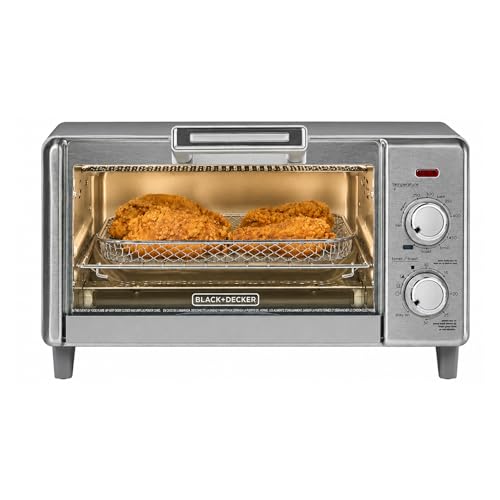
| Cuisinart TOA-28 Compact AirFryer Toaster Oven | About 12.5 x 15.5 x 11.5 in. | About 11 lb | Up to a 9-inch pizza; compact air-fry basket | Air fry, bake, broil, toast, warm, and convection | Air-fried food in limited width |
| Ninja Foodi 8-in-1 Digital Air Fry Oven SP101 | About 19.7 x 15.1 x 7.5 in. when closed | About 19.7 lb | Up to a 13-inch pizza; sheet-pan cooking | Powerful convection air frying and multiple cooking modes | Low vertical clearance with generous counter depth |
Dimensions vary slightly by trim, handle position, and whether the manufacturer measures with the door closed. Measure the usable counter area, not just the appliance footprint. Also account for the power cord and the space needed to remove the cooking tray.
Best for the smallest counter: Panasonic FlashXpress
The Panasonic FlashXpress NB-G110P is the easiest model to fit in a genuinely cramped kitchen. Its roughly 13-by-12-inch footprint is smaller than that of most convection and air-fryer toaster ovens, and its compact interior heats quickly for toast, frozen snacks, small portions of vegetables, and reheating.
Its main limitation is the feature set. The FlashXpress uses infrared quartz heating rather than a traditional fan-driven convection system, so it is not the best option if your buying decision specifically depends on even fan circulation for cookies, roasted vegetables, or multi-rack cooking. Its interior is also too small for many family-size portions.
Choose it when counter width and depth are the overriding constraints, or when you mainly want to replace a pop-up toaster and reduce microwave reheating. Leave space around the sides and back according to the manual, and do not push it directly beneath a low cabinet during high-heat operation.
Best all-purpose compact oven: Breville Mini Smart Oven
The Breville Mini Smart Oven is the strongest choice for cooks who want a true small oven rather than an oversized toaster. It is wide enough for an 11-inch pizza and offers bake, broil, toast, roast, reheat, and convection settings. Its Element IQ controls adjust power between the heating elements, which is more useful for small batches than simply adding a fan to a basic toaster oven.
The oven is approximately 16.5 inches wide and 13.5 inches deep, so it needs more counter area than the Panasonic. Its relatively low height can help under some cabinets, but the top still becomes hot and requires the manufacturer’s specified ventilation clearance. The front door and handle also extend beyond the nominal body depth when opened.
This is the best match for someone who regularly cooks one or two portions: a small casserole, four slices of toast, a tray of vegetables, a chicken breast, or an 11-inch frozen pizza. It costs more than basic compact ovens—typically falling in the mid-to-upper general market range—but the broader cooking controls make it more useful as a primary countertop oven.
Best compact air fryer: Cuisinart TOA-28
The Cuisinart TOA-28 is a good choice when crisping food matters more than maximum baking capacity. Its air-fry basket and convection fan circulate hot air around foods such as potatoes, wings, fish fillets, and frozen snacks. It also handles toast, broiling, baking, warming, and reheating.
Its footprint is relatively narrow but tall and deep for its capacity. That combination suits a narrow counter with available overhead space, but it can be awkward beneath low cabinets. The compact basket also means air frying is usually a batch process. Overfilling the basket reduces airflow and can produce food that is browned on top but soft underneath.
Compared with a full-size air-fryer toaster oven, the TOA-28 uses less counter width and is easier to heat for one or two servings. Compared with the Panasonic, it offers more cooking modes but occupies more vertical space and generally needs more attention during cleaning because oil collects on the basket and oven walls.
Best for a shallow counter or low overhead clearance: Ninja Foodi SP101
The Ninja Foodi 8-in-1 Digital Air Fry Oven SP101 has an unusual flip-up design. When it is not in use, it can be tilted upward to save counter depth, making it useful where front-to-back space is the problem. Its closed height is low, and it accommodates larger food than the Panasonic or Breville Mini, including a 13-inch pizza and sheet-pan meals.
The trade-off is weight and operating space. At roughly 20 pounds, it is not an appliance most people will want to move repeatedly. When laid flat, it needs substantial depth, and when flipped up it requires a suitable wall or backsplash area. The door and crumb tray design also require careful attention to where crumbs and grease will go.
Pick the SP101 when you have a shallow counter and regularly cook larger portions. Avoid it if your kitchen has a narrow walkway directly in front of the counter or if you need an appliance that can be stored in a cabinet after every use.
Decision matrix for tight kitchen layouts
| Your situation | Most suitable choice | Why | What to compromise on |
|---|---|---|---|
| Less than 13 inches of usable counter depth | Panasonic FlashXpress | Small footprint and quick everyday heating | No conventional convection and limited capacity |
| One or two people, frequent baking and reheating | Breville Mini Smart Oven | Better temperature and element control with a useful 11-inch pizza capacity | Higher price and wider footprint |
| Frequent air frying for one or two servings | Cuisinart TOA-28 | Compact air-fry basket and several cooking modes | Small batches and more grease cleanup |
| Shallow counter but larger meal portions | Ninja Foodi SP101 | Flip-up storage and 13-inch pizza capacity | Heavy, expensive, and demanding to reposition |
| Occasional use on a strict budget | Basic compact toaster oven with convection | Lower purchase cost and adequate toast, bake, and reheat functions | Less precise controls, weaker insulation, and fewer durable parts |
How much clearance do you really need?
Start with the manufacturer’s clearance instructions, which take priority over any general rule. As a planning estimate, reserve at least 2 to 4 inches at the sides and rear of a compact toaster oven, plus a larger open area above it. Some models specify more clearance when placed under cabinets, and air-fry operation can release considerable heat and steam.
Measure these four distances before buying:
- Usable width: the counter space between walls, cabinets, or appliances.
- Usable depth: the distance from the backsplash to the front edge, including room for the cord.
- Overhead clearance: the gap from the counter to the underside of a cabinet or shelf.
- Door and tray clearance: the space required to open the door and pull out a hot rack without striking a wall or handle.
For example, a 16.5-inch-wide oven in a 20-inch opening leaves only 1.75 inches per side. That may satisfy a particular manual, but it leaves little room to wipe the sides or safely handle a hot tray. A 13-inch oven in the same opening leaves 3.5 inches per side and is easier to live with, even if its interior is smaller.
Ownership realities in a small kitchen
The first parts to show wear are usually the crumb tray, door gasket or hinge area, nonstick air-fry basket, and control markings—not the heating elements. Foil can block airflow, touch heating elements, and interfere with temperature regulation, so use it only where the manual permits. Do not cover the entire crumb tray or line an air-fry basket so tightly that air cannot circulate.
Clean loose crumbs after every few uses and remove greasy residue before it bakes onto the interior. Let the oven cool fully, unplug it, and use a damp cloth rather than spraying cleaner into the controls or heating elements. Air-fry baskets often need soaking, but abrasive pads can damage their coating. A dirty oven may also smoke during high-heat cooking, which is often mistaken for a product defect.
Small convection ovens cook faster than a conventional full-size oven because the cavity is smaller and the fan improves heat transfer. Begin checking food several minutes earlier than the package instructions suggest, and avoid crowding the rack. If you cook two dishes at once, rotate them only when the recipe allows; opening the door repeatedly wastes heat and extends cooking time.
Final recommendation
Buy the Panasonic FlashXpress for the smallest footprint, the Breville Mini Smart Oven for the best balance of size and everyday versatility, the Cuisinart TOA-28 for compact air frying, and the Ninja Foodi SP101 when shallow counter depth and larger cooking capacity matter most. The correct choice is not the oven with the most functions—it is the one that fits with its required ventilation space and can remain accessible enough that you will use it regularly.