Key takeaways
- Clean after each production day: Drain the bath, wipe food residue from the housing, and follow the manufacturer’s descaling procedure.
- Control mineral buildup: Hard-water scale can coat the heater and pump, slowing heating and reducing circulation. Use a manufacturer-approved descaling solution at the recommended frequency.
- Inspect the clamp and seals: Clamps, silicone seals, pump covers, and display buttons usually wear before the heating element. Keep replacement parts available if the unit is operationally critical.
- Use a lid or insulation: A fitted lid lowers evaporation, protects the electrical head from steam, and reduces energy loss during long cooks.
- Do not run dry: Low-water protection is valuable, but it should not be treated as permission to operate below the minimum level.
- Verify temperature periodically: A calibrated reference thermometer can identify sensor drift before it affects a full production batch.
Best Commercial Grade Sous Vide Cirators
The best commercial grade sous vide circulator for most high-volume kitchens is the Sammic SmartVide 9 Plus, while the PolyScience HydroPro Plus is the better choice when temperature control, monitoring, and long unattended cycles matter more than maximum water volume.
Commercial kitchens should not choose by wattage alone. The useful questions are how quickly the unit recovers after loading cold food, how much water it can reliably move and heat, how tightly it holds temperature, and whether its pump, electronics, and housing are suited to repeated daily operation.
Our top picks

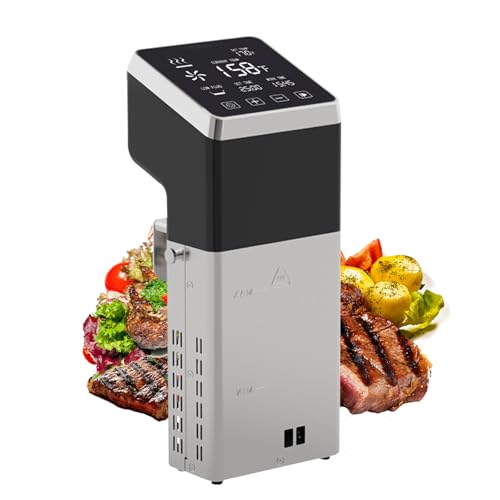


As an Amazon Associate we earn from qualifying purchases at no extra cost to you. Ratings are shown as listed on Amazon.
Commercial Sous Vide Circulators Compared
| Model | Rated heating power | Typical stated capacity | Temperature range | Construction and notable features | Best suited to |
|---|---|---|---|---|---|
| Sammic SmartVide 9 Plus | 2,000 W | Up to approximately 56 L | 5–95°C / 41–203°F | Stainless-steel commercial construction, circulation pump, programmable controls | Busy restaurants and catering operations needing high throughput |
| PolyScience HydroPro Plus | 1,450 W | Up to approximately 45 L, depending on container shape and load | 0–95°C / 32–203°F | Stainless-steel probe and housing elements, touchscreen controls, alarms, HACCP-oriented monitoring features | Precision-focused professional kitchens and production kitchens |
| PolyScience HydroPro | 1,450 W | Up to approximately 45 L | 0–95°C / 32–203°F | Commercial clamp, active circulation, digital temperature control | Restaurants wanting a durable professional unit without the Plus model’s added monitoring functions |
| Anova Precision Cooker Pro | 1,200 W | Up to approximately 100 L in suitable conditions | 0–92°C / 32–197.6°F | Powerful clamp-style circulator, stainless-steel components, app-enabled controls on supported versions | Small commercial kitchens and lower-volume batch work |
| Waring WSV16 | 1,500 W | Approximately 16 L | Up to about 95°C / 203°F | Compact professional circulator with digital controls and stainless-steel cooking components | Limited-counter-space operations and modest batch sizes |
Capacity figures are operating guidelines rather than promises for every load. A tightly packed container, an uncovered bath, cold food, or a low ambient temperature can reduce practical performance. Always confirm the current regional specification sheet before purchasing, particularly for electrical connection, Wi-Fi functions, and container-volume limits.
Head-to-Head: Which Circulator Fits Your Kitchen?
Best for maximum heating power: Sammic SmartVide 9 Plus
The SmartVide 9 Plus has the strongest heating specification in this group at 2,000 W. That matters when a kitchen loads a large bath with refrigerated bags or needs to recover temperature between production batches. Its larger working capacity also makes it a stronger fit for banquet prep, hotels, central kitchens, and restaurants cooking many portions at once.
The trade-off is physical size. A 56-liter bath occupies substantial counter or rack space and requires enough electrical capacity to support a 2,000 W appliance. It is excessive for a kitchen that normally cooks only a few steaks, portions of fish, or small batches of vegetables.
Best for temperature monitoring and process control: PolyScience HydroPro Plus
The HydroPro Plus is the more compelling choice when repeatability and documentation are central requirements. Its professional controls and monitoring-oriented features are useful for kitchens that need clear alarms, programmed steps, or a more structured cooking record rather than a simple target-temperature display.
Its 1,450 W heater is not the most powerful here, so it may recover more slowly than the Sammic in a large, heavily loaded bath. In return, the HydroPro Plus is easier to justify for delicate, long-duration cooking where stable control and staff consistency matter more than raw throughput.
Best lower-cost professional option: PolyScience HydroPro
The standard HydroPro provides the core commercial requirements: a robust clamp, active water circulation, and precise digital temperature control. It is a sensible middle ground for a restaurant that operates sous vide daily but does not need the Plus model’s additional monitoring and workflow features.
For many kitchens, the money saved is better spent on a covered polycarbonate container, rack, vacuum sealer, and spare gaskets. Those accessories often affect real-world output more than a small difference in circulator features.
Best for smaller spaces: Waring WSV16
The Waring WSV16 is designed around a smaller bath of roughly 16 liters. That makes it easier to place near a prep station and simpler to drain, clean, and store. It is a practical choice for a small restaurant, culinary school, tasting menu operation, or bar program using sous vide for ingredients rather than full production.
The limitation is obvious: a small bath has less thermal reserve and less room for bags to circulate freely. Overloading it can create cold spots, restrict flow, and extend recovery time even when the heater itself is adequate.
Heating Power Is Not the Same as Throughput
A useful approximation for heating water is:
Energy required in watt-hours = water mass in kilograms × temperature rise in °C × 1.163.
For example, heating 40 liters of water from 10°C to 60°C requires approximately:
40 × 50 × 1.163 = 2,326 watt-hours.
In ideal conditions, a 2,000 W circulator would need about 70 minutes. A 1,450 W unit would need about 97 minutes. Real times will be longer because of heat loss through the container, evaporation, the food load, and the lid design.
This calculation explains why a higher-wattage unit is valuable for opening a large bath quickly. It does not mean the higher-wattage model cooks food better once the target temperature has stabilized. Insulation and a properly fitted lid can reduce heat loss enough to offset a meaningful portion of the wattage difference.
Decision Matrix
| Your situation | Recommended type | Why | What to avoid |
|---|---|---|---|
| Daily batches above 30 L | 2,000 W commercial circulator | Faster recovery and better cold-load handling | Compact 16 L units used at their limit |
| Long cooks with strict process records | PolyScience HydroPro Plus or equivalent monitored model | Alarms and workflow controls reduce staff variation | Consumer units with limited alert and logging functions |
| Under 15–20 L per batch | Compact professional circulator | Lower space, water, and cleaning requirements | Oversized units that consume unnecessary counter space |
| Several batches every day | Stainless commercial model with replaceable service parts | Better suited to repeated heating, cooling, and sanitation | Units with inaccessible pumps or proprietary parts unavailable locally |
| Occasional catering or menu trials | Professional 1,200–1,500 W model | Adequate power without paying for maximum capacity | Buying based only on the largest advertised bath volume |
Water Capacity and Bag Loading
Do not fill a bath to its maximum stated volume and then pack it tightly with bags. Food displaces water, bags can block the intake, and restricted circulation can produce uneven temperatures. Leave enough space for water to move around every bag and keep the pump inlet clear.
As a practical starting point, a 40–50 liter container may be loaded with roughly 25–35 liters of water once bag displacement and safe operating space are considered. Use a rack to separate bags vertically, especially when cooking multiple portions of meat or fish. A rack improves circulation and makes it easier to identify bags during service.
Duty Cycle, Cleaning, and Ownership Costs
Commercial duty suitability is about repeated operation, not merely a large wattage number. A kitchen running two eight-hour shifts should prioritize a model with a strong clamp, protected controls, accessible circulation components, and documented service support.
- Clean after each production day: Drain the bath, wipe food residue from the housing, and follow the manufacturer’s descaling procedure.
- Control mineral buildup: Hard-water scale can coat the heater and pump, slowing heating and reducing circulation. Use a manufacturer-approved descaling solution at the recommended frequency.
- Inspect the clamp and seals: Clamps, silicone seals, pump covers, and display buttons usually wear before the heating element. Keep replacement parts available if the unit is operationally critical.
- Use a lid or insulation: A fitted lid lowers evaporation, protects the electrical head from steam, and reduces energy loss during long cooks.
- Do not run dry: Low-water protection is valuable, but it should not be treated as permission to operate below the minimum level.
- Verify temperature periodically: A calibrated reference thermometer can identify sensor drift before it affects a full production batch.
For a high-volume operation, the cheapest ownership strategy is often one correctly sized primary circulator plus a backup unit, rather than pushing one machine continuously beyond its practical bath capacity. The best commercial grade sous vide circulators are the ones that maintain circulation, recover predictably, and remain serviceable throughout the kitchen’s actual schedule—not simply the ones with the biggest number on the specification label.