Our Short List of 3

- Best for: Drivers who want front and rear coverage and a memory card included in the box.
- Front recording 3840x2160P, rear recording 1920x1080P
- Sony STARVIS 2 IMX675 sensor for the front camera
- 3 inch IPS screen
- Built-in GPS
- Best for: Rideshare drivers and families who want cabin footage as well as front and rear views.
- Three channels: front, inside, and rear
- 1440P plus 1440P plus 1080P triple recording described in the listing title, with 4K plus 1080P dual options
- Infrared night vision for the cabin camera
- Built-in supercapacitor

- Best for: Commuters who want a single front camera with GPS and a screen for settings and playback.
- 2K recording, 2560x1440P Quad HD+ described in the listing
- Sony STARVIS IMX335 5MP sensor and F1.6 7G lens in listing material
- 140-degree wide angle
- GPS included
All 5 Picks at a Glance
| Product | Specs | Action |
|---|---|---|
| ROVE R2-4K DUAL Dash Cam |
| Check price on Amazon |
| Vantrue N4 3 Channel Dash Cam |
| Check price on Amazon |
| VIOFO A119 V3 Dash Cam |
| Check price on Amazon |
 REDTIGER F7N Touch Dash Cam |
| Check price on Amazon |
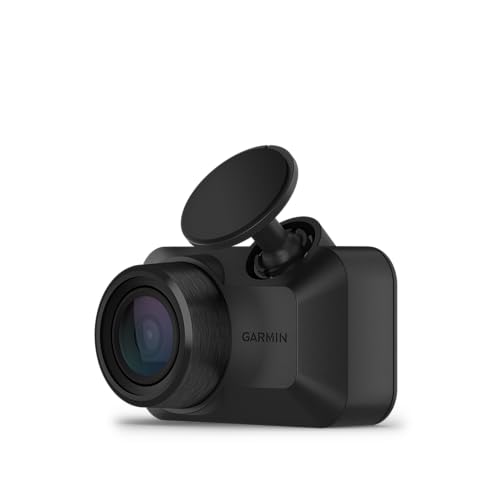 Garmin Dash Cam Mini 3 |
| Check price on Amazon |
Our Top Picks
 ROVE R2-4K DUAL Dash Cam Front and RearBus, Car, Minivan, SUV, TruckUSB, Wi-Fi1080p, 2160pCheck on Amazon
Pros & cons
- Sony STARVIS 2 sensor improves low-light footage
- Dual-band WiFi enables faster app downloads
- 128GB card and GPS tracking come included
- Full 24-hour parking mode needs a separate hardwire kit
- Setup involves mounting both front and rear cameras
Pros & cons
- Voice control allows hands-free operation while driving
- 128GB card is included so no extra purchase needed
- Touch screen and GPS add convenient on-device control
- Wired installation means routing cables through the cabin
- Relies on an SD card that needs periodic management


Cyber Monday is a busy moment to shop for a dash cam, because strong models from earlier seasons sit alongside newer dual and three-channel systems, and listings change quickly through the day. This roundup focuses on five dash cameras that cover different needs, from a tiny screen-free unit to a three-camera setup for rideshare work. That variety matters, because a driver who parks on the street overnight needs different coverage from someone recording long highway trips in changing light every day.
Prices change fast on Cyber Monday, and a listing that looked attractive in the morning may look very different by the evening. Verify the current price on Amazon for the exact model and bundle before ordering, check what is included in the box, and confirm the seller and return terms shown on that page.
Quick Picks
As an Amazon Associate we earn from qualifying purchases
| Product | Best for | Key spec from title |
|---|---|---|
| ROVE R2-4K DUAL Dash Cam | Front and rear coverage with a card included | 4K 2160P front and FHD rear, STARVIS 2 sensor |
| Vantrue N4 3 Channel Dash Cam | Rideshare and cabin coverage | 1440P plus 1440P plus 1080P front, inside and rear |
| VIOFO A119 V3 Dash Cam | Simple front-only recording with GPS | 2K Quad HD+, GPS included, buffered parking mode |
| REDTIGER F7N Touch Dash Cam | Touchscreen control and dual recording | 4K front and rear, 3.18 inch touch screen |
| Garmin Dash Cam Mini 3 | Discreet, screen-free mounting | 1080p HD, 140-degree field of view, voice control |
How to Choose
Check the Current Price Before You Commit
Deal hunting on Cyber Monday starts on the product page itself, not in a headline. Open the Amazon listing for the exact model, read the current price shown there, and compare it with the list price and any price history information shown on Amazon itself. Be cautious about inflated reference prices that make an ordinary figure look dramatic. Confirm the seller name, delivery estimate, and return terms on the same page, because bundles and sellers can change while a promotion is running, and the cheapest-looking option is not helpful if the box contents differ.
Decide How Many Channels You Actually Need
A single front camera records the road ahead and suits many commuters. A front and rear system adds coverage for tailgating incidents and parking knocks from behind, at the cost of routing a long cable to the back window. Three-channel models add a cabin camera, which matters for rideshare drivers, instructors, and anyone carrying passengers professionally. More channels mean more wiring, more footage to manage, and often lower resolution per channel when all cameras run together, so match the channel count to a real need rather than collecting lenses for their own sake.
Read Resolution Alongside Sensor and Lens
Resolution figures alone do not describe picture quality. Look for the sensor named in the listing, the lens aperture, and whether features such as HDR or WDR are stated, because those details affect how plates and signs read at night and in harsh sunlight. A wide field of view captures more of junctions and neighbouring lanes, although very wide angles can make distant objects appear smaller. Frame rate also matters for smooth motion. Treat headline resolution as a starting point, then check how the listing describes low-light recording and exposure handling.
Plan Storage, Power, and Parking Mode
Dash cams record in loops, overwriting older footage, so card capacity decides how much history remains before it disappears. Check the maximum card size the listing supports and whether a card is included. Parking mode usually needs a hardwire kit bought separately, and that kit should include low-voltage protection for the vehicle battery. Supercapacitors handle heat and cold differently from internal batteries and help a camera finish writing a file if power is cut. Confirm these details in the listing, because assuming a kit or card is included leads to a second order.
The 5 Best Options
ROVE R2-4K DUAL Dash Cam
- Best for: Drivers who want front and rear coverage and a memory card included in the box.
- Front recording 3840x2160P, rear recording 1920x1080P
- Sony STARVIS 2 IMX675 sensor for the front camera
- 3 inch IPS screen
- Built-in GPS
Drivers who want front and rear coverage and a memory card included in the box.
The front result described as 4K in the listing involves upscaling from the native capture described in listing material, so read that section carefully.
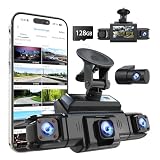
The ROVE R2-4K DUAL pairs a front camera recording at 4K with a rear camera recording in Full HD, giving drivers coverage at both ends of the car in one kit. Its front camera uses a Sony STARVIS 2 IMX675 sensor, built-in GPS logs speed and location, and dual-band Wi-Fi connects to the ROVE app for viewing and downloading clips. A 128GB card is included in the listing, which removes an immediate extra purchase. Parking mode is offered in several forms, although it requires a hardwire kit bought separately.
Vantrue N4 3 Channel Dash Cam
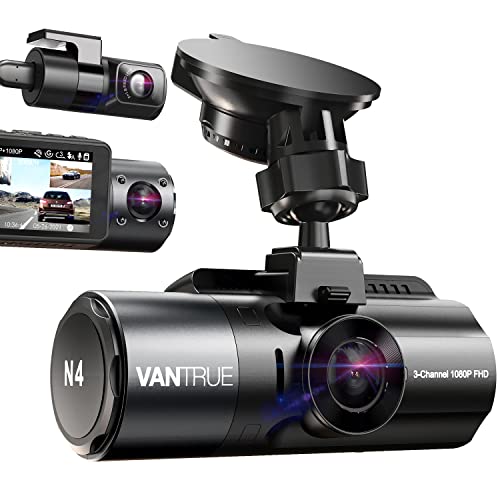
- Best for: Rideshare drivers and families who want cabin footage as well as front and rear views.
- Three channels: front, inside, and rear
- 1440P plus 1440P plus 1080P triple recording described in the listing title, with 4K plus 1080P dual options
- Infrared night vision for the cabin camera
- Built-in supercapacitor
Rideshare drivers and families who want cabin footage as well as front and rear views.
This original N4 listing does not present itself as a Wi-Fi app model, and GPS is an optional extra described separately in listing material.
The Vantrue N4 records three views at once: the road ahead, the cabin, and the road behind. With all three channels running, the listing describes 1440P front plus 1080P cabin plus 1080P rear recording, while dual-channel combinations allow other pairings including a 4K front option. The cabin camera uses infrared night vision, which helps after dark, and a built-in supercapacitor replaces a conventional battery. Parking monitoring runs around the clock when the camera is powered appropriately, and loop recording with a G-sensor protects clips after an impact.
VIOFO A119 V3 Dash Cam
- Best for: Commuters who want a single front camera with GPS and a screen for settings and playback.
- 2K recording, 2560x1440P Quad HD+ described in the listing
- Sony STARVIS IMX335 5MP sensor and F1.6 7G lens in listing material
- 140-degree wide angle
- GPS included
Commuters who want a single front camera with GPS and a screen for settings and playback.
There is no rear or cabin camera in this package, and parking mode through an ACC hardwire cable requires that cable bought separately.
The VIOFO A119 V3 takes a focused approach, with one front camera, a small screen, and an emphasis on clear daytime and night footage from a single lens. The listing describes Quad HD+ recording, a Sony STARVIS IMX335 5MP sensor, an F1.6 lens, True HDR, and a 140-degree wide angle view. GPS is included, so speed and location can be logged with the video. Buffered parking mode is listed, along with motion detection, a G-sensor, time lapse, and loop recording. For drivers who do not want a rear cable, this straightforward layout keeps installation simpler.
REDTIGER F7N Touch Dash Cam
- Best for: Drivers who prefer tapping a touchscreen over working through small buttons or a phone app.
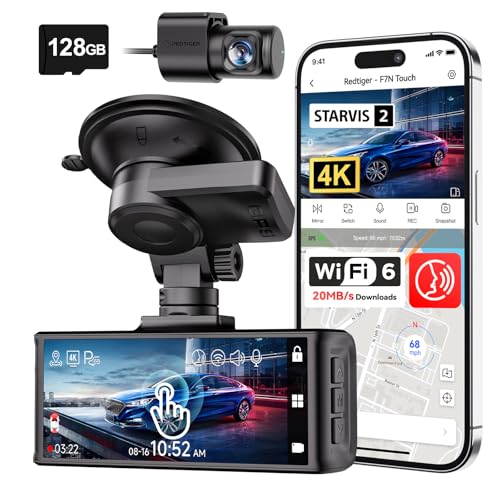
- Front 4K and rear 1080P dual recording
- STARVIS 2 sensor in the listing
- 3.18 inch touch screen
- Voice control
Drivers who prefer tapping a touchscreen over working through small buttons or a phone app.
The front view is described as a very wide 170 degrees in listing material, which can make distant detail appear smaller than on narrower lenses.
The REDTIGER F7N Touch combines 4K front recording with a 1080P rear camera and puts control on a 3.18 inch touch screen, which can make changing settings and reviewing clips on the device itself more straightforward. The listing names a STARVIS 2 sensor, voice control, built-in GPS, and Wi-Fi 6 with an app connection for transferring footage to a phone. A 128GB card is included, loop recording keeps the card cycling, and a G-sensor emergency lock function protects a clip after a sudden movement. Parking mode is listed for monitoring while the vehicle is stationary.
Garmin Dash Cam Mini 3
- Best for: Drivers who want a camera that sits quietly behind the mirror and stays out of sight.
- 1080p HD video capture resolution in the listing
- 140-degree field of view
- Built-in Clarity polarizer
- Voice control
Drivers who want a camera that sits quietly behind the mirror and stays out of sight.
There is no screen on the camera, so setup and clip review depend on a connected phone or computer.
The Garmin Dash Cam Mini 3 is built around discretion. The listing describes an ultracompact, key-sized camera with no prominent screen, a low-profile adhesive mount, and automatic recording that stores video of detected incidents with date and time. It records 1080p HD video through a wide 140-degree field of view and includes a built-in Clarity polarizer intended to reduce windshield glare. Voice control allows spoken commands, and connectivity listed includes Wi-Fi, Bluetooth, and USB. A dual-USB power adapter and vehicle power cable are listed in the box, while a microSD card is needed for recording.
Which One Fits Your Situation
You Drive Passengers for Work
Cabin footage changes the conversation after a disputed ride, so the Vantrue N4 is the natural starting point here because it records the inside of the car with infrared night vision as well as the road in both directions. Allow extra time for fitting the rear camera cable, and choose a card size that keeps a full shift of footage available before the loop begins overwriting older material.
You Want Front and Rear Coverage Without Extra Shopping
Both the ROVE R2-4K DUAL and the REDTIGER F7N Touch list a 128GB card in the box, which makes either one easier to install on the day it arrives. Choose between them by interface: the ROVE centres on its 3 inch IPS screen and app, while the REDTIGER offers a touch screen and voice control. Either way, budget separately if parking mode matters, because hardwiring is an additional step.
You Mostly Commute and Park on the Street
A commuter needs reliable front footage, GPS context, and a camera that does not demand attention. The VIOFO A119 V3 fits that pattern with its single lens, GPS included, and buffered parking mode described in the listing. If the car sits on the street overnight, read the hardwire requirements carefully, because parking features depend on constant power and battery protection rather than the camera alone.
You Prefer Equipment That Disappears
Some drivers dislike screens glowing on the windshield and buttons competing for attention. The Garmin Dash Cam Mini 3 suits that preference, with its key-sized body, adhesive mount, and voice control replacing on-device menus. The trade is convenience at the roadside: reviewing a clip means using a phone connection instead of turning a screen toward you, so decide which routine fits daily life better.
Common Mistakes
- Buying a bundle without checking whether a memory card and hardwire kit are actually included in that specific listing.
- Assuming parking mode works from a standard power socket, when many models need hardwiring and battery protection.
- Choosing the widest field of view or the highest headline resolution without reading the sensor, aperture, and night recording details.
- Forgetting that rear and cabin cameras add cable routing, so installation takes longer than a front-only camera.
- Ordering during a fast-moving promotion without confirming the seller, the exact model name, and the return terms on the product page.
Frequently Asked Questions
Is a rear camera worth adding to a front dash cam?
A rear camera records following traffic and contact from behind, which a front camera cannot show. That extra view helps when an incident begins behind the vehicle or continues there after an initial impact. The cost is installation time, because a cable must reach the rear window neatly. For many family cars, front and rear coverage is a balanced middle ground.
Does parking mode require extra equipment?
Usually, yes. Most listings describe parking mode as a camera feature, but continuous power while the engine is off normally comes from a hardwire kit bought separately. That kit should monitor vehicle battery voltage and cut power before the battery runs too low. Read the product page for the specific kit the maker names, rather than assuming any cable will work correctly.
How large a memory card should a dash cam use?
Card size decides how much footage remains before loop recording overwrites the oldest clips. Dual and three-channel cameras fill a card faster than a single front camera, especially at higher resolutions. Check the maximum size the listing supports, use a card intended for continuous recording, and copy important clips to a phone or computer promptly after an incident instead of relying on the card.
Can a dash cam record clearly at night?
Night clarity depends on the sensor, lens aperture, and exposure features named in the listing, not on resolution alone. Models describing STARVIS sensors, HDR, or infrared cabin lighting are addressing low-light recording in different ways. Street lighting, headlights, and windshield cleanliness still affect the result, so keep expectations realistic and position the lens where glare and reflections are limited as much as possible.
FAQ
Is a rear camera worth adding to a front dash cam?
Does parking mode require extra equipment?
How large a memory card should a dash cam use?
Can a dash cam record clearly at night?
More from Amazon
Programs that pair well with the guide above. Offers and eligibility are set by Amazon and may change.
Send a Prime gift membership to someone who would use free shipping and Prime Video.
Gift Amazon PrimeGive audiobooks to someone who loves to listen. Plans and prices are set by Amazon.
Gift AudibleFree shipping on eligible items, Prime Video and more. Eligible new members can start with a free trial.
Start a Prime free trialA Prime membership for ages 18-24 with a trial period. Eligibility is set by Amazon.
See Prime for Young AdultsAs an Amazon Associate we earn from qualifying purchases.