Our Short List of 3

- Best for: Seasonal vehicles and cars parked for weeks at a time.
- SUNER POWER 20W solar battery trickle charger
- 12V battery compatibility
- Trickle charger and maintainer function
- PRO model designation
- Best for: A daily driver that sits unused for a week or two at a stretch.
- SUNER POWER 12W solar battery charger
- 12V battery compatibility
- Charger and maintainer function
- Pro model designation

- Best for: RVs, boats, and vehicles with heavy standby drain.
- ECO-WORTHY 25W solar battery charger
- 12V battery compatibility
- Trickle charger and maintainer function
- 25W solar panel output
All 4 Picks at a Glance
| Product | Specs | Action |
|---|---|---|
| SUNER POWER 20W 12V Solar Battery Trickle Charger PRO |
| Check price on Amazon |
| SUNER POWER 12W 12V Solar Battery Charger Pro |
| Check price on Amazon |
| ECO-WORTHY 25W 12V Solar Battery Charger |
| Check price on Amazon |
 ECO-WORTHY Upgrade 7.5W Solar Car Battery Charger |
| Check price on Amazon |
Key takeaways
- Our November 2026 guide to the best solar trickle chargers explains wattage, battery types, and setup so your parked vehicle stays ready to start every time.
A vehicle that sits parked for weeks slowly loses battery charge, and a dead battery on the first cold morning is a familiar frustration. A solar trickle charger keeps a slow charge flowing into the battery while the vehicle rests, using sunlight to replace the small drain from clocks, alarms, and onboard electronics. It is a quiet, low-effort fix for a problem that only shows up when you need the car most.
This guide is for owners of seasonal vehicles, RVs, boats, and classic cars, and for anyone whose car sits unused for long stretches. Every product below was chosen from the name and specifications shown on its Amazon page, and each one is a solar panel charger built to maintain a 12V battery.
Quick Picks
As an Amazon Associate we earn from qualifying purchases
| Product | Best for | Key spec from title |
|---|---|---|
| SUNER POWER 20W 12V Solar Battery Trickle Charger PRO | The strongest maintainer here | 20W 12V solar panel |
| SUNER POWER 12W 12V Solar Battery Charger Pro | A compact daily maintainer | 12W 12V solar panel |
| ECO-WORTHY 25W 12V Solar Battery Charger | The highest wattage pick | 25W 12V solar panel |
| ECO-WORTHY Upgrade 7.5W Solar Car Battery Charger | The smallest dashboard panel | 7.5W 12V solar panel |
How to Choose
Match Wattage to the Battery Drain
Wattage decides how much charge the panel can replace on a sunny day, and the right size depends on how fast your battery drains. A small 7.5W panel suits a healthy battery in a car that sits for a week or two, while a 20W or 25W panel better covers a vehicle with an alarm, a tracker, or other electronics that draw power around the clock. Check the panel wattage in the listing title first, then think about how long the vehicle rests between drives before choosing. A panel that is too small leaves the battery slowly draining, while a larger panel keeps it topped up through long rests.
Confirm the Battery Type and Voltage
Almost every car, truck, RV, and boat in this guide uses a 12V battery, and every charger here is built for that voltage. The battery chemistry still matters: a standard lead-acid battery, an AGM battery, and a lithium battery each have their own charging behavior. Read the listing for which battery types the charger supports, and match it to the battery under your hood before you buy anything. Most cars, trucks, and RVs use a standard 12V lead-acid battery, and every charger in this guide is built for that voltage. Check the label on your battery for its type and voltage before ordering, since the wrong match can damage the battery or the charger.
Check the Charge Controller
A charge controller sits between the panel and the battery, and it is what stops the panel from overcharging a full battery on a bright day. Some panels include a controller in the box, while others expect you to add one. A built-in controller with overcharge protection is the safer choice for a panel left connected for weeks, so read the listing for controller details rather than assuming one is included. A controller also protects the battery on bright days, when an unregulated panel could push too much current into a full battery. If the listing does not mention a controller, plan to buy one separately before leaving the panel connected for weeks.
Plan the Placement and Connection
A solar panel only works in sunlight, so placement decides everything. Dashboard mounting suits a car parked in the open, while a panel suction-cupped to a windshield or laid on a roof works better for larger vehicles. Check how the charger connects: some use battery clamps for a direct hookup, others use a cigarette lighter plug, and a few offer both. Choose the connection that fits how you actually park. Suction cups and dashboard mounts suit a car, while a larger panel on a roof or a boat deck needs a stable bracket. Check the cable length too, since a short cable limits where the panel can sit relative to the battery.
The 4 Best Options
SUNER POWER 20W 12V Solar Battery Trickle Charger PRO
- Best for: Seasonal vehicles and cars parked for weeks at a time.
- SUNER POWER 20W solar battery trickle charger
- 12V battery compatibility
- Trickle charger and maintainer function
- PRO model designation
Seasonal vehicles and cars parked for weeks at a time.
The larger panel needs a clear sunny spot, so check your parking position before ordering.
The SUNER POWER 20W panel is the strongest maintainer in this guide, and its higher wattage makes it the pick for vehicles that sit longest. Twenty watts of solar input replaces the daily drain from alarms and onboard electronics with more margin than the smaller panels, which matters for a car parked through a whole season. The PRO designation marks it as the brand’s fuller-featured maintainer in this wattage class. Its stronger output also helps on cloudy days, when a smaller panel produces far less charge. For a vehicle parked through winter, that extra margin is the difference between a battery that starts and one that does not.
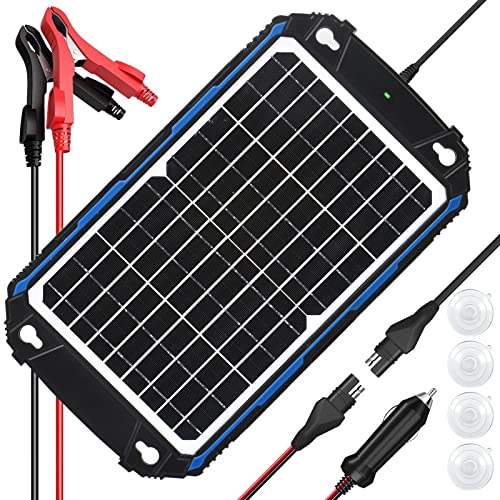
SUNER POWER 12W 12V Solar Battery Charger Pro
- Best for: A daily driver that sits unused for a week or two at a stretch.
- SUNER POWER 12W solar battery charger
- 12V battery compatibility
- Charger and maintainer function
- Pro model designation
A daily driver that sits unused for a week or two at a stretch.
A vehicle with heavy parasitic drain may need the 20W or 25W panel instead.
The SUNER POWER 12W panel is the compact middle ground in this guide, offering a useful maintenance charge in a smaller footprint. Twelve watts covers a healthy battery in a car that sits for a week or two, and the smaller panel is easier to place on a dashboard or windshield. It suits an owner who wants steady maintenance without the bulk of the largest panels. It mounts easily on a dashboard or a windshield, and its smaller size makes it simple to move between vehicles. For a car driven every week or two, it provides exactly the maintenance charge the battery needs.
ECO-WORTHY 25W 12V Solar Battery Charger
- Best for: RVs, boats, and vehicles with heavy standby drain.
- ECO-WORTHY 25W solar battery charger
- 12V battery compatibility
- Trickle charger and maintainer function
- 25W solar panel output
RVs, boats, and vehicles with heavy standby drain.
The larger panel takes more dashboard or roof space, so measure your mounting spot first.
The ECO-WORTHY 25W panel is the highest-wattage charger in this guide, and it is the pick for the biggest maintenance jobs. Twenty-five watts gives the most headroom for vehicles with alarms, trackers, and other electronics drawing power while parked, and for batteries that sit through long stretches of weak winter sun. It is the panel to choose when a smaller maintainer has already proven too weak. The higher wattage also covers boats and RVs, where onboard electronics draw power around the clock. When a smaller maintainer has already failed to keep a battery ready, this panel is the logical next step.
ECO-WORTHY Upgrade 7.5W Solar Car Battery Charger
- Best for: A healthy battery in a car driven every week or two.
- ECO-WORTHY Upgrade 7.5W solar car battery charger
- 12V battery compatibility
- Trickle charger and maintainer function
- 7.5W solar panel output
A healthy battery in a car driven every week or two.
It is a maintainer, not a fast charger, so it cannot revive a deeply discharged battery.
The ECO-WORTHY 7.5W panel is the smallest and simplest maintainer in this guide, built for a car that only needs a gentle top-up between drives. Its compact size fits easily on a dashboard, and its lower wattage suits a healthy battery with light standby drain. It is the right pick when the car is driven every week or two and just needs a little help staying ready. Its compact size fits neatly on a dashboard without blocking the driver’s view, and its gentle output suits a battery that is already healthy. It is the simplest maintainer in this guide, and the easiest to set up.
Which One Fits Your Situation
A Car Parked for the Whole Season
Choose the ECO-WORTHY 25W panel when the vehicle will sit for months. Its higher wattage gives the most margin against weak winter sun and constant standby drain, and the extra output helps the battery stay ready across a long rest. Place the panel where it catches the most daylight and check the connection monthly. A monthly check also catches a loose clamp before it becomes a dead battery.
A Daily Driver That Sits for a Week or Two
Choose the SUNER POWER 12W panel when the car is driven regularly but rests for a week or two between trips. Twelve watts covers a healthy battery with light drain, and the compact panel fits easily on a dashboard. It is the balanced pick for the most common parking pattern. Move the panel to follow the sun when you can, since a shaded panel charges far more slowly.
An RV or Boat With Extra Electronics
Choose the SUNER POWER 20W panel when the vehicle carries an alarm, a tracker, or other electronics that draw power around the clock. The stronger output replaces that drain with more margin, and the maintainer function keeps the battery topped up through long stays at a dock or storage lot. Check the battery type first, since the panel must match the battery it maintains.
A Healthy Battery That Just Needs a Top-Up
Choose the ECO-WORTHY 7.5W panel when the car is driven weekly and the battery is in good shape. Its small size mounts neatly on a dashboard, and its gentle output is exactly what a healthy battery needs between regular drives. Do not expect it to rescue a battery that is already flat. A deeply discharged battery needs a proper charger first, not a maintainer.
Common Mistakes
- Expecting a trickle charger to revive a battery that is already deeply discharged. Use a full charger first, then a maintainer to keep it ready.
- Mounting the panel in shade and wondering why the battery still drains. Park in the sunniest spot you can find.
- Buying a panel without checking whether a charge controller is included. Read the listing for controller details before ordering.
- Using a 12V charger on a battery with a different voltage. Confirm the voltage on the battery label first.
- Leaving the panel connected without ever checking the clamps or cable condition. A loose clamp can stop charging without any warning.
Frequently Asked Questions
Will a solar trickle charger overcharge my battery?
A panel with a charge controller will not overcharge a healthy battery, because the controller limits the charge once the battery is full. Panels without a controller can keep pushing current on bright days, so check the listing for controller details before buying. For a panel left connected for weeks, a built-in controller with overcharge protection is the safer choice.
Can I leave a solar trickle charger connected all winter?
Yes, a maintainer with a charge controller is designed to stay connected through long rests, including winter storage. The panel still needs some daylight to work, so keep it clear of snow and positioned toward the sun. Check the connection and the panel surface monthly so dirt or snow does not block the light. Clear snow promptly.
Does a solar trickle charger work through a windshield?
Yes, a panel mounted inside the windshield still receives sunlight, though tinted glass and the angle of the sun reduce its output. A panel placed outside on a roof or hood catches more light, but an inside mount is simpler and keeps the panel protected. Either way, aim for the sunniest parking spot you can find. Outside mounts catch more.
How long does it take a trickle charger to help a weak battery?
A trickle charger works slowly, adding a small charge over days rather than hours, so it is a maintainer rather than a rescue tool. A healthy battery stays topped up with steady use, while a weak battery needs several sunny days to improve. If the battery will not hold a charge, it likely needs replacement.
FAQ
Will a solar trickle charger overcharge my battery?
Can I leave a solar trickle charger connected all winter?
Does a solar trickle charger work through a windshield?
How long does it take a trickle charger to help a weak battery?
More from Amazon
Programs that pair well with the guide above. Offers and eligibility are set by Amazon and may change.
Free shipping on eligible items, Prime Video and more. Eligible new members can start with a free trial.
Start a Prime free trialA Prime membership for ages 18-24 with a trial period. Eligibility is set by Amazon.
See Prime for Young AdultsAudiobooks and podcasts to listen to on the go. Eligible new members can start with a free trial.
Try Audible freeAd-free music streaming. Eligible new subscribers can start with a free trial.
Try Music Unlimited freeAs an Amazon Associate we earn from qualifying purchases.