Our Top Picks
 NOCO Boost GB40 12V 1000A UltraSafe Portable LithiumLithium12 Volts2150 Milliamp HoursCheck on Amazon
As an Amazon Associate we earn from qualifying purchases.
Disclosure: This article contains affiliate links. If you buy through a link on this page, we may earn a commission at no extra cost to you.

A motorcycle battery rarely fails at home, next to a charger and a warm garage. It fails at a fuel stop two hours from anywhere, after a cold night of camping, or in a parking lot after the bike sat through lunch with the ignition left on. In a car you can flag down another driver and use jumper cables. On a bike there may be no second vehicle, the battery is buried under a seat or side panel, and the terminals are smaller and harder to reach. A portable lithium jump starter pack solves that problem in a way that suits two wheels: it is self-contained, needs no donor vehicle, and the smaller packs are light enough to live permanently in a tail bag, tank bag or under-seat compartment.
The best motorcycle jump starters for roadside use are not the biggest packs in the category. A motorcycle starter motor draws far less current than a truck engine, so a compact pack rated at a few hundred peak amps already has comfortable headroom for most bikes, including large-displacement twins and inline fours. What matters more is carry size, clamp size, protection against reversed connections, and how the pack holds its charge while it sits unused for weeks. This guide compares three portable lithium jump starter packs sold on Amazon US and sized realistically for motorcycle luggage: the NOCO Boost Sport GB20, the NOCO Boost Plus GB40 and the GOOLOO GP3000. All three are the same type of product, a self-contained lithium jump starter pack with its own clamps, and all three list motorcycle use among their intended applications or are rated well above what a motorcycle battery needs.
Quick Picks
- Best fit for most riders: NOCO Boost Sport GB20. The smallest pack here, rated at 500 peak amps for gasoline engines up to 4.0 liters, with powersport-sized clamps and a 24 Wh lithium battery. It is the easiest of the three to justify carrying on every ride.
- Best if you also run a car or a big twin: NOCO Boost Plus GB40. Doubles the peak output to 1,000 amps, keeps a similar footprint, and adds enough reserve for a car or truck as well as the bike, at the cost of a little more weight.
- Best for maximum headroom in a still-portable pack: GOOLOO GP3000. A 3,000 peak amp rating and a 16,000 mAh battery in a pack that still weighs under a pound and a half on its listing, with quick-charge USB output for phones and other ride electronics.
1. NOCO Boost Sport GB20 — Best Fit for Most Riders
The GB20 is the pack that makes the most sense as dedicated motorcycle kit. NOCO rates it at 500 peak amps and positions it directly at motorcycles, ATVs and lawn equipment alongside small cars, with gasoline engine coverage up to 4.0 liters. No production motorcycle engine comes close to that ceiling, so the rating translates into generous margin for a cold, reluctant starter motor on a big twin or a high-compression single. The listing describes up to 20 jump starts on a single charge, which for a rider means the pack can sit in a bag for a long stretch and still be useful when it is finally needed, provided you top it up on a sensible schedule.
Size is the real argument. The unit measures roughly 6.7 by 3.1 by 1.7 inches, a shape that slides into a tail bag or a larger tank bag without displacing tools or a rain layer. The clamps matter as much as the box: motorcycle battery terminals sit in tight trays, often partly hidden by the frame or a wiring loom, and full-size car clamps can be clumsy or impossible to seat properly. The GB20 ships with smaller powersport clamps in some listings, which are easier to place on compact terminals without touching surrounding metalwork.
Safety features are where a small pack earns its place on a bike. The GB20 uses NOCO’s UltraSafe design with spark-proof connections and reverse polarity protection, so an accidental reversed hookup in poor light should shut the pack down rather than damage the bike’s electronics. Modern motorcycles carry sensitive ECUs and TFT dashboards, and a mistake an older bike would shrug off can be expensive now. The housing is rated IP65 with the port covers closed, and there is a 100-lumen LED flashlight with several modes including SOS and strobe.
The trade-offs are clear. The GB20 is not rated for diesel engines, which is irrelevant on almost every motorcycle but matters if you hoped one pack would cover a diesel truck as well. Its USB output is a modest 5V, 2.1A port, fine for a phone but slow by current standards, and recharging the pack itself is not especially fast. Riders of very large cruisers who tour two-up in winter may simply prefer the extra reserve of the next pick.
Specifications
- Peak current: 500 amps
- Internal battery: lithium, 24 Wh
- Engine rating: gasoline up to 4.0 liters, not rated for diesel
- Jump starts per charge: up to 20, per the manufacturer
- Dimensions: about 6.7 x 3.1 x 1.7 inches
- Weight: about 2.4 pounds in its listed form factor, less for the bare unit
- Enclosure: IP65 rated with ports closed
- Light: 100-lumen LED with multiple modes including SOS and strobe
- USB output: 5V, 2.1A
Pros
- Sized and clamped for powersport batteries, not adapted from a car pack
- Spark-proof and reverse polarity protection for safer use in bad light
- Small enough to carry permanently rather than only on long trips
- IP65 housing suits life in an exposed luggage bag
Cons
- No diesel rating, so it is a poor one-pack answer for diesel vehicle owners
- USB charging for phones is slow compared with newer packs
- Riders wanting one pack for bike and large car may outgrow it
Check the NOCO Boost Sport GB20 on Amazon
2. NOCO Boost Plus GB40 — Best for Bike Plus Car Duty
The GB40 is the step up for riders who want a single pack to live wherever it is needed most. Its 1,000 peak amp rating and coverage of gasoline engines up to 6.0 liters and diesel engines up to 3.0 liters means the same unit that restarts your motorcycle can also restart the car that tows it or the family vehicle in the driveway. For a touring rider, that flexibility can justify the slightly larger carry size, because the pack earns its space all year rather than only during riding season.
In physical terms the GB40 stays close to its smaller sibling. The body measures about 7.7 by 3.2 by 1.7 inches and the listed weight is around 2.4 pounds. That is still tail-bag territory, though on a small bike you will notice it more than the GB20, and the clamps are heavier-duty units sized for car batteries. On motorcycle terminals they work, but you need to place them carefully in a crowded battery tray.
The feature set follows the GB20: an UltraSafe lithium design with spark-proof connection and reverse polarity protection, an IP65-rated housing, a 100-lumen LED flashlight with multiple modes, and a USB port that turns the pack into a basic power bank. The internal battery is again listed at 24 Wh, with up to 20 jump starts per charge in the manufacturer’s figures. For a motorcycle, 1,000 peak amps is far beyond requirement, which has a practical benefit: a partially discharged pack, or a very cold morning, still leaves a wide margin before the pack is the limiting factor.
Where the GB40 loses ground is purely about fit for purpose. If the pack will only ever serve the bike, the GB20 does the same job in a smaller, lighter package with clamps better matched to the terminals. The GB40 makes sense when the household fleet, not just the motorcycle, is part of the decision.
Specifications
- Peak current: 1,000 amps
- Internal battery: lithium, 24 Wh
- Engine rating: gasoline up to 6.0 liters, diesel up to 3.0 liters
- Jump starts per charge: up to 20, per the manufacturer
- Dimensions: about 7.7 x 3.2 x 1.7 inches
- Weight: about 2.4 pounds
- Enclosure: IP65 rated
- Light: 100-lumen LED with multiple modes
- USB output: 5V, 2.1A
Pros
- Double the peak output of the GB20 for stubborn, cold starts
- Covers a car as well as the bike, so one pack serves the whole garage
- Same spark-proof, reverse polarity protected design as the smaller model
- Still compact enough for a tail bag or saddlebag
Cons
- Heavier-duty clamps are less nimble on small motorcycle terminals
- More pack than a small or mid-size motorcycle will ever need
- USB output remains basic rather than fast-charging
Check the NOCO Boost Plus GB40 on Amazon
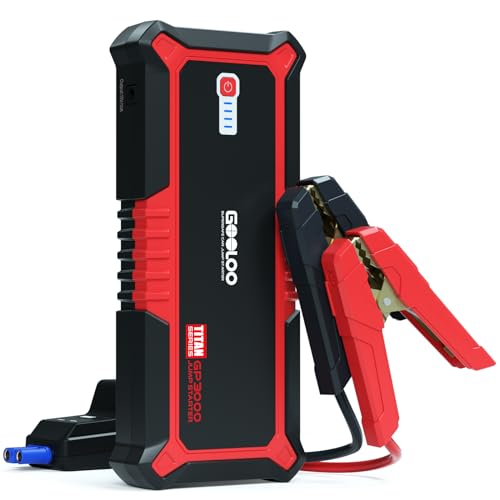
3. GOOLOO GP3000 — Most Headroom, Still Easy to Carry
The GP3000 takes the opposite approach to sizing a pack: rather than trimming output to motorcycle needs, it keeps a very high rating and trims the weight instead. The listing gives 3,000 peak amps, coverage of gasoline engines up to 9.0 liters and diesel engines up to 7.0 liters, and a 16,000 mAh lithium polymer battery, in a pack listed at 1.39 pounds. Motorcycle use is named directly in the listing’s vehicle types, alongside ATVs, cars, trucks and snowmobiles, so this is not a car-only unit being stretched into a role it was not sold for.
For a rider, that combination has a specific appeal. Adventure and touring bikes increasingly run auxiliary lights, GPS units and phone mounts from the same small battery, and a tired battery can fall over after a cold night at altitude. A pack with this much reserve, plus quick-charge USB output and a Type-C port, doubles as the emergency power source for the rest of your electronics while you sort out the bike. The pack includes smart jumper clamps, USB cables and a cloth storage bag, per the listing, which keeps the kit together in a pannier.
There are honest caveats. Peak amp figures in this category are not measured to a single shared standard, so a 3,000 amp claim should be read as headroom rather than as a precise multiple of the NOCO figures. The pack is also physically longer than the GB20, which matters if your under-seat space is a shallow tray rather than a proper bag. And like every lithium pack here, it needs periodic attention: leave any of these units flat for a year and the roadside rescue becomes a phone call instead.
Specifications
- Peak current: 3,000 amps
- Internal battery: lithium polymer, 16,000 mAh
- Engine rating: gasoline up to 9.0 liters, diesel up to 7.0 liters
- Vehicle types listed: motorcycle, ATV, passenger car, truck, UTV, van, snowmobile and lawn mower
- Weight: 1.39 pounds, per the listing
- Ports: USB quick charge output and Type-C port
- Included, per the listing: jump starter, smart jumper cable, USB-A to USB-C cable, USB-C to USB-C cable and cloth bag
Pros
- Very high peak rating gives the widest margin for a weak, cold battery
- Light for its output class, so it remains realistic motorcycle luggage
- Quick-charge USB output is genuinely useful for phones and GPS units
- Motorcycle use is listed explicitly rather than implied
Cons
- Longer body may not suit shallow under-seat trays
- Peak amp claims in this class are not directly comparable between brands
- More output than most riders need, so you are paying for reserve
Check the GOOLOO GP3000 on Amazon
How to Choose a Jump Starter for a Motorcycle
Start with carry size, not peak amps. Almost any lithium pack sold for cars will start a motorcycle, because bike starter motors are comparatively small. The deciding question is whether the pack fits the space you actually have: under the seat, in a tail bag, or in one pannier alongside tools. Measure that space before ordering, including room for the clamps and cable, which add bulk that the headline dimensions of the unit alone do not show.
Check the clamps against your battery tray. This is the detail riders most often miss. Motorcycle batteries sit in tight trays with short cable runs, and terminals may be partly covered. Smaller powersport clamps are easier to seat fully and less likely to bridge against the frame. Whatever pack you choose, practice the connection once at home, in daylight, so the first attempt is not at night on a shoulder.
Look for reverse polarity and spark-proof protection. A reversed connection can damage an ECU or dashboard long before it damages the battery. All three packs in this guide include protection against that mistake, and for a modern motorcycle that feature is worth more than extra peak amps.
Think about how the pack holds a charge. A roadside pack spends its life waiting. Check the manufacturer’s guidance on storage charge and recharge intervals, and recharge the pack after any use rather than putting it away depleted. Cold weather also reduces what a lithium pack delivers, so a pack stored on the bike through winter starts the morning with less in hand.
Match the pack to your other vehicles honestly. If one pack must also cover a car, the GB40 or GP3000 makes that easy. If it is bike-only kit, a smaller pack that you actually carry beats a larger one left in the garage.
Know what a jump pack cannot fix. A pack will start a bike with a discharged but healthy battery. It will not fix a failed starter motor, a broken charging system or a battery with an internal short. If a bike needs jumping repeatedly, treat that as a diagnosis problem. Follow the pack maker’s connection order and your bike maker’s guidance, and never use a lithium pack on a battery that is swollen, cracked or leaking.
FAQs
How many peak amps does a motorcycle actually need?
Far fewer than a car. Most motorcycles start comfortably with a few hundred peak amps available, which is why the 500-amp GB20 is rated for gasoline engines up to 4.0 liters. Larger packs are about reserve for cold weather, weak batteries and other vehicles, not about a basic requirement of the bike.
Can a car jump starter damage a motorcycle?
A modern lithium pack with reverse polarity and spark-proof protection is designed to prevent the common mistakes. The real risks are poor clamp contact in a tight tray and using any jump source on a physically damaged battery. Connect carefully, follow the instructions for your specific pack and bike, and stop if the battery is swollen or leaking.
Will one of these packs fit under my seat?
It depends on the bike. The GB20 is the most likely candidate, at about 6.7 inches long before you add clamps and cable. Many under-seat trays are shallower than they look, so measure yours, and consider a tail bag or tank bag as the more realistic home for the full kit.
How often should I recharge a pack I rarely use?
Follow the interval in the pack’s manual and check the charge indicator every few months. Lithium packs lose charge slowly in storage and age faster when stored completely flat, so a simple routine of checking and topping up keeps the pack ready for the one morning it matters.
Can I use the pack to run heated gear or charge a phone all day?
These are starting packs first and power banks second. The USB output is meant for topping up a phone, headset or GPS in an emergency, not for powering heated clothing, which draws far more than these ports are built to supply.
What should I do after a successful jump start?
Ride long enough for the charging system to restore the battery, then investigate why it discharged. A battery that needed one jump after lights were left on is a different problem from one that needs a jump every week, and the second case calls for a battery or charging system check.
Conclusion
For most riders, the NOCO Boost Sport GB20 is the right answer: it is the smallest pack here, its clamps suit motorcycle terminals, and its 500-amp rating still covers far more engine than any motorcycle carries. Choose the NOCO Boost Plus GB40 if the same pack also needs to cover a car, and the GOOLOO GP3000 for the lightest route to a very large reserve plus faster USB charging. Any of the three will turn the most common roadside motorcycle failure, a flat battery far from help, into a few minutes of work instead of a tow, as long as the pack is charged and on the bike.
More from Amazon
Programs that pair well with the guide above. Offers and eligibility are set by Amazon and may change.
Free shipping on eligible items, Prime Video and more. Eligible new members can start with a free trial.
Start a Prime free trialA Prime membership for ages 18-24 with a trial period. Eligibility is set by Amazon.
See Prime for Young AdultsAudiobooks and podcasts to listen to on the go. Eligible new members can start with a free trial.
Try Audible freeAd-free music streaming. Eligible new subscribers can start with a free trial.
Try Music Unlimited freeAs an Amazon Associate we earn from qualifying purchases.