Key takeaways
- Compare the best single cam compound bow picks by draw length, draw weight and speed, with two verified single-cam bows for hunting and target shooting.
As an Amazon Associate we earn from qualifying purchases.
A single cam compound bow runs its string and cables around one powered cam and one idler wheel instead of two matched cams. That layout is the whole reason the type exists. With only one cam doing the work, there is no second cam to fall out of sync with the first, so the bow holds its tune longer, draws with a characteristically smooth and even feel, and asks less of the owner between seasons. Archers who want a compound bow that stays consistent without constant timing checks have chosen single cam designs for decades, and the layout still anchors both ends of the market: full-power hunting bows and the school and club bows that introduce new shooters to the sport.

This guide holds a strict line on the cam system. Every bow below states a single cam design on its product page, in its specification fields or in the maker’s own description of that listing. Dual cam and hybrid cam bows were left out, however good they are, because a buyer searching for the best single cam compound bow is asking for this specific eccentric system and the ownership experience that comes with it. Several well-known adjustable bows failed that test during research, including popular youth models that look like single cam bows in photographs but run two cams in their manuals. What remains is a short, honest list of two bows that cover the two jobs single cam bows do best. One is a full-power ready-to-hunt hunting bow. The other is the zero let-off teaching bow used in school archery programmes, built around a single cam precisely so that anyone can pick it up and shoot it.
Read the choosing section first. Draw length fit, draw weight range, and what the single cam gives up and gains against a dual cam design decide satisfaction far more than arrow speed alone, and the two bows below sit at opposite ends of those scales on purpose.
Disclosure: This article contains affiliate links. If you buy through these links, we may earn a commission at no additional cost to you.
How to Choose a Single Cam Compound Bow
What the single cam layout actually changes
In a single cam bow, one elliptical cam at the bottom limb controls both the draw cycle and the let-off, while the wheel at the top limb simply idles and feeds string. Because one cam governs everything, the two ends of the string cannot drift out of time with each other. The practical results are a draw cycle that tends to build and release weight evenly, a bow that rarely needs cam timing work, and a shot that many archers describe as softer in recoil and quieter in noise. The trade is peak efficiency: the fastest competition and hunting designs generally use two cams or a hybrid system, so a single cam bow usually gives away some arrow speed against an equivalent dual cam bow. Buyers who value a forgiving draw and low maintenance over the last increment of speed are the natural audience.
Draw length has to fit the archer
A compound bow only shoots accurately when its draw length matches the archer’s wingspan and anchor position. A bow drawn too long pushes the anchor past its natural point and opens groups; a bow drawn too short cramps the shot. Adjustable single cam bows solve this with rotating modules or cam settings that move the draw length across a stated range. Check the stated range on the listing against the archer before anything else, and note whether adjustment needs a bow press or only hand tools, because that decides whether changes happen at home or at a shop. One bow in this guide adjusts across a wide hunting range with modules. The other takes the opposite approach and removes fixed draw length altogether, which is exactly right for shared and teaching use and exactly wrong for a dedicated hunting setup.
Draw weight and the job in front of the bow
Draw weight decides what the bow can be used for. Hunting regulations in most places set minimum draw weights for game, and ethical hunting shots need enough weight behind a suitable arrow. Target, school, and form work need far less, and a bow that can be drawn comfortably for dozens of arrows teaches better than one that exhausts the shooter in ten. The two bows here bracket the span: one adjusts across full hunting weights, the other stays in a light training band with no let-off, so holding at full draw means holding the whole weight, which is a deliberate coaching feature rather than a flaw. Choose by the job, not by the biggest number.
Brace height, axle length, and forgiveness
Brace height, the distance from the grip to the string at rest, shapes how forgiving a bow feels. A longer brace height keeps the arrow on the string for a shorter time and tolerates small form errors better, at some cost to speed. A shorter brace height does the reverse. Axle-to-axle length shapes handling: shorter bows move easily in blinds and stands, longer bows settle steadier for target work. Neither figure makes a bow good or bad on its own, but together with the cam system they describe the bow’s character, and the listings below state both so the comparison is grounded in the page rather than in impressions.
Package or bare bow
A ready-to-hunt package arrives with a sight, rest, quiver, and stabiliser fitted, which suits a first hunting bow or a spare bow that must work immediately. A bare bow suits a school, club, or archer who already owns accessories or wants none. The hunting bow below is a package bow. The teaching bow is sold as a bow alone in the listing used here, which matches how programmes buy it, since arrows, arm guards, and quivers are usually bought as shared kit. Confirm what the exact listing includes before ordering, because the same model name can appear as a bare bow in one listing and a kit in another.
Bear Archery Species XT RTH Compound Bow
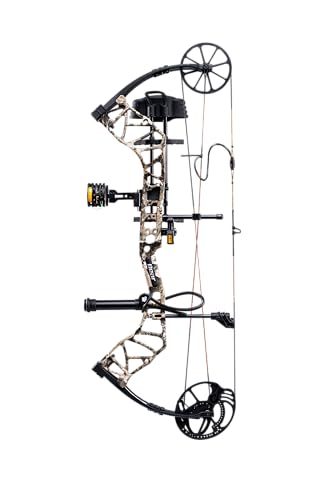
The Bear Archery Species XT RTH is the hunting entry in this guide: a ready-to-hunt compound bow built around what the listing describes as a smooth drawing single cam system that ensures consistent accuracy with every shot. The listing used here is the left-hand configuration in Mossy Oak Roots with black, at the sixty-pound peak setting, with an aluminium build and the model name Species XT RTH. The same model family is listed in right-hand and other finish and weight configurations, so confirm hand, finish, and peak weight on the listing before ordering, because those three choices are set at purchase and are not field adjustments.
Speed is stated at up to 320 feet per second, which is strong pace for a single cam hunting bow and reflects how far the layout has come from its gentle origins. The fit ranges are the practical heart of the bow. Draw length adjusts from 23.5 to 30.5 inches, a span that covers most adult archers, and draw weight is offered in two bands, 45 to 60 pounds and 55 to 70 pounds, so the buyer chooses the band that matches their strength and quarry rather than accepting a single fixed weight. The bow measures 30 inches from axle to axle, compact enough for ground blinds and tight treestands, and the brace height is 6.75 inches, a middle-ground figure that leans toward forgiveness over the shortest, fastest layouts. Let-off is generous, so holding at full draw while waiting for a shot angle costs a fraction of the peak weight.
The RTH letters mean the bow arrives as a working hunting setup rather than a bare riser. The package listed includes an IMS V-Biscuit rest, a Picatinny-mounted 4-pin sight, a 5-arrow quiver, a stabiliser, a peep sight, and a wrist sling. The integrated mounting system for the rest and the Picatinny sight mount are worth noting for a single cam buyer, because they show where this design spends its effort: not on cam complexity, but on a rigid, modern accessory interface around a simple, dependable eccentric system. For a hunter who wants one cam to keep in time, a complete accessory set in the box, and adjustments that cover a full adult fit range, this is the complete expression of the single cam idea in this guide.
Key specifications from the product page
- Cam system: single cam, described on the listing as a smooth drawing single cam system
- Speed: up to 320 feet per second
- Draw length: adjustable from 23.5 to 30.5 inches
- Draw weight: 45 to 60 pounds or 55 to 70 pounds, by configuration
- Axle-to-axle length: 30 inches
- Brace height: 6.75 inches
- Included: IMS V-Biscuit rest, Picatinny-mounted 4-pin sight, 5-arrow quiver, stabiliser, peep sight, wrist sling
- View on Amazon: https://www.amazon.com/dp/B0DKQ481YN
Genesis Original Compound Bow
The Genesis Original is the other honest shape of a single cam bow, and it could hardly be more different from the hunting bow above. Its Amazon specification fields state the cam system directly as Single Cam, and the maker’s description explains what that cam is for: a single cam for no tuning issues, minimal recoil, and more accuracy, in a bow designed to eliminate let-off and specific draw length requirements. This is the bow built for the National Archery in the Schools Program and for clubs, families, and ranges where one bow has to fit every shooter who walks up to the line.
The draw figures explain the concept. Draw length runs from 15 to 30 inches with no fixed draw stop, so the archer simply draws to their own comfortable anchor and the bow works there, and draw weight adjusts from 10 to 20 pounds. There is zero let-off, which means the weight held at full draw is the weight on the limbs. For a hunting bow that would be a burden; for a teaching bow it is the point, because it builds honest form and strength and keeps every shot feeling the same for a six-foot adult and a much smaller beginner. Arrow speed is modest by design, matched to indoor ranges and school gyms rather than to game.
Construction is stated plainly on the page. The riser is machined 6061-T6 aluminium, the limbs are composite, and the cam and idler wheel are aluminium, with high-strength strings and cables. The bow arrives pre-assembled, weighs 3.5 pounds, and is offered in right and left hand in a range of colours, with the listing used here being the right-hand bow in pink. Because it fits nearly anyone and asks for almost no tuning, it is the bow a programme buys in quantity and the bow a household buys when several people of different sizes will share it. What it is not is a hunting bow: its weight band sits below hunting minimums in most places, and buyers who need a field bow should choose the Species XT above instead. Judged on its own stated job, the Genesis Original is the purest single cam design in this guide, the one where the single cam exists to remove every adjustment barrier between a new archer and their first well-shot arrow.
Key specifications from the product page
- Cam system: Single Cam, as stated in the Amazon specification field for compound bow cam system
- Draw length: 15 to 30 inches, with no fixed draw length requirement
- Draw weight: adjustable from 10 to 20 pounds
- Let-off: zero let-off design, as described on the product page
- Riser: machined 6061-T6 aluminium
- Limbs: composite split limbs
- Cam and idler: aluminium cam and idler wheel
- Weight: 3.5 pounds, pre-assembled
- View on Amazon: https://www.amazon.com/dp/B001F0IP7E
Comparison Table
| Feature | Bear Archery Species XT RTH | Genesis Original |
|---|---|---|
| Cam system | Single cam | Single Cam, as stated in the page specification field |
| Primary use | Hunting, ready-to-hunt package | School, club, and shared beginner archery |
| Speed | Up to 320 feet per second | Not stated as a headline figure on the listing used |
| Draw length | 23.5 to 30.5 inches, adjustable | 15 to 30 inches, no fixed draw length |
| Draw weight | 45 to 60 or 55 to 70 pounds, by configuration | 10 to 20 pounds, adjustable |
| Axle-to-axle | 30 inches | Not stated on the listing used |
| Brace height | 6.75 inches | Not stated on the listing used |
| Included equipment | Rest, 4-pin sight, quiver, stabiliser, peep, wrist sling | Bow only in the listing used; kits are separate listings |
| ASIN | B0DKQ481YN | B001F0IP7E |
Frequently Asked Questions
What is a single cam compound bow?
It is a compound bow with one powered cam and one idler wheel. The single cam controls the draw cycle and let-off for both ends of the string, while the idler simply feeds string as the bow is drawn. Because there is only one cam, there is no cam-to-cam timing to keep in sync, which is the design’s main ownership advantage.
Is a single cam bow easier to maintain than a dual cam bow?
Generally, yes, in one specific way: it cannot fall out of cam timing, because there is only one cam. Strings and cables still stretch and wear on any compound bow and still need periodic inspection and replacement, and draw length and weight settings still need checking. The saving is the timing work, not all maintenance.
Are single cam bows slower than dual cam bows?
The layout usually gives away some peak speed against an equivalent two-cam design, and that trade is worth understanding before buying. The hunting bow in this guide is still rated at up to 320 feet per second, which shows that a modern single cam hunting bow is not slow in any practical sense. For most hunting and all teaching use, the smooth draw and low upkeep matter more than the last increment of speed.
Can a beginner start on a single cam bow?
Yes, and both bows here suit beginners in different ways. The Genesis Original is built for first-time and school archers, with a light draw weight and no set draw length. The Species XT suits a beginner who is starting directly in hunting, provided its draw weight band and draw length range fit them and local rules are met. The right choice depends on whether the goal is learning the sport or hunting with it.
Why does the Genesis Original have no let-off?
Deliberately. Its page describes a design that eliminates let-off so every archer holds the full, light draw weight at anchor. That builds consistent form, keeps the bow identical for every shooter in a class, and removes one more setting from a shared bow. It is a coaching feature, not a missing specification.
Which of these two bows is right for hunting?
The Bear Archery Species XT RTH. Its draw weight bands reach full hunting weights, it is rated at up to 320 feet per second, and it arrives with a sight, rest, and quiver fitted. The Genesis Original’s 10 to 20 pound draw weight band is a training range and sits below hunting minimums in most places, so it should be bought for learning, school, and club shooting.
Conclusion
The best single cam compound bow divides by purpose, and this guide’s two verified picks make the split plainly. The Bear Archery Species XT RTH is the hunting bow: a single cam system rated at up to 320 feet per second, adjustable across 23.5 to 30.5 inches of draw length and full hunting draw weights, in a 30-inch frame with a complete ready-to-hunt accessory package in the box. The Genesis Original is the teaching bow: a single cam design stated as such in its own specification fields, with no fixed draw length, no let-off, and a 10 to 20 pound range that lets one bow serve an entire class or family.
Both earn their place the same way, by stating the single cam design on the product page rather than asking the buyer to guess from a photograph. Before ordering either, confirm the configuration on the listing itself: hand, finish, and peak weight for the Bear, hand and colour for the Genesis, and draw length fit for the archer who will actually shoot it. A single cam bow chosen on those checks delivers exactly what the layout promises, a smooth draw, a steady tune, and a bow that asks little between seasons.
FAQ
What is a single cam compound bow?
Is a single cam bow easier to maintain than a dual cam bow?
Are single cam bows slower than dual cam bows?
Can a beginner start on a single cam bow?
Why does the Genesis Original have no let-off?
Which of these two bows is right for hunting?
More from Amazon
Programs that pair well with the guide above. Offers and eligibility are set by Amazon and may change.
Free shipping on eligible items, Prime Video and more. Eligible new members can start with a free trial.
Start a Prime free trialA Prime membership for ages 18-24 with a trial period. Eligibility is set by Amazon.
See Prime for Young AdultsAudiobooks and podcasts to listen to on the go. Eligible new members can start with a free trial.
Try Audible freeAd-free music streaming. Eligible new subscribers can start with a free trial.
Try Music Unlimited freeAs an Amazon Associate we earn from qualifying purchases.