Key takeaways
- Best long-range barcode scanners for fulfillment centers: compare rugged 2D imagers and cordless models on published specs for fulfillment buildings where.
As an Amazon Associate, we earn from qualifying purchases made through links on this page.


Choosing a barcode scanner for fulfillment buildings where operators read rack and pallet labels from the floor, from forklifts and across wide staging lanes is a specification exercise. Distance changes everything about scanner choice in a fulfillment center: the imager’s decode-range table, the size of the rack labels, and whether the site also needs the same device to read pick labels at arm’s length. This roundup leads with the one true extended-range imager in the verified set and is explicit about the supporting roles of the others.
Every model below is a real product sold on Amazon US, with its ASIN verified against the manufacturer’s model name before inclusion. The comparison works from published manufacturer specifications: imager type, symbology list, sealing, drop figures, radio class and battery ratings. Where a model has a genuine limitation for this brief, the article says so in its own section rather than leaving it to a footnote.
What to look for
- Decode-range table, not headline distance. Manufacturers publish range by code size; match your largest rack label against the table.
- Near-to-far flexibility. A scanner that reads 7.6 cm to 21.4 m covers pick faces and rack labels with one device and one training programme.
- Forklift-proof construction. Vehicle-mounted drops are the worst in the building; ultra-rugged figures are mandatory.
- Label stock audit. Long-range programmes usually pair the scanner purchase with larger, higher-contrast rack labels.
Two checks apply to every shortlist in this series. First, confirm the exact kit contents before ordering, because scanners in this class are sold as scanner-only units, USB kits and cradle kits under closely related listings. Second, match the interface to the host: USB for most workstations, RS-232 or Ethernet where the scanner feeds industrial or point-of-sale infrastructure.
The picks
Zebra DS3678-ER Ultra-Rugged Extended-Range 2D Imager
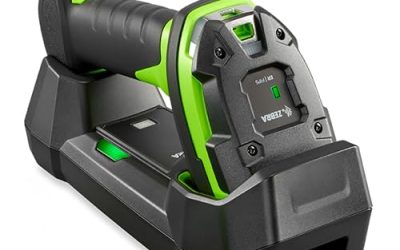
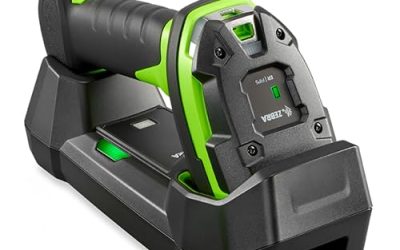
The DS3678-ER uses the same ultra-rugged 3600-series platform as its standard-range sibling but swaps in an extended-range imager that, per Zebra’s specification sheet, captures 1D and 2D barcodes from 7.6 cm out to 21.4 m depending on code size. One device can therefore read a pick label at arm’s length and a rack label from the floor.
Key specifications from the manufacturer:
– Extended-range imager: 7.6 cm to 21.4 m per the manufacturer specification sheet
– Ultra-rugged housing with IP65 and IP67 sealing
– Bluetooth Class 1 cordless connection, up to 100 m line of sight
– Reads codes under shrinkwrap and poorly printed labels with PRZM software
– GS1 DataBar and GS1-128 decoding included in the symbology list
Best for: teams working on fulfillment buildings where operators read rack and pallet labels from the floor, from forklifts and across wide staging lanes, where its combination of decode capability and published endurance figures fits the station as specified.
Limitations to know: Extended range depends on large, high-contrast codes at distance; small dense labels still need to be read up close, and the kit is the heaviest option in this roundup.
Zebra LI4278 Cordless Linear Imager
The LI4278 is a cordless linear imager dedicated to 1D barcodes. Zebra’s specification lists up to 57,000 scans per charge, a Bluetooth range of up to 100 m line of sight, and the ability to read large 1D codes at extended distances, which keeps it relevant wherever the label standard is still purely linear.
Key specifications from the manufacturer:
– 1D linear imager; does not read QR or DataMatrix codes
– Bluetooth cordless operation, up to 100 m line of sight
– Up to 57,000 scans per charge per the manufacturer specification
– Reads 100 percent UPC codes from near contact to over 76 cm
– IP53-sealed housing rated for 1.8 m drops to concrete
Best for: teams working on fulfillment buildings where operators read rack and pallet labels from the floor, from forklifts and across wide staging lanes, where its combination of decode capability and published endurance figures fits the station as specified.
Limitations to know: The 1D-only engine is the hard boundary: any workflow moving to 2D codes, GS1 Digital Link or DataMatrix needs an imager instead.
Zebra DS3678-SR Ultra-Rugged Cordless 2D Imager
The DS3678-SR sits in Zebra’s 3600 ultra-rugged family, the cordless standard-range imager built for docks and production floors. The housing carries IP65 and IP67 sealing, a manufacturer drop specification of 2.4 m to concrete, and a 5,000-tumble endurance figure, with a PowerPrecision+ battery and a sealed charging cradle.
Key specifications from the manufacturer:
– Ultra-rugged 1D and 2D imager for standard-range work
– IP65 and IP67 sealing with a 2.4 m drop-to-concrete specification
– Bluetooth Class 1 radio with up to 100 m line-of-sight range
– PowerPrecision+ battery with battery-health reporting through the cradle
– Full GS1 symbology support, including GS1 DataBar and GS1-128
Best for: teams working on fulfillment buildings where operators read rack and pallet labels from the floor, from forklifts and across wide staging lanes, where its combination of decode capability and published endurance figures fits the station as specified.
Limitations to know: It is heavier than general-duty scanners, and the ultra-rugged build is more hardware than a quiet stockroom or office station can justify.
Quick comparison
| Model | ASIN | Imager | Connection | Sealing |
|---|---|---|---|---|
| Zebra DS3678-ER Ultra-Rugged Extended-Range 2D Imager | B0DVZVNPCZ | 1D/2D imager | Bluetooth | IP65/IP67 |
| Zebra LI4278 Cordless Linear Imager | B00HYOPAJG | 1D linear | Bluetooth | IP53 |
| Zebra DS3678-SR Ultra-Rugged Cordless 2D Imager | B078VSY5DJ | 1D/2D imager | Bluetooth | IP65/IP67 |
Frequently asked questions
How far up a rack can the extended-range model read?
With suitably large labels, Zebra specifies reads out to 21.4 m; real reach depends on label size, contrast and lighting.
Why include standard-range models in a long-range roundup?
Because most fulfillment scanning is still near-field; the standard-range ultra-rugged unit is the honest partner device for pick faces.
Can the LI4278 read rack labels?
Large 1D rack labels, yes, at moderate distances; it is not a substitute for an extended-range imager and cannot read 2D codes.
Do long-range scanners need special bases?
The DS3678-ER uses the sealed 3600-series cradle ecosystem, designed for dock and vehicle environments.
Conclusion
For fulfillment buildings where operators read rack and pallet labels from the floor, from forklifts and across wide staging lanes, start with the Zebra DS3678-ER Ultra-Rugged Extended-Range 2D Imager and work down the list in order: each subsequent pick trades a specific capability, whether that is range, cord management, form factor or budget tier, for a better fit at a particular station. The right fleet is usually one primary model standardised across the site, with a second model only where a station’s requirements genuinely differ. Verify the kit configuration and interface against your host systems before ordering, and the scanners in this roundup will cover the brief on published specifications rather than promises.
More from Amazon
Programs that pair well with the guide above. Offers and eligibility are set by Amazon and may change.
Free shipping on eligible items, Prime Video and more. Eligible new members can start with a free trial.
Start a Prime free trialA Prime membership for ages 18-24 with a trial period. Eligibility is set by Amazon.
See Prime for Young AdultsAudiobooks and podcasts to listen to on the go. Eligible new members can start with a free trial.
Try Audible freeAd-free music streaming. Eligible new subscribers can start with a free trial.
Try Music Unlimited freeAs an Amazon Associate we earn from qualifying purchases.