Key takeaways
- Best industrial handheld barcode scanners with GS1 decoding for warehouse picking: compare rugged 2D imagers and cordless models on published specs for.
As an Amazon Associate, we earn from qualifying purchases made through links on this page.


Choosing a barcode scanner for warehouse picking teams whose case and item labels carry GS1 data: batch, expiry, weight and serial information the warehouse system must capture at the pick face is a specification exercise. An industrial GS1 picking scanner has to satisfy two specifications at once: the industrial endurance figures for aisle work and a decode list that names the GS1 family. All four picks publish GS1 symbologies in their manufacturer decode lists; they differ in cord, range and feedback style.
Every model below is a real product sold on Amazon US, with its ASIN verified against the manufacturer’s model name before inclusion. The comparison works from published manufacturer specifications: imager type, symbology list, sealing, drop figures, radio class and battery ratings. Where a model has a genuine limitation for this brief, the article says so in its own section rather than leaving it to a footnote.
What to look for
- GS1 symbologies by name. GS1-128, GS1 DataBar and GS1 DataMatrix should appear explicitly in the decode specification.
- Industrial endurance. Aisle work punishes scanners; compare drop and sealing figures before features.
- Pick-face feedback. Green-spot or vibration confirmation speeds picks and cuts double-scans in noisy aisles.
- Cord strategy by zone. Cordless for the aisles, corded at decant and pack; both appear here deliberately.
Two checks apply to every shortlist in this series. First, confirm the exact kit contents before ordering, because scanners in this class are sold as scanner-only units, USB kits and cradle kits under closely related listings. Second, match the interface to the host: USB for most workstations, RS-232 or Ethernet where the scanner feeds industrial or point-of-sale infrastructure.
The picks
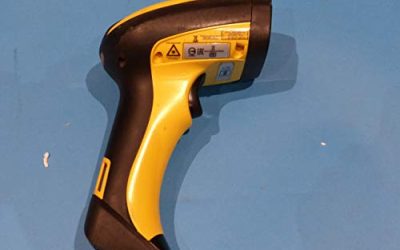
Datalogic PowerScan PD9530-HP Corded Industrial Imager
The PowerScan PD9530-HP is Datalogic’s corded industrial imager in its high-performance near-field configuration, aimed at dense and small codes on parts and cartons. The PowerScan housing carries IP65 sealing and a 2.0 m drop specification, and Datalogic’s 3GL feedback system confirms a good read with a green spot projected onto the code itself.
Key specifications from the manufacturer:
– Corded industrial 1D and 2D high-performance imager
– IP65-sealed housing with a 2.0 m drop specification
– 3GL good-read feedback with a projected green spot
– GS1 DataBar and GS1-128 in the decode list
– USB and RS-232 interface options
Best for: teams working on warehouse picking teams whose case and item labels carry GS1 data: batch, expiry, weight and serial information the warehouse system must capture at the pick face, where its combination of decode capability and published endurance figures fits the station as specified.
Limitations to know: It is corded, so the operator works within cable reach of the host, and the high-performance optics are tuned for near-field codes rather than long-range rack labels.
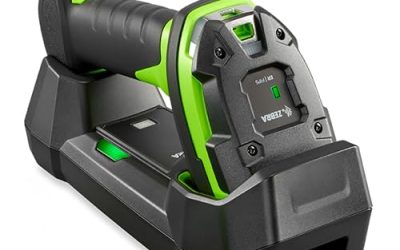
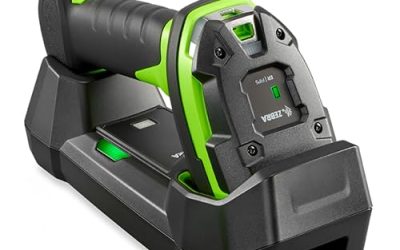
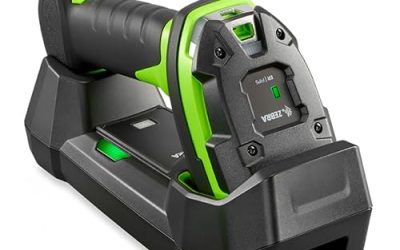
Zebra DS3678-SR Ultra-Rugged Cordless 2D Imager
The DS3678-SR sits in Zebra’s 3600 ultra-rugged family, the cordless standard-range imager built for docks and production floors. The housing carries IP65 and IP67 sealing, a manufacturer drop specification of 2.4 m to concrete, and a 5,000-tumble endurance figure, with a PowerPrecision+ battery and a sealed charging cradle.
Key specifications from the manufacturer:
– Ultra-rugged 1D and 2D imager for standard-range work
– IP65 and IP67 sealing with a 2.4 m drop-to-concrete specification
– Bluetooth Class 1 radio with up to 100 m line-of-sight range
– PowerPrecision+ battery with battery-health reporting through the cradle
– Full GS1 symbology support, including GS1 DataBar and GS1-128
Best for: teams working on warehouse picking teams whose case and item labels carry GS1 data: batch, expiry, weight and serial information the warehouse system must capture at the pick face, where its combination of decode capability and published endurance figures fits the station as specified.
Limitations to know: It is heavier than general-duty scanners, and the ultra-rugged build is more hardware than a quiet stockroom or office station can justify.
Zebra DS2208-SR Corded 2D Imager
The DS2208-SR is the corded member of Zebra’s DS2200 family: the same PRZM-based 1D and 2D imaging as the cordless DS2278, delivered over a USB cable with no battery to manage. The kit versions add a gooseneck stand that switches the scanner into hands-free presentation mode when docked.
Key specifications from the manufacturer:
– Corded 1D and 2D imager with PRZM decoding
– USB kit with stand for hands-free presentation scanning
– IP52-sealed housing; 1.5 m drop-to-concrete specification
– GS1 DataBar and GS1-128 in the supported symbology list
– No battery or radio to configure or maintain
Best for: teams working on warehouse picking teams whose case and item labels carry GS1 data: batch, expiry, weight and serial information the warehouse system must capture at the pick face, where its combination of decode capability and published endurance figures fits the station as specified.
Limitations to know: The cable defines the working radius, so it suits a fixed station rather than aisle work, and high rack labels remain out of reach.
Zebra DS9308-SR Presentation Imager
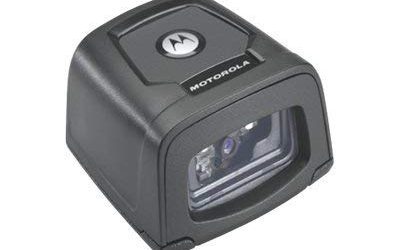
The DS9308-SR is a compact presentation imager that sits on a counter or bench and reads codes as they are passed through its large field of view. It handles 1D, 2D and Digimarc-style screen codes, which makes it a natural fixed-position reader at a receiving bench or returns desk.
Key specifications from the manufacturer:
– Hands-free presentation imager with a wide field of view
– 1D and 2D decoding, including codes shown on screens
– Compact footprint for benches and counters
– GS1 DataBar support for fresh and variable-measure items
– IP52-sealed housing with a recessed, scratch-resistant window
Best for: teams working on warehouse picking teams whose case and item labels carry GS1 data: batch, expiry, weight and serial information the warehouse system must capture at the pick face, where its combination of decode capability and published endurance figures fits the station as specified.
Limitations to know: Presentation range is short by design; it reads what is brought to the window, so it cannot replace a handheld unit for pallet or rack work.
Quick comparison
| Model | ASIN | Imager | Connection | Sealing |
|---|---|---|---|---|
| Datalogic PowerScan PD9530-HP Corded Industrial Imager | B01ISQFIS6 | 1D/2D imager | USB / RS-232 corded | IP65 |
| Zebra DS3678-SR Ultra-Rugged Cordless 2D Imager | B078VSY5DJ | 1D/2D imager | Bluetooth | IP65/IP67 |
| Zebra DS2208-SR Corded 2D Imager | B06VYGFGR7 | 1D/2D imager | USB corded | IP52 |
| Zebra DS9308-SR Presentation Imager | B08RN5V3SG | 1D/2D imager | USB corded | IP52 |
Frequently asked questions
Does the scanner or the software parse GS1 application identifiers?
The scanner decodes and transmits the data; parsing and validation happen in the warehouse system, so test the pair together.
Can a presentation imager really help picking?
At goods-to-person and decant stations, yes: items are presented to the reader rather than the other way round.
What about GS1 codes on fresh food cases?
GS1 DataBar is the usual symbology there, and all four picks list it in their decode specifications.
Is extended range needed for GS1 picking?
Only where rack labels are read from the floor; most pick-face GS1 work is standard range.
Conclusion
For warehouse picking teams whose case and item labels carry GS1 data: batch, expiry, weight and serial information the warehouse system must capture at the pick face, start with the Datalogic PowerScan PD9530-HP Corded Industrial Imager and work down the list in order: each subsequent pick trades a specific capability, whether that is range, cord management, form factor or budget tier, for a better fit at a particular station. The right fleet is usually one primary model standardised across the site, with a second model only where a station’s requirements genuinely differ. Verify the kit configuration and interface against your host systems before ordering, and the scanners in this roundup will cover the brief on published specifications rather than promises.
More from Amazon
Programs that pair well with the guide above. Offers and eligibility are set by Amazon and may change.
Free shipping on eligible items, Prime Video and more. Eligible new members can start with a free trial.
Start a Prime free trialA Prime membership for ages 18-24 with a trial period. Eligibility is set by Amazon.
See Prime for Young AdultsAudiobooks and podcasts to listen to on the go. Eligible new members can start with a free trial.
Try Audible freeAd-free music streaming. Eligible new subscribers can start with a free trial.
Try Music Unlimited freeAs an Amazon Associate we earn from qualifying purchases.