Key takeaways
- Compare suspension data loggers for mountain bikes, from Bluetooth sag tuners to 9-axis IMU sensors and a WiFi logger that records every bump on the trail.
A mountain bike only works as well as its suspension is set up, and setup is guesswork without numbers. A suspension data logger turns that guesswork into measurements: sag in millimetres, travel used on a descent, and how often the fork bottoms out. Only one purpose-built dynamic logger has a verifiable Amazon listing, and it already appears in the downhill-racing guide on this site. Everything else is either a sag tuner that measures setup rather than ride data, or a general-purpose motion sensor that records acceleration, angle and vibration and leaves the interpretation to the rider. That is what this guide covers: two purpose-built sag tuners and three WitMotion inertial sensors, each framed honestly for what it can and cannot do.
As an Amazon Associate, I earn from qualifying purchases.
How to Choose a Suspension Data Logger for Mountain Bikes
Decide first what you want to measure. Sag tuners measure static setup: how far the suspension compresses when the rider sits on the bike. That number sets spring preload and air pressure, and it is the single most important suspension measurement most riders will ever take. A sag tuner does not record what happens during a descent. If you want ride data, you need a motion logger: an accelerometer and gyroscope package that records acceleration, angle and vibration while the bike is moving, so harsh hits and repeated bottoming show up after the ride.
Connection type decides how you get the data. Bluetooth sensors stream live readings to a phone app. WiFi sensors can push data to a phone, a PC or a web client. Wired modules need a serial connection to a microcontroller or a USB converter and a PC, which suits riders who already build electronics and want raw data to analyse themselves. Sampling rate and range matter more than brand names: a sensor that outputs at 200 Hz captures short, sharp hits that a 10 Hz logger smooths over, and an accelerometer range of plus or minus 16 g covers hard landings without clipping.
Comparison Table
| Product | Connection | Sensor Type | Power | Best For |
|---|---|---|---|---|
| Slacker Tuner | Bluetooth LE | Sag cable encoder | 2 AAA batteries | Solo sag setup |
| Slacker V5 | Bluetooth | Sag cable encoder | 2 AAA batteries | Phone sag tracking |
| BWT901BCL | Bluetooth, Type-C | 9-axis IMU, barometer | Battery, about 4 hours | Wireless motion logging |
| BWT61CL | Bluetooth 2.0, TTL | 6-axis IMU | Battery, about 4 hours | Compact Bluetooth logging |
| WT901 | Serial TTL, IIC | 9-axis IMU module | External 3.3-5V | DIY logging projects |
The 5 Best Suspension Data Loggers for Mountain Bikes
Motool Slacker Digital Suspension Tuner
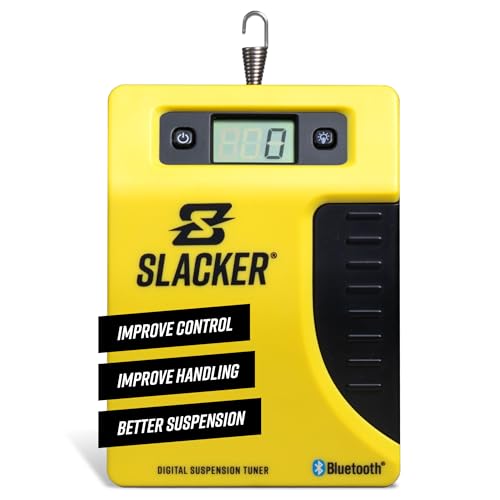
The Slacker is the only purpose-built suspension setup tool in this guide that measures sag directly on the bike. A retractable nylon-coated steel cable extends from the unit to a fixed point on the frame, and an encoder wheel measures how far the suspension compresses when the rider sits on the bike. The LCD display shows the sag reading in real time, so one person can set sag alone. Bluetooth LE connects the unit to a phone, and the listing states compatibility with mountain bikes as well as street, off-road and adventure motorcycles. It runs on two AAA batteries, not included, measures 4 by 2 by 5 inches and weighs 1.17 pounds. It measures setup, not ride data, but sag is the number that sets everything else.
- Specs:
- Bluetooth LE connectivity to a phone
- Retractable nylon-coated steel cable with encoder measurement
- LCD display with backlight, power and reset button, auto-zero button
- Rare-earth magnet mount plus universal mount and cinch straps
- Includes fork adapter, seat rail loops, adhesive loops and universal clip
- Runs on 2 AAA batteries, not included
- Dimensions: 4 x 2 x 5 inches; weight: 1.17 pounds
- Compatible with mountain bikes, street bikes, off-road bikes and adventure motorcycles
Motool Slacker V5 Bluetooth Digital Suspension Tuner
The Slacker V5 is the current generation of the same tool, and the newest purpose-built suspension tuner in this guide. Like the earlier model, it measures rider sag with a retractable cable and shows the reading on a digital display, and it pairs with a phone over Bluetooth so sag data can be tracked and settings saved. The listing names mountain bikes alongside dirt, street and adventure bikes. The V5 is the version sold in the mountain-bike kits that add a Virtual Fender Mount, a seat-post clamp with rods that extends over the rear wheel to give the cable an attachment point directly above the axle on bikes without a rear fender. The MTB Starter kit pairs the V5 tuner with that mount, and the MTB Pro kit adds a carrying case and a smartphone bar mount. It measures 6.5 by 3.5 by 7.5 inches, weighs 1.06 pounds and requires two AAA batteries.
- Specs:
- Bluetooth connection to a phone for sag tracking and saved settings
- Digital sag measurement with retractable cable
- Compatible with dirt, street, adventure and mountain bikes
- Works with Virtual Remote app and Service Assistant app
- Fits MTB Starter and MTB Pro kits with Virtual Fender Mount
- Requires 2 AAA batteries
- Dimensions: 6.5 x 3.5 x 7.5 inches; weight: 1.06 pounds
- Manufacturer part number: 3080-105
WitMotion BWT901BCL
The BWT901BCL is a general-purpose 9-axis inertial sensor, not a suspension-specific device, and it earns its place here because it records exactly the motion data a rider needs to judge suspension behaviour: acceleration, angular velocity, angle and magnetic field, plus barometric pressure and altitude. It uses the MPU9250 chip and a Kalman filter to keep its attitude output stable while the bike is moving, and it outputs data at a selectable rate from 0.2 to 200 Hz, fast enough to capture sharp hits on a rocky descent. Bluetooth connects the sensor to the WitMotion phone app on Android and iOS, and a Type-C connection links it to a PC. The sensor has an internal battery rated at about four hours, and it can keep measuring while charging. It weighs 40 grams and measures 51.5 by 36.1 by 15 millimetres. The honest limit is that it does not know what suspension is: it records motion, and the rider must interpret the graphs.
- Specs:
- 9-axis IMU: accelerometer, gyroscope, magnetometer, barometer
- MPU9250 chip with Kalman filtering
- Bluetooth connectivity, about 10 metres range; Type-C USB
- Output rate selectable from 0.2 to 200 Hz
- Internal battery, about 4 hours; operates while charging
- Dimensions: 51.5 x 36.1 x 15 mm; weight: 40 g
- WitMotion PC software and phone app for live data and recording
- 12-month warranty
WitMotion BWT61CL
The BWT61CL is the compact 6-axis sibling of the BWT901BCL, and the lightest Bluetooth logger in this guide. It measures acceleration, angular velocity and angle with a 6-axis sensor built on the MPU6050 chip, and it drops the magnetometer and barometer found on its bigger sibling. Bluetooth 2.0 connects the sensor to the WitMotion phone app and to PC software, with a range of about 10 metres. A 3.7-volt, 260 mAh internal battery runs it for about four hours, and it can operate while charging over its Type-C connection. It measures 51 by 36 by 15 millimetres and weighs 20 grams, half the weight of the 9-axis model. Its accelerometer covers plus or minus 16 g, its gyroscope covers plus or minus 2000 degrees per second, and its static angle accuracy on the level axes is 0.05 degrees. The PC software can record its data and export it as a text file.
- Specs:
- 6-axis IMU: accelerometer, gyroscope, angle; MPU6050 chip
- Bluetooth 2.0 connectivity, about 10 metres range; Type-C interface
- Acceleration range: plus or minus 16 g; gyroscope range: plus or minus 2000 degrees per second
- Static angle accuracy: 0.05 degrees on level axes
- Output rate: 0.2 to 200 Hz
- Internal 3.7V 260 mAh battery, about 4 hours; operates while charging
- Dimensions: 51 x 36 x 15 mm; weight: 20 g
- WitMotion PC software and phone app; data export as text file
- 12-month warranty
WitMotion WT901
The WT901 is a bare 9-axis inertial module, and the most do-it-yourself pick in this guide. It is a circuit board measuring 15.24 by 15.24 by 2 millimetres and weighing one gram, with a 9-axis sensor that outputs acceleration, angular velocity, angle, magnetic field and quaternion data. It has no case, no battery and no wireless radio of its own. It connects over a serial TTL or IIC interface to a microcontroller or to a PC through a USB-UART converter, which is not included. The module draws less than 12 milliamps from a 3.3 to 5 volt supply, its accelerometer range adapts from plus or minus 2 g to plus or minus 16 g, its gyroscope covers plus or minus 2000 degrees per second, and its output rate runs from 0.2 to 200 Hz. The package includes the module, two six-pin male headers and a welcome guide.
- Specs:
- 9-axis IMU module: acceleration, gyro, magnetic field, angle, quaternion
- Serial TTL and IIC interface; baud rate 4800 to 230400 bps
- Acceleration range: plus or minus 2, 4, 8 or 16 g, adaptive
- Gyroscope range: plus or minus 2000 degrees per second
- Angle accuracy: 0.05 degrees on level axes after calibration
- Output rate: 0.2 to 200 Hz
- Supply: 3.3-5V; current draw under 12 mA
- Size: 15.24 x 15.24 x 2 mm; weight: 1 g
- Includes module, two six-pin male headers and welcome guide; USB-UART converter not included
- 12-month warranty
Which Suspension Data Logger Should You Pick
Pick the Slacker V5 if the goal is correct suspension setup on a mountain bike. It is the current purpose-built sag tuner, it works with the Virtual Fender Mount kits made for mountain bikes, and its phone app tracks sag and saves settings per bike. Pick the WitMotion BWT901BCL if the goal is logged ride data over Bluetooth, pick the BWT61CL if weight and size matter most, and pick the WT901 module only if the rider builds electronics and wants raw data from several mounting points at the lowest cost.
FAQ
Is a sag tuner the same as a suspension data logger?
No. A sag tuner measures static setup, which is how far the suspension compresses when the rider sits on the bike. A data logger records movement during a ride, such as acceleration, angle and vibration over time. The two Slackers in this guide are sag tuners, while the three WitMotion sensors are motion loggers.
Can a general-purpose IMU sensor really log suspension behaviour?
It can record the motion that suspension behaviour produces. An accelerometer mounted on a fork leg records harsh hits and bottoming, while a second sensor on the frame records how much of that movement reaches the rider. The sensor does not analyse suspension on its own, so the rider must read the logged curves to find problems. That is the trade for a logger that costs far less than a dedicated telemetry system.
Do I need more than one sensor to log suspension?
One sensor gives useful data, and two give far more. A single sensor on the handlebar or frame records overall chassis movement. Adding a second sensor on the fork or rear shock lets the rider compare unsprung and sprung movement, which shows how much impact the suspension absorbs.
How do I mount a small IMU sensor on a mountain bike?
Use a strap, a zip tie or an adhesive pad on a flat, rigid part of the frame, fork or handlebar, and keep the sensor away from magnets and strong electromagnetic interference during calibration. The sensor should sit firmly enough that it cannot rattle, because any looseness shows up in the data as vibration that did not come from the trail. A 20 to 40 gram sensor adds no meaningful weight, so the best mounting point is the one that gives the cleanest data.
Conclusion
Suspension data logging on a mountain bike comes down to two different jobs, and this guide covers both. The two Slackers measure sag, which is the setup number that decides how the suspension behaves before the ride starts. The three WitMotion sensors record motion during the ride, which shows how the suspension actually copes with the trail. Neither group replaces a dedicated dynamic suspension analyser, and no other dedicated dynamic logger with a verifiable Amazon listing exists in this class beyond the one already covered in the downhill-racing guide.
FAQ
Is a sag tuner the same as a suspension data logger?
Can a general-purpose IMU sensor really log suspension behaviour?
Do I need more than one sensor to log suspension?
How do I mount a small IMU sensor on a mountain bike?
More from Amazon
Programs that pair well with the guide above. Offers and eligibility are set by Amazon and may change.
Free shipping on eligible items, Prime Video and more. Eligible new members can start with a free trial.
Start a Prime free trialA Prime membership for ages 18-24 with a trial period. Eligibility is set by Amazon.
See Prime for Young AdultsAudiobooks and podcasts to listen to on the go. Eligible new members can start with a free trial.
Try Audible freeAd-free music streaming. Eligible new subscribers can start with a free trial.
Try Music Unlimited freeAs an Amazon Associate we earn from qualifying purchases.