Key takeaways
- Traditional laces: Offer the most independent adjustment and are easy to replace. You can make the forefoot snug while leaving the upper section slightly looser. They take longer to tighten and may need adjustment during the day.
- Single-zone BOA: A dial-driven steel cable system is quick and convenient. It usually tightens the boot as one zone, so it may not separate forefoot and ankle tension as precisely.
- Dual-zone BOA: Two dials control separate lower and upper zones. This is useful when you need a secure ankle but do not want excessive pressure across the toes. It adds hardware and cost, and damaged cables can be more complicated to replace.
- Speed-lace systems: Pull handles can be fast and consistent, but the tension distribution varies by design. Check whether the system provides a separate ankle harness or only one continuous pull.
The best snowboard boots are the ones that hold your heel securely, match your riding level and terrain, and fit snugly without painful pressure points; for most riders, a medium-flex boot with heat-moldable liners and either traditional laces or dual-zone BOA is the safest choice.
Our top picks


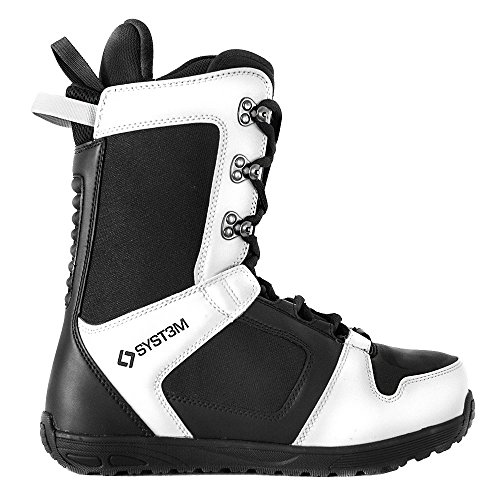

As an Amazon Associate we earn from qualifying purchases at no extra cost to you. Ratings are shown as listed on Amazon.
Best snowboard boots by riding situation
| Rider or situation | Best boot type | Useful flex range | Lacing choice | Examples to compare |
|---|---|---|---|---|
| First season, mostly groomed runs | Soft, forgiving all-mountain boot | 3–5 out of 10 | Traditional lace or single-zone BOA | Burton Moto, ThirtyTwo STW |
| Intermediate rider wanting one versatile pair | Medium-flex all-mountain boot | 5–7 out of 10 | Dual-zone BOA or lace with an ankle harness | Burton Photon, K2 Maysis, Salomon Dialogue |
| Freeride, steeps and aggressive carving | Supportive medium-stiff or stiff boot | 7–9 out of 10 | Dual-zone BOA or precise speed-lace system | Ride Lasso Pro, Burton Ion |
| Park, presses and soft landings | Flexible, natural-feeling boot | 3–5 out of 10 | Traditional lace or simple BOA | ThirtyTwo Lashed, Burton Moto |
| Frequent riding and long days | Durable boot with moldable liner and replaceable footbed | 5–8 out of 10 | Dual-zone BOA or traditional lace | K2 Maysis, Salomon Dialogue, Burton Photon |
Flex numbers are not standardized between brands, so treat them as a comparison tool rather than a laboratory measurement. A “7” from one manufacturer may feel closer to a “6” from another. Your body weight, riding style and ankle mobility also affect how stiff a boot feels.
Flex: comfort versus control
Soft flex: approximately 1–4 out of 10
Soft boots bend easily at the ankle and are forgiving when your technique is still developing. They suit beginners, casual riders, park laps and people who prioritize walking comfort. The trade-off is less resistance when you drive hard into a carve or land at speed. Excessive forward flex can also allow your heel and ankle to move inside the boot.
Medium flex: approximately 5–7 out of 10
Medium-flex boots are the best starting point for most all-mountain riders. They provide enough support for steeper terrain while remaining comfortable for learning turns and riding varied snow. Models such as the Burton Photon, K2 Maysis and Salomon Dialogue occupy this general category, although each has its own liner, shell and lacing feel.
Stiff flex: approximately 8–10 out of 10
Stiff boots transfer movements quickly and can feel powerful during carving, technical descents and freeriding. They are less forgiving of poor fit and can become tiring for beginners. A stiff boot is not automatically better: if you cannot flex your knees and ankles naturally, it may reduce control rather than improve it.
Lacing systems: choose the adjustment you will actually use
- Traditional laces: Offer the most independent adjustment and are easy to replace. You can make the forefoot snug while leaving the upper section slightly looser. They take longer to tighten and may need adjustment during the day.
- Single-zone BOA: A dial-driven steel cable system is quick and convenient. It usually tightens the boot as one zone, so it may not separate forefoot and ankle tension as precisely.
- Dual-zone BOA: Two dials control separate lower and upper zones. This is useful when you need a secure ankle but do not want excessive pressure across the toes. It adds hardware and cost, and damaged cables can be more complicated to replace.
- Speed-lace systems: Pull handles can be fast and consistent, but the tension distribution varies by design. Check whether the system provides a separate ankle harness or only one continuous pull.
Whichever system you choose, tighten the lower zone first, then secure the ankle and upper cuff. Over-tightening the top of the boot to compensate for a loose heel often creates shin pressure without solving the underlying fit problem.
Heel hold is the control feature many shoppers miss
Your heel should remain close to the footbed when you flex forward. A small amount of movement while walking is normal, but noticeable lifting inside the boot can cause delayed edge response, rubbing and premature liner wear.
Look for an internal ankle harness, shaped heel pocket, effective liner lacing and a shell that wraps the ankle without crushing it. Test heel hold by bending your knees into a riding stance and lifting your toes slightly. If your heel rises substantially while the boot is tightened correctly, try another shape or size rather than simply adding more pressure.
Heel hold is especially important for advanced riders because precise edge control depends on quick movement from your foot to the binding. Beginners benefit too: a secure heel makes it easier to learn consistent turns without clamping the boot painfully tight.
Heat-moldable liners: useful, but not a substitute for fit
Many snowboard boots use liners that gradually conform through riding, while some are designed for professional or controlled heat molding. A moldable liner can reduce pressure points and improve heel retention, but it cannot reliably fix a boot that is too long, too narrow or incompatible with your foot shape.
Do not heat a liner at home unless the manufacturer specifically provides instructions for that model. Excessive heat can damage foam, adhesives or structural components. If a boot offers heat molding, use an authorized boot fitter and wear the socks you normally ride in during the fitting.
Expect new liners to feel snug. Your toes should lightly touch the front when standing upright, then pull back slightly when you bend your knees. A boot that feels roomy in the store may become loose after the liner packs down.
Sizing the best snowboard boots
Start with your measured foot length, not your casual shoe size. Brand sizing differs, and snowboard boots should generally fit closer than everyday footwear. Try both boots late in the day, when feet are often slightly larger, and wear one thin snowboard sock rather than several thick layers.
- Stand in the fully fastened boot with your knees straight. Your toes may lightly brush the end.
- Bend into a snowboard stance. Your toes should pull away slightly from the front.
- Flex forward repeatedly. The heel should stay planted without painful pressure.
- Keep the boots on for at least 10–15 minutes. Check for numbness, sharp hotspots or pressure over the instep.
- Try the boots with your bindings if possible. A heel cup or ankle strap that conflicts with the boot can change the feel.
A useful fit calculation is simple: if your foot measures 27.0 cm, begin by trying the manufacturer’s size corresponding to 27.0 cm, then compare adjacent sizes and widths. Do not automatically add a size for thick socks. One extra 5 mm increment can become noticeable heel movement after the liner compresses.
Which boots suit beginners through advanced riders?
Beginners
Choose soft-to-medium flex, uncomplicated adjustment and a forgiving cuff. The Burton Moto is a familiar example of this category, while the ThirtyTwo STW is another soft-oriented option. Prioritize comfort, reliable heel hold and easy walking over maximum response. A beginner rarely benefits from a very stiff freeride boot.
Intermediate all-mountain riders
This is where medium-flex boots deliver the widest range. The Burton Photon, K2 Maysis and Salomon Dialogue are worth comparing for their different approaches to support and lacing. Choose dual-zone adjustment if you change tension between long traverses, steep runs and relaxed laps.
Advanced and freeride riders
Look for a supportive cuff, stable heel pocket and a sole that can tolerate frequent edge pressure and walking on hard surfaces. The Burton Ion and Ride Lasso Pro represent the stiffer end of the mainstream all-mountain and freeride market. Match stiffness to your bindings: an extremely stiff boot paired with a very soft binding can feel mismatched and less predictable.
Ownership: what wears first
Liners usually pack down before the outer shell fails. Heel pockets, ankle foam, toe caps, lace zones and outsole tread are common wear points. BOA cables and dials can last for years but should be replaced with the correct manufacturer-approved parts if damaged; do not substitute random wire or cable.
After every day, remove the footbeds and dry the liners in a ventilated room. Avoid direct heaters, radiators and high heat, which can deform foam and adhesives. Brush off salt and dirt, leave the boots open to dry, and store them loosely fastened rather than compressed in a gear bag.
As a practical ownership calculation, a $300 pair used for 30 riding days costs about $10 per day before maintenance. Used for 60 days, the same pair costs about $5 per day. A comfortable boot that preserves heel hold for two seasons can therefore be better value than a cheaper boot that packs out after one season.
Final buying recommendation
For the broadest range of riders, start with a medium-flex snowboard boot that fits your measured foot closely, includes a supportive heel pocket and has either dual-zone BOA or well-designed traditional laces. Pick a softer model if you are learning or spend most of your time in the park; move to a stiffer boot only when your speed, terrain and binding setup demand quicker response. Fit and heel retention matter more than the brand name or the largest flex number on the box.