Key takeaways
- Confusing maximum height with total height. A 21-inch lift rating does not mean the jack is 21 inches tall when stored.
- Ignoring the saddle. The saddle may add several inches to the contact point, especially with an adapter.
- Buying by tonnage alone. Capacity does not tell you whether the jack will fit under the vehicle or reach the lifting point.
- Forgetting travel space. A rolling jack may move several inches as it rises. The wheels need a clear path.
- Using a vehicle jack for structural work. Automotive floor jacks are not substitutes for rated house support jacks or permanent structural supports.
- Skipping jack stands. A hydraulic jack is for lifting, not for supporting a vehicle while someone works underneath it.
- Measuring the wrong location. Ground clearance at the rocker panel may differ substantially from clearance at the approved lifting point.
What's inside
Floor jack lift height dimensions explained clearly can save you from buying a jack that will not fit under your vehicle, reach the lifting point, or provide enough clearance for the repair. The most important measurements are collapsed height, maximum lift height, overall length, width, saddle height, and rated capacity. A low-profile automotive jack may slide beneath a sports car, while a high-reach house jack is designed for structural support and has a completely different size range.
The Short Answer
For an automotive floor jack, measure the vehicle’s lowest lifting point from the ground before choosing a model. The jack’s minimum height must be lower than that measurement, with some extra clearance for uneven pavement or a garage floor. A typical low-profile jack starts at about 2 1/2 to 3 inches (6.4 to 7.6 cm), while a standard garage jack may begin around 5 to 6 inches (12.7 to 15.2 cm).
As an Amazon Associate we earn from qualifying purchases at no extra cost to you. Product prices and availability are accurate as of the date shown and are subject to change.


Maximum lift height is equally important. Many passenger-car jacks reach approximately 18 to 21 inches (45.7 to 53.3 cm), enough for wheel and brake work on many cars. SUVs and trucks may need 24 to 30 inches (61 to 76.2 cm), or a separate high-lift solution. Never select a jack based only on its advertised tonnage. The lifting range, saddle position, jack length, and clearance around the vehicle all affect whether it will work.
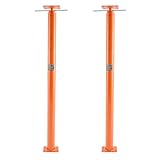
For structural or house floor jacks, the measurement refers to the supported height range rather than a short lifting stroke. For example, a two-piece VEVOR house floor jack set is advertised with a 54- to 150-inch range, equal to 137.2 to 381 cm. That is intended for temporary support and adjustment in buildings, not for lifting a vehicle.
Standard Sizes
The table below shows common floor jack dimensions and representative examples. Exact measurements vary by manufacturer, saddle design, handle position, and wheel configuration, so confirm the specification sheet before purchase.
| Floor jack type | Minimum height | Maximum height | Typical overall size | Typical capacity | Typical price |
|---|---|---|---|---|---|
| Ultra-low automotive jack | 2.5–3 in (6.4–7.6 cm) |
14–19 in (35.6–48.3 cm) |
24–29 in long × 10–13 in wide (61–73.7 × 25.4–33 cm) |
2–3 tons (4,000–6,000 lb) |
$140–$220 |
| Standard garage floor jack | 5–6 in (12.7–15.2 cm) |
18–21 in (45.7–53.3 cm) |
25–30 in long × 11–14 in wide (63.5–76.2 × 27.9–35.6 cm) |
2–3 tons (4,000–6,000 lb) |
$80–$180 |
| Low-profile high-reach jack | 3–4 in (7.6–10.2 cm) |
22–24 in (55.9–61 cm) |
27–32 in long × 12–15 in wide (68.6–81.3 × 30.5–38.1 cm) |
3 tons (6,000 lb) |
$220–$350 |
| SUV or truck floor jack | 5–6.5 in (12.7–16.5 cm) |
23–30 in (58.4–76.2 cm) |
28–34 in long × 12–16 in wide (71.1–86.4 × 30.5–40.6 cm) |
3–4 tons (6,000–8,000 lb) |
$90–$300 |
| House or support floor jack | 54 in (137.2 cm) |
150 in (381 cm) |
Varies by post and base | Up to 11,200 lb (5,080 kg), depending on set |
$130–$200 |
A SATA 3-ton automotive floor jack is an example of the ultra-low category, with a stated minimum height of 2 11/16 inches, or approximately 6.8 cm. Its listed price is $165.99. A Road DAWG 3-ton low-profile, high-reach jack is positioned at the more expensive end, with a listed price of $281.54. The BIG RED T83006 is marketed for SUVs and extended-height trucks, has a 3-ton rating, and is listed at $89.99. These prices illustrate why lift range and intended vehicle type should be compared alongside capacity.
How to Measure Your Space
- Park on a level, hard surface. Use concrete or another stable floor. Do not measure on soft soil, loose gravel, or a sloped driveway.
- Find the actual lifting point. Consult the vehicle manual and identify the approved pinch weld, frame point, axle, or differential location. The lowest body panel is not always the correct point.
- Measure minimum clearance. Place a tape measure vertically from the floor to the lifting point. Record the smallest measurement, not the average clearance under the vehicle.
- Allow a safety margin. Choose a jack that is at least 1/2 inch, or 1.3 cm, shorter than the available clearance. This helps account for small floor irregularities and tire pressure differences.
- Measure required working height. Determine how high the tire, suspension component, or frame must rise for the job. Add the height of the jack saddle and any approved adapter to the calculation.
- Check the jack’s footprint. Measure the open floor area beside and beneath the vehicle. A 30-inch-long jack needs room for its body and handle, and its wheels must remain fully supported.
- Check storage clearance. Measure the shelf, cabinet, or corner where the jack will be stored. A folded handle may still add 20 to 30 inches, or 50.8 to 76.2 cm, to the required length.
- Match capacity to the load. A 3-ton jack is rated for 6,000 pounds, but it does not mean the entire vehicle should be lifted at once. The jack must support only the portion of the vehicle being raised, and jack stands must support the vehicle during work.
By Room or Use Case
Home garage
For a typical sedan, coupe, or crossover, a 2- or 3-ton jack with a 3- to 21-inch range is a practical starting point. Low-profile models are helpful for lowered cars, but their long frames can take more storage space. Leave a clear working zone of at least 36 inches, or 91.4 cm, around the side of the vehicle where the jack will be used.
Sports cars and lowered vehicles
Measure carefully before choosing a jack. If the lifting point is only 3 1/2 inches, or 8.9 cm, above the floor, a standard 5-inch jack will not fit. An ultra-low model around 2 1/2 to 3 inches provides useful clearance. Check whether a rubber saddle pad or lifting puck reduces the available height.
SUVs and pickup trucks
Trucks often require more maximum height than ordinary cars. A jack reaching 23 to 30 inches may be more suitable, particularly when lifting an axle or frame. Confirm the jack’s width and wheel clearance, because a large chassis can make it difficult to position a narrow jack squarely.
Furniture, beams, and house support
House floor jacks are tall, adjustable support tools rather than automotive service jacks. A model with a 54- to 150-inch range can fit applications from roughly 4 1/2 feet to 12 1/2 feet. Use the manufacturer’s load rating, base requirements, and installation instructions. Because structural loads can shift, consult a qualified professional before using one to support a beam, ceiling, wall, or floor.
Common Sizing Mistakes
- Confusing maximum height with total height. A 21-inch lift rating does not mean the jack is 21 inches tall when stored.
- Ignoring the saddle. The saddle may add several inches to the contact point, especially with an adapter.
- Buying by tonnage alone. Capacity does not tell you whether the jack will fit under the vehicle or reach the lifting point.
- Forgetting travel space. A rolling jack may move several inches as it rises. The wheels need a clear path.
- Using a vehicle jack for structural work. Automotive floor jacks are not substitutes for rated house support jacks or permanent structural supports.
- Skipping jack stands. A hydraulic jack is for lifting, not for supporting a vehicle while someone works underneath it.
- Measuring the wrong location. Ground clearance at the rocker panel may differ substantially from clearance at the approved lifting point.
FAQ
What lift height do I need for a car?
Most cars need approximately 18 to 21 inches of maximum lift for wheel, brake, and suspension work. The exact requirement depends on the lifting point and tire diameter. Measure first rather than relying on vehicle class alone.
Is a 3-ton floor jack enough for an SUV?
Often, yes, if the SUV’s portion of the lifted load is within the jack’s rating and the jack reaches the approved lifting point. A 3-ton rating equals 6,000 pounds, but you still need to check minimum height, maximum height, saddle size, and stability.
How low should a low-profile floor jack be?
For most lowered cars, a minimum height between 2 1/2 and 3 inches is useful. Compare that figure with the measured lifting-point clearance and allow at least a small margin. A low-profile design is not automatically better if its maximum height is insufficient.
Can a house floor jack lift a vehicle?
Do not assume it can. House floor jacks are built around tall support ranges and structural applications, while automotive jacks are designed for rolling loads and vehicle lifting points. Use each tool only for its stated purpose and capacity.