Key takeaways
- 1/4-inch drive: 4–14 mm and 5/32–9/16 inch sockets for small fasteners, appliances, bicycles, trim, and tight engine-bay work.
- 3/8-inch drive: 8–19 mm and 1/4–3/4 inch sockets for routine vehicle maintenance, furniture assembly, lawn equipment, and household repairs.
- 1/2-inch drive: 10–24 mm and 3/8–1 inch sockets for lug nuts, suspension hardware, mower blades, and stubborn bolts.
What's inside
The Short Answer
For most home garages, the right choice is a 3/8-inch-drive socket set with both SAE and metric sockets, plus a small 1/4-inch-drive set for compact spaces. If you work on trucks, larger SUVs, lawn tractors, or suspension components, add a 1/2-inch-drive breaker bar and socket set.
A practical first setup includes:
As an Amazon Associate we earn from qualifying purchases at no extra cost to you. Product prices and availability are accurate as of the date shown and are subject to change.


- 1/4-inch drive: 4–14 mm and 5/32–9/16 inch sockets for small fasteners, appliances, bicycles, trim, and tight engine-bay work.
- 3/8-inch drive: 8–19 mm and 1/4–3/4 inch sockets for routine vehicle maintenance, furniture assembly, lawn equipment, and household repairs.
- 1/2-inch drive: 10–24 mm and 3/8–1 inch sockets for lug nuts, suspension hardware, mower blades, and stubborn bolts.
If you are buying only one complete kit, look for a 150- to 230-piece mechanics tool set with 1/4-, 3/8-, and 1/2-inch drives. These typically cost about $65 to $150 and provide the most useful coverage for a home garage. For light-duty household jobs only, a compact 1/4-inch-drive kit in the $15 to $35 range can be enough.
In 2026, most home vehicle and equipment repairs still require a mix of metric and SAE sizes. Even if your current car is metric, SAE sockets are useful for older vehicles, American-made outdoor equipment, shelving hardware, and miscellaneous garage projects.
Standard Sizes
Socket “size” can refer to two different measurements: the drive size, which is the square opening that connects to a ratchet, and the fastener size, which is the width of the nut or bolt head. Drive size determines strength and access; socket size determines whether it fits the fastener.
| Drive size | Square drive measurement | Metric socket range for a useful home set | SAE socket range for a useful home set | Best uses |
|---|---|---|---|---|
| 1/4 inch drive | 0.25 in / 0.64 cm | 4–14 mm / 0.16–0.55 in | 5/32–9/16 in / 0.40–1.43 cm | Small screws and bolts, electronics, bicycles, hose clamps, interior trim, compact engine spaces |
| 3/8 inch drive | 0.375 in / 0.95 cm | 8–19 mm / 0.31–0.75 in | 1/4–3/4 in / 0.64–1.91 cm | Oil changes, spark plugs, brake work, mower repairs, shelving, general garage maintenance |
| 1/2 inch drive | 0.50 in / 1.27 cm | 10–24 mm / 0.39–0.94 in | 3/8–1 in / 0.95–2.54 cm | Lug nuts, suspension bolts, trailer hardware, mower blades, large outdoor equipment |
| 3/4 inch drive | 0.75 in / 1.91 cm | 19–36 mm / 0.75–1.42 in | 3/4–1 1/2 in / 1.91–3.81 cm | Heavy trucks, farm equipment, large machinery; usually unnecessary at home |
For a standard passenger car, the most frequently used metric sizes are 8 mm, 10 mm, 12 mm, 13 mm, 14 mm, 15 mm, 17 mm, 18 mm, and 19 mm. The 10 mm socket is especially common for battery terminals, small brackets, covers, and engine-bay fasteners. Common SAE sizes include 1/4 inch, 5/16 inch, 3/8 inch, 7/16 inch, 1/2 inch, 9/16 inch, and 5/8 inch.
Choose a set with both shallow and deep sockets. Shallow sockets work where clearance is limited. Deep sockets fit over long bolt threads and are useful for spark plugs, exhaust hardware, and nuts on threaded studs. A good home set should include six-point sockets for maximum grip. Twelve-point sockets can be useful in tight swing areas, but they are more likely to round a damaged or rusty fastener.
How to Measure Your Space
A socket set does not require much room, but its storage case, drawers, and working clearance should fit your garage layout. Measure before choosing a large mechanics kit or rolling chest.
- Measure the storage footprint. Identify a shelf, cabinet, workbench drawer, or wall cabinet for the case. Compact 1/4-inch kits often fit in a case about 10 to 12 inches wide. Larger 200-plus-piece mechanics kits may need roughly 18 to 22 inches of width, 14 to 18 inches of depth, and 4 to 6 inches of height.
- Check drawer depth. Measure from the front of the drawer to its back wall. Allow at least 1 inch of extra space beyond the case depth so the drawer closes without pinching handles or latches.
- Check vertical clearance. A socket case stored under a bench needs enough height to lift it out comfortably. Plan for the case height plus 2 inches for your fingers and the lid.
- Measure workbench clearance. Reserve a clear work area at least 24 inches wide by 18 inches deep for laying out sockets, a ratchet, extensions, and removed hardware. A 36-inch-wide bench is more comfortable for automotive work.
- Consider carrying weight. A small 40- to 60-piece kit may weigh 3 to 6 pounds. A 200- to 230-piece mechanics set commonly weighs about 20 to 30 pounds once the case is full. Store heavier kits below waist height rather than on a high shelf.
- Plan for future tools. Leave room beside the socket set for a torque wrench, breaker bar, pliers, screwdrivers, and a small organizer for loose fasteners. A 1/2-inch-drive breaker bar is commonly 18 to 24 inches long.
By Room or Use Case
Apartment, Condo, or Small Utility Closet
Choose a 1/4-inch-drive set with a ratchet, 4–14 mm metric sockets, 5/32–9/16 inch SAE sockets, extensions, and screwdriver bits. A 46-piece kit around $15 to $30 is suitable for furniture, appliance panels, bicycles, and small repairs. Its case is usually small enough for a closet shelf or kitchen utility cabinet.
A compact kit is not the right tool for lug nuts or heavily tightened automotive bolts. Its smaller ratchet and sockets are designed for access, not high torque.
Typical One- or Two-Car Home Garage
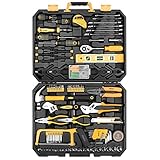
A 150- to 230-piece set with 1/4-, 3/8-, and 1/2-inch drives is the best all-around option. Look for metric and SAE shallow sockets, a selection of deep sockets, at least two extensions, a universal joint, and combination wrenches. Expect to spend approximately $65 to $150.
For example, a larger 230-piece mechanics set priced around $129 gives a household broad size coverage without requiring separate purchases immediately. Keep the main case in a base cabinet or on a lower workbench shelf, since a full kit can be awkward to carry.
Vehicle Maintenance and DIY Car Repair
Start with 3/8-inch drive, then add 1/2-inch drive for wheel and suspension work. Your minimum useful socket range is 8–19 mm, with deep 10 mm, 13 mm, 14 mm, 15 mm, 17 mm, 18 mm, and 19 mm sockets. Add a spark-plug socket that matches your vehicle, commonly 5/8 inch or 14 mm, but verify the owner’s manual before buying.
For wheel service, use a correctly sized impact socket only if you own an impact wrench. A hand ratchet should not be used to final-tighten lug nuts; use a torque wrench and follow the vehicle manufacturer’s specified torque value.
Lawn, Garden, and Outdoor Equipment
A mixed SAE and metric 3/8-inch-drive set covers most push mowers, snow blowers, pressure washers, garden carts, and small engines. A 1/2-inch-drive socket and breaker bar are useful for mower blade bolts and stubborn trailer hardware. Deep sockets help with long studs on mower decks and outdoor equipment frames.
Furniture, Shelving, and General Household Repairs
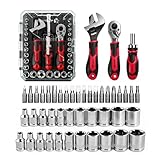
A compact mixed tool kit with a 1/4-inch ratchet, bit sockets, hex keys, screwdriver, and adjustable wrench is often more convenient than a large automotive case. Combination kits priced around $30 to $70 can be a practical secondary set for the house, while the larger mechanics set stays in the garage.
Common Sizing Mistakes
- Buying by piece count alone. A 228-piece kit may include bits, hex keys, and duplicates, while a smaller kit may have better socket coverage. Check the actual metric and SAE size list.
- Skipping metric sockets. Most modern vehicles and many imported tools use metric fasteners. A SAE-only set is limiting for a home garage.
- Using an adjustable wrench instead of the correct socket. Adjustable jaws can slip and round bolt heads. Use the exact socket whenever possible.
- Confusing socket size with drive size. A 13 mm socket may be available in 1/4-, 3/8-, and 1/2-inch drive. The 13 mm opening fits the fastener; the drive determines the ratchet connection.
- Forcing a near-match. A 1/2-inch socket is not a substitute for 13 mm, and a 9/16-inch socket is not a substitute for 14 mm. Near matches can damage fasteners.
- Ignoring deep sockets and extensions. A standard socket cannot reach a recessed nut or fit over a long threaded stud. At least one 3-inch extension and a few deep sockets save repeated frustration.
- Using a small drive for high-force jobs. Do not use a 1/4-inch ratchet on wheel, suspension, or seized hardware. Move to 1/2-inch drive and use a breaker bar when appropriate.
FAQ
What is the best socket set size for a beginner?
A beginner should buy a mixed SAE and metric set with 1/4-inch and 3/8-inch drives. For a garage that includes vehicle work, choose a set that also includes 1/2-inch drive. A 150- to 230-piece mechanics set is usually the most complete starting point.
Do I need SAE sockets if my car uses metric bolts?
Yes, if your budget and storage space allow. Metric sockets handle most modern vehicle work, but SAE sizes remain useful for older equipment, home fixtures, outdoor tools, and hardware from American manufacturers.
Should I buy deep sockets or regular sockets?
Buy both. Regular, or shallow, sockets fit more easily in tight spaces. Deep sockets reach nuts located on long bolts and are useful for spark plugs, studs, and recessed fasteners. If choosing only a few deep sockets, prioritize commonly used sizes from 10 mm through 19 mm.
What size socket do I need for lug nuts?
Many passenger vehicles use lug nuts between 17 mm and 21 mm, or SAE equivalents such as 3/4 inch and 13/16 inch. There is no universal size, so confirm your vehicle’s lug-nut size with its owner’s manual or test-fit a socket before applying force. Use a 1/2-inch-drive socket and torque wrench for final tightening.