Key takeaways
- A huge peak-amp claim with no engine-size guidance, starting-amp rating, battery capacity, or clear testing information.
- Very thin cables, small clamps, loose hinges, or a cable connection that feels weak.
- No reverse-polarity warning or unclear instructions for connecting the clamps.
- A warranty that covers only the plastic housing and excludes the battery.
- A product that arrives partially charged, lacks a proper charger, or provides no recommended recharge schedule.
- Claims that one compact unit will reliably start every gasoline and diesel engine in every temperature without conditions.
- Accessories that appear to be included in photos but are not listed in the package contents.
What's inside
Shopping for a jump starter can look like a simple numbers game: find the biggest peak-amp rating, pay as little as possible, and keep the unit in the trunk. That approach can leave you with a bulky device that will not hold a charge, cables that are too short, or a peak rating that says little about real-world starting power.
The better question is not simply “how many amps do I need?” It is “how to choose a jump starter peak amps rating that matches my vehicle, climate, storage habits, and backup needs?” Peak amps are only one part of the decision. Cable quality, battery capacity, clamp design, recharge options, safety features, and warranty support often matter just as much.
As an Amazon Associate we earn from qualifying purchases at no extra cost to you. Product prices and availability are accurate as of the date shown and are subject to change.


This guide explains what to look for in 2026, using common portable jump boxes as reference points. Product claims vary by brand, and peak-amp figures are not always measured under identical conditions, so treat them as a comparison starting point rather than a laboratory ranking.
Decide These 3 Things First
- Your engine type and size: A small four-cylinder gasoline engine generally needs less starting assistance than a large V8, diesel pickup, van, or commercial vehicle. Gasoline engines are usually easier to start than diesel engines because diesel vehicles use higher compression and may require glow-plug power in cold weather.
- How often you will use it: For a once-a-year emergency, a compact lithium unit with a USB-C charger may be the most practical choice. For frequent use, a workshop, multiple vehicles, or roadside work, consider a heavier jump starter with thicker cables, a larger internal battery, and a longer warranty.
- What else it must do: Some models are jump starters only. Others function as power banks, flashlights, tire inflators, or 12-volt power sources. Extra functions add convenience, but they can increase cost, weight, and the number of parts that can wear out.
Size and Weight
Size affects whether you will actually keep the jump starter charged and accessible. Compact lithium models commonly measure about 7 to 10 inches long, 3 to 4 inches wide, and 1.5 to 3 inches thick. Many weigh roughly 2 to 4 pounds, making them easy to store under a seat or in a glove-box-sized compartment, although the cables and case may require more room.
Heavier portable units often measure about 12 to 18 inches long and weigh 15 to 25 pounds. Their larger batteries can support more repeated starts, but they are less convenient to carry across a parking lot. A traditional lead-acid unit may also need to remain upright and may be less tolerant of rough storage.
Check the complete packed dimensions, not just the jump box. A molded case, air-inflator hose, AC charger, and cable compartment can add several inches. If you drive a sedan or compact crossover, a 3-pound lithium unit may be sufficient. For a truck, diesel SUV, boat, or farm vehicle, the extra size of a professional-style unit may be worthwhile.
Materials and Battery Type
Most modern compact jump starters use lithium-ion batteries, while larger traditional units often use sealed lead-acid batteries. Lithium models are lighter and typically include USB outputs for charging phones and other small devices. Lead-acid models are heavier but can offer a substantial physical battery reserve and may be better suited to repeated use when kept properly charged.
Look for a housing made from thick, impact-resistant plastic with rubberized bumpers around corners. Rubber covers over the clamps and charging ports help protect against dust and accidental contact. A water-resistant rating is useful, but “water resistant” does not mean the unit can be submerged or left outdoors.
Pay attention to operating and storage temperatures. Cold weather reduces battery performance, especially in lithium units. Do not assume that a jump starter advertised for a large diesel engine will deliver its full advertised performance after sitting in a freezing trunk for months. Store it according to the manufacturer’s instructions and recharge it on a schedule.
Construction and Cable Design
Construction quality is easier to judge from the cables and clamps than from the peak-amp number. Look for cables at least 12 to 18 inches long on a compact model, with thicker, flexible insulation that does not become stiff in cold weather. Longer leads, around 20 to 30 inches, make it easier to reach battery terminals in a large engine bay.
Clamps should open wide enough to grip common top-post battery terminals and should have strong springs. Copper-coated or copper-alloy jaws can provide good contact, but the design matters more than the label. A clamp that barely reaches the terminal or slips under tension is a practical failure point.
Safety electronics should include reverse-polarity protection, short-circuit protection, over-temperature protection, and an audible or visual warning when the connection is incorrect. A manual override can help with a deeply discharged battery, but it should be used only when you have confirmed the positive and negative connections.
Inspect the cable connection where it enters the housing. A flexible strain relief is preferable to a sharp bend or a thin molded joint. For repeated professional use, replaceable or serviceable cables can be more valuable than a higher advertised peak rating.
Handling and Starting Performance
Peak amps describe the highest burst of current a unit claims to provide. Cranking amps or starting amps, when listed, are often more useful because they describe sustained output under a defined test condition. Unfortunately, brands do not always publish comparable measurements. A 6,000-amp claim from one manufacturer cannot automatically be compared with a 1,700-amp claim from another.
For a typical four-cylinder or six-cylinder gasoline vehicle, a reputable unit rated around 1,000 to 1,500 peak amps may be adequate when the battery is weak but not completely failed. A unit in the 1,500-to-2,500-peak-amp range provides more margin for larger gas engines, cold weather, and older batteries. Large diesel engines may justify a model advertised at 2,000 peak amps or more, but verify the manufacturer’s engine-size guidance rather than relying on the number alone.
Controls should be large enough to operate while wearing gloves. A battery-status display is more useful than a row of vague lights because it shows whether the unit needs charging before an emergency. An LED work light is convenient; USB-A and USB-C ports are helpful if you want the jump starter to serve as a power bank.
Do not crank continuously. Most manufacturers recommend short attempts, often around 3 to 5 seconds, followed by a cooling pause. Repeated long cranking can overheat the starter, cables, or jump box.
Price Tiers
Budget: $45 to $90. This tier is dominated by compact lithium units advertised from roughly 1,000 to 8,000 peak amps. They commonly include a flashlight, USB charging, a digital display, and basic smart clamps. The OXILAM 6,000A and TREKURE 8,000A examples are listed at $59.99, but buyers should examine the warranty, cable thickness, charging instructions, and independent owner feedback rather than assuming the larger number means greater output.
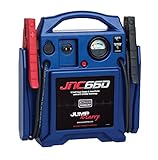
Midrange: $90 to $160. These models may offer stronger housings, longer cables, larger battery capacity, better displays, or more reliable accessories. The Clore Automotive Jump-N-Carry JNC660, listed at $126.02 with a 1,700-amp peak rating, illustrates why a lower peak number can still appeal to buyers who prioritize a known automotive-tool design and substantial construction.
Premium: $160 to $250 or more. Premium units may add a tire inflator, AC power options, heavy-duty clamps, higher usable capacity, or commercial-oriented support. The DEWALT DXAEJ14 is listed at $169 and combines a 1,600-amp jump starter with a 120 PSI air inflator. This category is most sensible when you will use the extra functions, not simply because the price suggests stronger starting performance.
Warranty and Battery Support
Look for at least a one-year warranty; two years is preferable for a frequently used unit. Confirm whether the warranty covers the internal battery, cables, charger, and inflator separately. Some warranties exclude capacity loss, accidental damage, or units that were stored discharged.
Ask how often the product should be recharged. A jump starter that sits at zero percent for months may be unavailable when needed. Many manufacturers recommend checking the charge every 30 to 90 days. A USB-C input can make maintenance easier because you may already have a compatible vehicle or wall charger.
Also check whether replacement clamps, charging cables, and protective cases are available. A repairable $130 unit may have a lower long-term cost than a $60 product that must be discarded after one failed cable.
Delivery, Storage, and Setup
Unlike furniture, a jump starter needs no assembly, but setup still matters. Allow about 10 minutes to inspect the clamps, charge the unit fully, read the connection sequence, and test the flashlight or display. If the product includes an inflator, store the hose and adapters together so they are not lost.
Keep the unit secured so it does not slide around the trunk. Avoid leaving lithium batteries in extreme heat for long periods; a closed vehicle can become much hotter than the outdoor temperature. Do not store the jump starter in a damp compartment or directly against loose metal tools.
Spec Checklist
| Spec | Budget | Mid | Premium |
|---|---|---|---|
| Typical price | $45–$90 | $90–$160 | $160–$250+ |
| Advertised peak amps | 1,000–8,000 | 1,200–2,500 | 1,500–3,000+ |
| Typical weight | 2–4 lb | 4–15 lb | 15–25 lb |
| Cable length | 12–18 in. | 18–24 in. | 20–30 in. |
| Engine guidance | Small and midsize gas engines | Most gas engines; some diesel applications | Large gas, diesel, or multiple vehicles |
| Extra features | Flashlight, USB ports | Display, USB-C, better clamps | Inflator, AC output, heavy-duty accessories |
| Warranty target | 1 year | 1–2 years | 2 years or more |
Red Flags
- A huge peak-amp claim with no engine-size guidance, starting-amp rating, battery capacity, or clear testing information.
- Very thin cables, small clamps, loose hinges, or a cable connection that feels weak.
- No reverse-polarity warning or unclear instructions for connecting the clamps.
- A warranty that covers only the plastic housing and excludes the battery.
- A product that arrives partially charged, lacks a proper charger, or provides no recommended recharge schedule.
- Claims that one compact unit will reliably start every gasoline and diesel engine in every temperature without conditions.
- Accessories that appear to be included in photos but are not listed in the package contents.
FAQ
How many peak amps do I need for a car?
For many four-cylinder and six-cylinder gasoline cars, a reputable unit rated around 1,000 to 1,500 peak amps is a reasonable starting point. Choose more capacity for cold climates, older vehicles, large engines, or frequent use. Always follow the product’s stated engine-size limits.
Are higher peak amps always better?
No. Peak amps are not measured identically across all brands. Cable quality, sustained output, battery capacity, clamp contact, temperature performance, and safety controls can matter more than the largest number on the package.
Can a jump starter start a completely dead battery?
Sometimes, but not always. A battery with a very low voltage, internal damage, or a failed cell may not accept a jump. Some units include a manual override for low-voltage situations, but use it only with the correct polarity and according to the instructions.
Should I buy a jump starter with an air compressor?
Buy one with an inflator if you regularly need emergency tire top-offs and accept the added weight and cost. A 120 PSI rating describes the compressor’s maximum pressure, not necessarily its speed. For routine inflation, compare the hose length, pressure display, automatic shutoff, and duty-cycle instructions.