Key takeaways
- Pro: The 31″-56″ adjustment range eliminates guesswork when your next tire size changes.
- Pro: At under $63 it is one of the most affordable wall-mount options that still carries a published spec sheet rather than vague claims.
- Con: Owner feedback notes the wall anchors included in the box are adequate for drywall over studs but undersized for masonry, so budget extra for proper concrete fasteners if you mount into a block wall.
Stacking tires in a corner of the garage is a slow-motion disaster. They roll, they flatten against each other, and within a season you’re dealing with dry rot on the sidewalls that face up. A proper rack solves the problem by holding each tire independently, distributing weight evenly, and keeping rubber off concrete where moisture accelerates degradation. The question is not whether you need one, but which design matches your tire size, available floor space, and how often you actually rotate through your set.
Across the listings that buyers pull up from any tire rack official website search, the market splits into two camps: wall-mount units that disappear against the garage wall and rolling or freestanding racks that let you roll a loaded set out of the way. Wall-mounts win on floor space and typically cost less per tire position, while rolling racks win on flexibility because you can reposition a full load without lifting a single tire. Owner feedback consistently highlights load capacity, caster quality, and whether the arms accept your actual tire width. We compared the following eight options on published specifications, listed prices, and what owners report about day-to-day use.
Our top picks


As an Amazon Associate we earn from qualifying purchases at no extra cost to you.
Quick Picks
| Product | Best For | Price |
|---|---|---|
| JY PERFORMANCE Wall Mounted | Home garages with standard passenger tires | $62.99 |
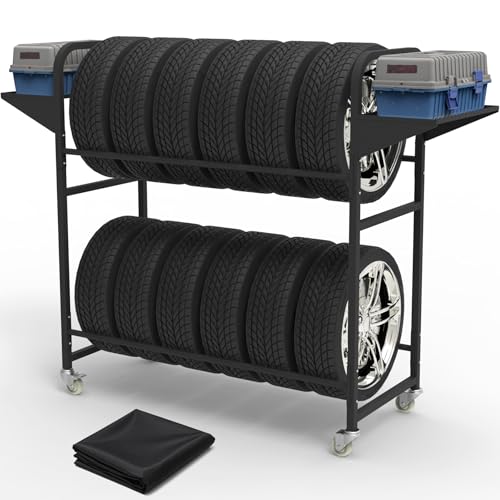
| NULTRUMA Rolling Rack | Garage owners who reposition stored tires seasonally | $185.99 |
| Neorexon 57″ with Cover | Dust-sensitive storage in open or shared garages | $169.99 |
| SafeRacks Wall Mount | Wide tires up to 400 lb per pair | $69.98 |
| Semi Truck Spare Tire Rack | Class 8 truck owners mounting a spare underneath | $72.99 |
| ZUIWAN Rolling Rack | Maximum load capacity on a mobile base | $193.64 |
| ROBLOCK Folding Wall Rack | Tight spaces where the rack must collapse when idle | $48.44 |
| Neorexon 44″ with Cover | Compact footprint with weather protection | $113.99 |
How We Picked
We filtered on four criteria that separate racks people use for years from ones that end up in the scrap pile. First, width and diameter range: the rack must physically accept your tires without modification. Second, load capacity per arm or per tier, because a rating that only applies to ideal conditions is misleading. Third, real-world assembly quality reflected in owner feedback on hardware fit, weld consistency, and finish durability. Fourth, whether the storage method protects sidewalls from dust, UV, or concrete moisture over months of storage.
The 8 Best Tire Rack Official Website in 2026
JY PERFORMANCE Adjustable Wall Mounted Tire Rack, Fits 31″-56″ Wide
This unit targets the most common home garage scenario: four to six passenger or light truck tires stored against a wall with limited floor space. The adjustable arms accommodate a very wide diameter range from 31 to 56 inches, which covers everything from a sedan set to lifted truck mud-terrains without needing a different rack.
- Pro: The 31″-56″ adjustment range eliminates guesswork when your next tire size changes.
- Pro: At under $63 it is one of the most affordable wall-mount options that still carries a published spec sheet rather than vague claims.
- Con: Owner feedback notes the wall anchors included in the box are adequate for drywall over studs but undersized for masonry, so budget extra for proper concrete fasteners if you mount into a block wall.
Skip this if you need to move a loaded rack across the garage or if your tires exceed the per-arm weight the published capacity supports.
NULTRUMA Adjustable Rolling Tire Rack
The NULTRUMA suits someone who wants to roll a full set of tires to the driveway at tire-change time rather than hauling them one at a time off a wall. Standing at 59″ H by 58.6″ W, it holds four tires on adjustable tiers and folds flat against a hole board panel when not in use. The four self-locking casters keep it planted while loading.
- Pro: Self-locking casters prevent the rack from rolling away while you wrestle a heavy tire onto an upper tier.
- Pro: The foldable hole-board design lets you store the rack against a wall when tires are mounted on the vehicle.
- Con: At $185.99 it costs roughly three times a comparable wall-mount, and the price premium only makes sense if you genuinely reposition stored tires.
Skip this if your garage layout always keeps tires in one spot and you have clear wall space.
Neorexon Tire Storage Rack 57″ x 55.1″ x 20″ with Anti-Dust Cover
This rack is built for garages where dust, sawdust, or pet hair accumulates during the off-season. The included anti-dust cover fully encloses the stored tires, which matters because contaminants embedded in rubber accelerate sidewall cracking far faster than UV alone.
- Pro: The full-enclosure cover is included rather than sold separately, adding genuine value at this price point.
- Pro: At 20″ deep it fits in shallow storage alcoves where wider freestanding racks cannot.
- Con: Owners report the cover fabric is thin enough that a snagged zipper or sharp stud on a tire can tear it, so it is a convenience item rather than a long-term weather barrier.
Skip this if your tires are mounted on rims and you need a design that accommodates the wheel barrel rather than the tire sidewall.
SafeRacks Heavy-Duty Adjustable Steel Wall Mount Tire Rack, Black, 400 lb
SafeRacks markets a 400 lb published capacity, which places this in the upper tier for wall-mount strength. The black powder coat finish resists the scuffs that come from sliding heavy tires on and off arms repeatedly. It suits owners of light trucks or SUVs running wide, heavy tires where a budget rack’s arms flex or fail.
- Pro: The 400 lb rating is specific and conservative relative to competitor claims, giving you headroom for a full truck set.
- Pro: Adjustable spacing lets you set arm width for 44″ to 54″ tires without buying a dedicated rack per size.
- Con: Installation requires precise stud location and level alignment; if your wall has irregular framing the rack sits crooked and tires roll.
Skip this if you rent and cannot drill into wall studs, or if your tire sizes are smaller than 44″ in diameter.
Semi Truck Spare Tire Rack for Class 8 Trucks
This is a niche product aimed squarely at commercial drivers who need a secure spare tire carrier beneath a Class 8 truck. The adjustable tire carrier accommodates the oversized tires used on tractor units, and the steel construction handles road vibration and weather exposure that would corrode a residential rack within a season.
- Pro: Designed for under-chassis mounting, it keeps the spare off the trailer deck and clears loading dock space.
- Pro: The adjustable clamping mechanism accepts a range of commercial tire diameters without shims or spacers.
- Con: At $72.99 the hardware set is bare-bones; owners note you will need to supply your own grade-8 bolts and lock washers for a secure under-truck install.
Skip this entirely if you are a passenger vehicle owner; the mounting geometry is wrong for anything smaller than a truck tire.
ZUIWAN Rolling Tire Rack, Height 59″, 660 lb Capacity
The ZUIWAN is the highest-capacity rolling option on this list at 660 pounds, which comfortably handles four light truck tires plus a set of rims. At 59″ tall it uses vertical space efficiently, and the four self-locking swivel casters allow repositioning even at full load. This suits the owner with multiple vehicle sets who wants a single mobile solution.
- Pro: The 660 lb capacity is the strongest published rating among rolling racks here, giving you margin for oversized tires.
- Pro: Swivel casters rotate a full load in place, useful in tight garages where you cannot pull the rack forward without clearance.
- Con: The highest price on the list at $193.64, and some owners report the tier spacing is fixed, so very wide tires on adjacent levels can contact each other.
Skip this if your tires are all the same narrow width and a wall-mount would free up floor space.
ROBLOCK Folding Tire Wheel Rack Wall Mount, 32″-48″, Red
The ROBLOCK wins on one metric: collapse when idle. The folding arms tuck flat against the wall, freeing up a path in a narrow garage aisle that a fixed-arm rack blocks permanently. At $48.44 it is also the cheapest option here, making it a low-risk entry for someone who has never used a tire rack.
- Pro: The fold-flat design means the rack occupies zero usable aisle space between tire-season changes.
- Pro: Lowest price on the list with a published 32″-48″ size range that covers most passenger tires.
- Con: Owner feedback indicates the 48″ upper diameter limit excludes larger truck tires, so verify your size before committing.
Skip this if your tires are wider than 48″ or if you need a rack that holds its arms open under partial loads.
Neorexon Tire Storage Rack 44″ x 44″ x 18″ with Anti-Dust Cover
The smaller Neorexon is the same design philosophy as the 57″ model in a footprint that fits inside a standard garage cabinet bay or under a workbench. The 44″ square frame holds two tires per tier across two levels, and the included cover protects against dust in shared or multi-purpose spaces.
- Pro: At 18″ deep it slides under shelving or into alcoves where the wider models physically cannot fit.
- Pro: The anti-dust cover protects tires in workshops where grinding, sanding, or wood dust contaminates exposed rubber.
- Con: The two-tier, four-tire capacity means owners with more than one set still need a second rack or a different solution.
Skip this if you need to store more than four tires; the compact footprint trades capacity for placement flexibility.
Buying Guide
Match Arm Width to Tire Diameter and Sidewall Height
Every rack lists a diameter range, but sidewall height also matters. A tall-walled mud-terrain tire at the upper end of a 31″-56″ range needs more vertical clearance between tiers than a low-profile summer tire at 31″. When shopping on any tire rack official website, check tier spacing rather than only the overall height. If a rolling rack lists tiers at 16″ apart and your tire is 15″ tall, you will have only an inch of clearance for the next tire down.
Wall Mount vs. Rolling: Floor Space Is the Deciding Factor
Wall-mount racks eliminate floor footprint entirely but require clear stud spacing and a fixed location. Rolling racks consume 20 to 25 inches of floor depth but let you move a loaded set without unmounting tires. If your garage has a concrete floor with no clear wall run of at least four feet, a rolling rack is the only option. Conversely, if the wall space is available and you change tires seasonally, wall-mounts cost less per position and never roll away.
Load Capacity: Per-Arm Rating Is What Actually Matters
A rack rated at 400 lb total might only support 100 lb per arm, which is sufficient for a 45 lb tire but leaves no margin if you store two tires side by side on one pair of arms. Look for per-arm or per-tier ratings rather than total capacity. A wall-mount rack with four arms each rated at 150 lb gives you confidence with heavy truck tires; one with 100 lb per arm does not.
Our Verdict
The JY PERFORMANCE Adjustable Wall Mounted Tire Rack is the top pick for most home garage owners. Its 31″-56″ range means one purchase covers every tire size you will likely run through the life of the rack, and the price is low enough that mounting it to studs requires minimal justification. The budget pick is the ROBLOCK Folding Wall Mount at $48.44, ideal if you want to test whether a rack solves your storage problem before investing in a permanent install. The ZUIWAN Rolling Rack wins if you routinely move stored tires between the garage and driveway for seasonal swaps, because the 660 lb capacity and self-locking casters make a full-load reposition a one-person job rather than a two-person lift.
FAQ
Can I store tires with rims on a wall-mount tire rack?
Yes, but only if the rack arms are wide enough to clear the rim barrel. Many budget wall-mounts have arms spaced for bare tires only, causing the rim lip to contact the wall or adjacent arms. Check the arm depth specification on the tire rack official website listing before ordering if your set stays mounted.
Do I need an anti-dust cover for garage-stored tires?
In a closed garage with low dust, a cover is optional. In shared spaces, workshops, or garages where you grind, sand, or store lawn equipment, airborne particulates embed in rubber and accelerate sidewall cracking. The Neorexon models include covers as standard, which adds measurable protection at no extra cost.
What hardware do I need for a concrete wall install?
Included anchor kits typically assume wood studs. For concrete or cinder block walls, buy wedge anchors or sleeve anchors rated for at least double the per-arm load. A 1/2″ wedge anchor in solid concrete supports well over 400 lb in shear, which clears the requirement for any rack on this list.
How many tires does a standard rack hold?
Most residential tire racks hold four tires, matching a single seasonal set. Rolling racks and larger wall-mounts sometimes accommodate six or eight. If you store two sets simultaneously, buy two smaller wall-mounts rather than one oversized rolling rack, since the per-position cost is lower and installation is simpler.