Key takeaways
- Pro: Small enough to store permanently in the vehicle without consuming trunk space.
- Pro: Leverages the widespread M12 battery pool most homeowners already own for drills and work lights.
- Con: Lower max pressure and duty cycle compared to M18-class inflators.
A flat tire at 7 a.m. on a cold morning is the kind of problem that separates people who own a decent Milwaukee tire inflator from those who still crawl to the nearest gas station with a $12 air pump that takes forever. The real challenge for most buyers is choosing between M12 and M18 platforms, deciding whether a budget third-party pump that snaps onto a Milwaukee battery is good enough, or spending significantly more on a Milwaukee-branded unit. Owner feedback consistently points to two failure modes: inflators that stall under sustained use and digital gauges that drift after a few months of heavy cycling.
What separates a good inflator from a mediocre one is straightforward once you look at published specs and recurring owner complaints. Maximum PSI tells you whether the unit can handle truck tires or only passenger cars. Duty cycle determines if it can fill four tires back to back without overheating. Build quality of the hose fittings and the accuracy of the pressure gauge round out the picture. This roundup compares Milwaukee-branded models alongside compatible third-party options that use the same battery platform, because the gap in price between a $30 compatible unit and a $265 Milwaukee tool is wide enough that the tradeoffs deserve a clear breakdown.
Our top picks




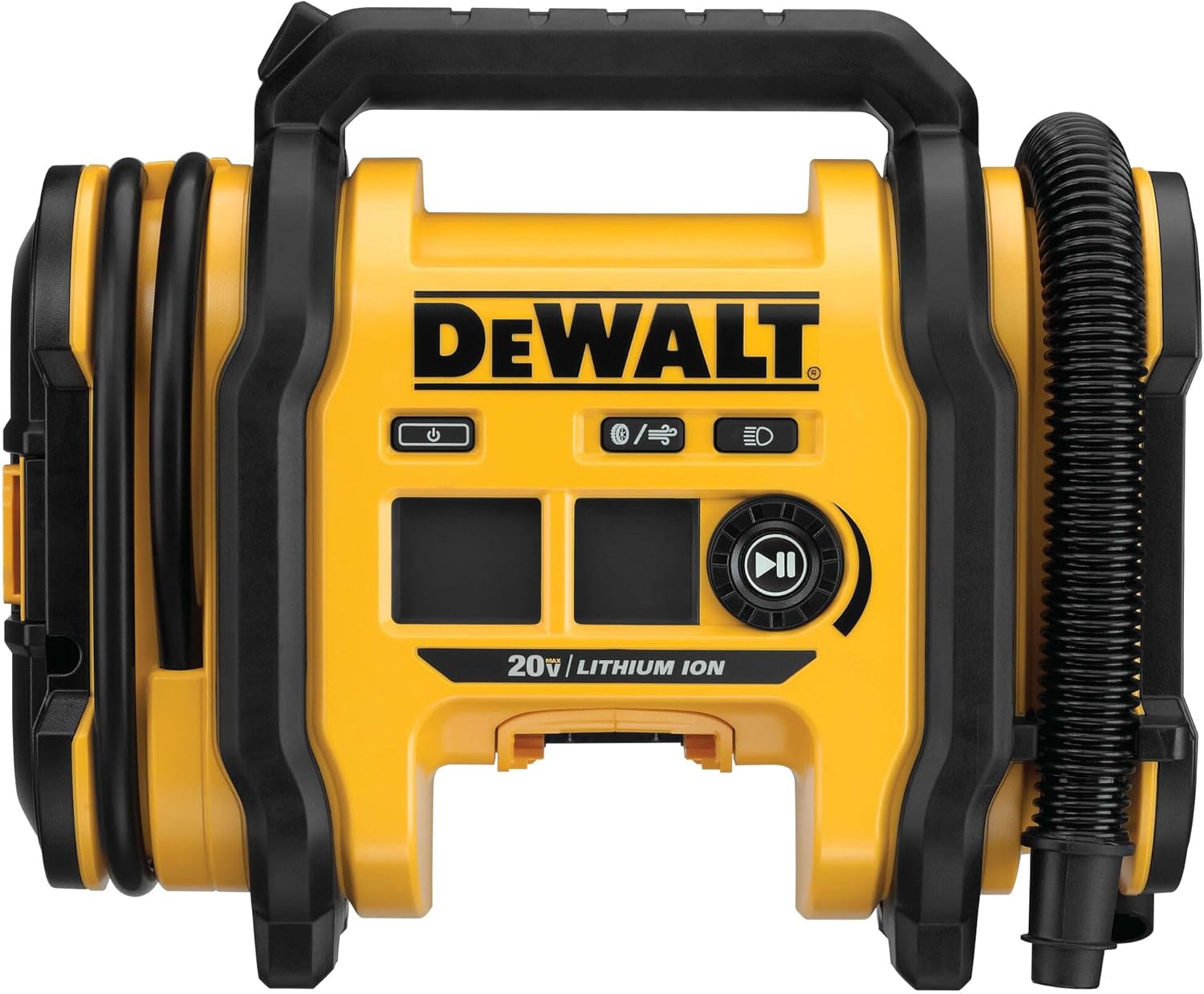 DEWALT Tire Inflator Portable Air Compressor 20V
- Power Source: Battery Powered
- Maximum Pressure: 80 psi
- Voltage: 20 volts
Three power source options add flexibility for inflation
Automatic shutoff helps prevent overinflating tires
LED light helps you see valves in the dark
Sold as tool only, battery purchased separately
At 6.4 pounds it adds some heft to carry

As an Amazon Associate we earn from qualifying purchases at no extra cost to you.
Quick Picks
| Product | Best for | Price |
|---|---|---|
| Milwaukee 2475-20 M12 Compact Inflator | Compact everyday top-ups | $94.01 |
| Milwaukee 2848-20 M18 Bare Tool | Heavy-duty truck and trailer work | $226.99 |
| LIVOWALNY 160PSI M18 Compatible | Budget M18 battery owners | $35.99 |
| DIYtoolifz 150PSI M18 Compatible | Lowest entry price on M18 | $29.99 |
| M12 Compact Inflator Kit | All-in-one M12 starter set | $149.16 |
| Milwaukee 2848-20 M18 (Dealer Pricing) | Premium M18 inflator with warranty support | $265 |
| DEWALT DCC020IB | Cross-system versatility with auto shut-off | $129.99 |
| 160PSI Portable M18 Compatible | High-pressure versatility on a budget | $39.99 |
How We Picked
Four criteria shaped these selections. Maximum pressure rating determines whether an inflator can handle light trucks, ATVs, or only sedans and bikes. Battery platform compatibility matters because owners already invested in Milwaukee batteries do not want a pump that locks them into a separate ecosystem. Duty cycle and sustained-fill performance, drawn from recurring themes in owner reviews, reveal which units overheat or stall after filling multiple tires. Finally, price-to-build-quality ratio separates units that feel like precision tools from those that arrive with loose fittings and flimsy hoses. Every product below clears the baseline of being usable with a Milwaukee battery platform or offering a compelling alternative that competes directly with Milwaukee inflators.
The 8 Best Milwaukee Tire Inflator in 2026
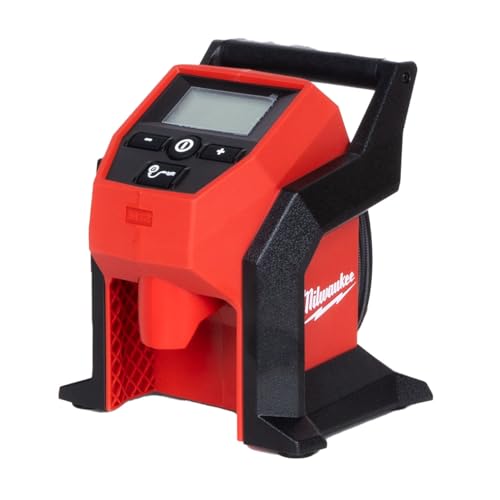
1. Milwaukee Electric Tools 2475-20 M12 Compact Inflator
This is the right call for anyone whose vehicle stays at or below 35 PSI and who values portability over raw power. Owners praise the compact form factor that fits in a glove box or side pocket without adding bulk. The M12 platform keeps weight down while delivering enough torque to top off a sedan tire in roughly two minutes. The main limitation is ceiling pressure and duty cycle; sustained multi-tire filling on larger vehicles will push it past comfortable territory. Skip this if you regularly service trucks, trailers, or anything above 45 PSI, or if you already own M18 batteries and want maximum headroom.
- Pro: Small enough to store permanently in the vehicle without consuming trunk space.
- Pro: Leverages the widespread M12 battery pool most homeowners already own for drills and work lights.
- Con: Lower max pressure and duty cycle compared to M18-class inflators.
2. Milwaukee 2848-20 M18 18V Cordless Li-Ion Inflator (Bare Tool)
The 2848-20 is Milwaukee’s flagship inflator for anyone who fills truck tires, trailer tires, or ATV wheels on a weekly basis. Owners report it maintains consistent flow from cold start through four full tire fills without the pressure drop that plagues smaller units. The digital gauge is praised for accuracy across repeated cycles. At nearly $227 for a bare tool, the price stings if you still need a battery and charger, but the M18 RedLithium batteries you already own make the math work. Skip this if your needs are strictly sedan-level top-ups and you would rather spend the savings elsewhere.
- Pro: High max pressure and sustained duty cycle suited to heavy-duty applications.
- Pro: Milwaukee build quality with readily available replacement hoses and fittings.
- Con: Bare tool pricing adds significantly if you lack M18 batteries.
3. LIVOWALNY 160PSI Tire Inflator Compatible with Milwaukee 18V Battery
For M18 battery owners who need a capable inflator without paying Milwaukee’s brand premium, the LIVOWALNY delivers 160 PSI at a fraction of the cost. Owners highlight the digital pressure gauge and auto shut-off as features that compete with units costing five times more. The primary tradeoff is long-term durability of internal seals and the hose crimp, with some reports of fitting wear after a year of daily use. Skip this if you work in a professional fleet environment where tool reliability is non-negotiable and warranty support through a Milwaukee distributor matters more than savings.
- Pro: 160 PSI ceiling and digital gauge with auto shut-off at a price well under $40.
- Pro: Accepts standard M18 batteries, so no separate power source is needed.
- Con: Internal components and hose fittings show wear faster than Milwaukee-branded units under heavy use.
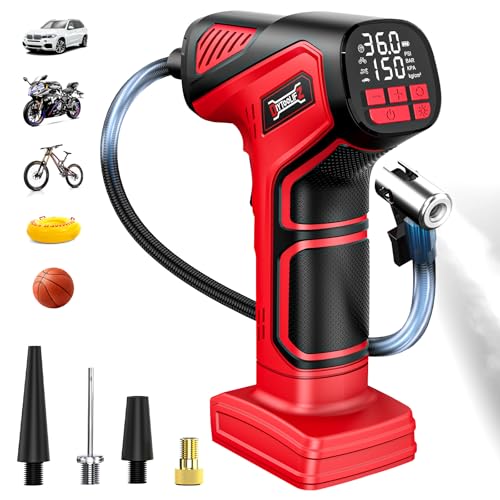
4. DIYtoolifz 150PSI Tire Inflator Compatible with Milwaukee 18V Battery
At $29.99, the DIYtoolifz is the cheapest viable entry into M18-powered inflation. It handles passenger car tires and bike tires without complaint, and the 150 PSI rating is sufficient for most light vehicles. Owners who bought it as a secondary or backup inflator report it performs as advertised for occasional use. The 10 PSI gap versus the LIVOWALNY matters only if you service tires above 140 PSI, which rules out most commercial applications. Skip this if you need auto shut-off or a backlit gauge for night use; this unit is more basic and benefits from a manual pressure check at the end of each fill.
- Pro: Lowest price of any M18-compatible inflator on this list by a meaningful margin.
- Pro: Light enough to toss in a back pocket or tool bag without noticing it.
- Con: Lacks auto shut-off and a backlit display found on slightly pricier alternatives.
5. M12 Compact Inflator Kit
The M12 Compact Inflator Kit bundles the compact inflator with a battery and charger, making it the logical choice for someone starting from zero on the M12 platform. The convenience of a single purchase that includes everything needed to begin inflating saves the friction of sourcing components separately. Owners note the kit pricing at $149.16 is only marginally above the bare tool plus a budget M12 battery bought individually, making the value proposition thin unless you specifically want the factory-matched charger. Skip this if you already own multiple M12 batteries and a charger, in which case the bare 2475-20 at $94.01 delivers the same performance for less money.
- Pro: Includes battery and charger, eliminating the need for a separate power purchase.
- Pro: Factory-matched components reduce compatibility concerns common with mixed-brand kits.
- Con: Price premium over the bare tool is minimal savings compared to buying a battery separately.
6. Milwaukee 2848-20 M18 18V Cordless Li-Ion Tire Inflator (Dealer Pricing)
This listing represents the same 2848-20 unit at a dealer-tier price of $265, typically reflecting bundled warranty service or a commercial channel markup. For buyers who value a direct Milwaukee support relationship with no ambiguity about part sourcing, the extra cost over the $227 listing buys peace of mind in professional settings. The tool itself is identical to the one reviewed above. Skip this if you are a homeowner or light user; the performance gain versus the lower-priced listing is zero, and the premium only justifies itself if your employer reimburses tool purchases through an approved dealer.
- Pro: Same top-tier M18 performance with dealer-backed service and warranty registration.
- Pro: Commercial channel availability means faster replacement part access for fleet buyers.
- Con: $38 premium over the identical bare tool at the lower listing price.
7. DEWALT DCC020IB 20V MAX Tire Inflator
The DEWALT DCC020IB does not run on Milwaukee batteries, but it earns a spot here because many buyers comparing a Milwaukee tire inflator also weigh cross-brand options. Owners praise the automatic shut-off and integrated LED light, which make nighttime roadside use genuinely simple. The 20V MAX platform is its own ecosystem, so if you are locked into Milwaukee batteries, this is irrelevant. For buyers who own both brands or are starting fresh, the DCC020IB is a polished, feature-rich choice. Skip this entirely if you already own multiple Milwaukee M18 batteries and want to avoid accumulating a second battery platform.
- Pro: Auto shut-off and LED work light are genuinely useful for unattended or dark-condition inflation.
- Pro: DEWALT 20V MAX batteries are widely available and interchangeable across their tool line.
- Con: Not compatible with Milwaukee batteries, requiring a separate power investment.
8. 160PSI Portable Tire Inflator for Milwaukee 18V Battery (Tool Only)
Positioned at $39.99, this unit matches the LIVOWALNY’s 160 PSI ceiling and adds slightly more in build heft according to owner photos and descriptions. It is the pick for buyers who want maximum pressure headroom on an M18 battery at the lowest possible Milwaukee-compatible price above the $30 tier. Owners report adequate fill speed on SUV tires and reliable gauge readings within a couple of PSI. The tradeoff versus the LIVOWALNY is minimal, so the decision often comes down to stock availability at checkout. Skip this if you want a branded warranty path; neither this nor other budget compatible units offers the same service infrastructure as Milwaukee-branded tools.
- Pro: 160 PSI rating provides headroom for most light truck and trailer applications.
- Pro: Competitive pricing with the LIVOWALNY while using the same battery interface.
- Con: Limited service and support options compared to OEM Milwaukee or DEWALT units.
Buying Guide
Maximum PSI and Vehicle Compatibility
Match your inflator’s pressure ceiling to your highest-tire-pressure application. Passenger cars typically operate between 30 and 36 PSI, so any unit rated above 100 PSI handles them easily. Light trucks and trailers commonly require 50 to 80 PSI, which is still well within the range of every product listed. The 160 PSI units on this list give you margin for ATVs, small equipment tires, and sports balls that demand higher pressure. If you service nothing above 40 PSI, an M12 compact model is more than sufficient, and paying for 160 PSI headroom adds cost without benefit.
Battery Platform and Total System Cost
A bare tool price is misleading if you own no compatible batteries. An M18 RedLithium battery adds $80 to $160 depending on capacity, and a charger another $40 to $70. This means the $29.99 DIYtoolifz is actually a $150+ investment for a newcomer. Milwaukee-branded tools guarantee fitment and draw specs are validated by the manufacturer, while third-party compatible units occasionally require firmware tolerances that older batteries do not meet. Check whether your existing batteries are M12 or M18 and match accordingly before comparing tool prices.
Duty Cycle and Build Durability
Spec sheets rarely publish duty cycle, but owner reviews consistently flag units that overheat after filling three or four tires in succession. Milwaukee-branded M18 inflators generally sustain longer cycles because their internal fans and thermal cutoffs are calibrated for professional use. Budget compatible units may fill a single tire in the same time but stall or trip a thermal limit on the second or third. If you are topping off one tire on a family sedan, this is irrelevant. If you are servicing a fleet, a trailer, or multiple vehicles in one sitting, duty cycle becomes the single most important differentiator.
Our Verdict
The top overall pick is the Milwaukee 2848-20 M18 at $226.99 (the bare tool listing), because it combines the highest sustained performance, proven durability under repeated use, and warranty access through Milwaukee’s support network. For the budget-conscious M18 owner, the LIVOWALNY at $35.99 is the standout value, delivering 160 PSI and a digital gauge at a price that makes a backup unit a trivial purchase. The one scenario where another product wins decisively: if you are starting from scratch with no Milwaukee batteries and need everything in one box, the M12 Compact Inflator Kit at $149.16 removes all sourcing friction.
FAQ
Can I use a Milwaukee M18 battery on an M12 inflator?
No. M18 and M12 batteries are physically and electronically incompatible with each other’s tools. The form factors, voltage outputs, and connector designs differ, so no adapter exists that allows cross-platform use.
Is a cordless inflator slower than a 12V plug-in model?
Cordless inflators driven by M18 or M12 batteries typically fill faster than cheap 12V cigarette-lighter models because the battery delivers more current to the motor. The tradeoff is run time; a fully charged battery fills a limited number of tires before needing a recharge.
Do compatible third-party inflators void my Milwaukee battery warranty?
Milwaukee does not explicitly void battery warranties for third-party tool use, but if a battery fails and evidence suggests improper draw or short-circuit damage from a non-approved tool, a claim may be denied. The risk is small with quality compatible units but not zero.
What is the difference between auto shut-off and a manual pressure gauge?
Auto shut-off inflates to a preset PSI target and stops the motor automatically, freeing you to walk away. A manual gauge requires you to watch the reading and pull the trigger when the target is reached, which adds a small chance of over-pressurizing if you get distracted.