Key takeaways
- Pro: Most refined app and scheduling experience of any unit tested
- Pro: Adjustable amperage from 16 to 50A handles any panel configuration gracefully
- Con: Priciest unit here, and the hardwired-only design adds electrician costs on top
Most EV drivers hit the same wall within the first few months of ownership. The included portable charger plugs into a standard outlet and adds maybe five miles per hour, which means you are either planning your life around slow charging or paying absurd amounts at public DC fast stations. A Level 2 home charger fixes that entirely. You pull into your garage, plug in, and wake up to a full battery no matter how far you drove the day before.
The hard part is choosing one. Amperage determines how fast you charge. Cable length determines whether you can actually reach your port. Smart features determine whether you can schedule around off-peak rates. And build quality determines whether the unit survives a Minnesota winter or a Phoenix summer. After installing and running these units on daily-driver vehicles for weeks at a stretch, the spread in real-world performance is wider than spec sheets suggest. This guide ranks the eight chargers that consistently delivered.
Our top picks
 ChargePoint HomeFlex Level 2 EV Fast Charger
- Charge with Confidence: ChargePoint builds reliable, flexible EV…
- Charge Smart: With the user-friendly ChargePoint Mobile App,…
- Vast Network: Wherever you go, ChargePoint’s network includes…


 EVIQO Level 2 EV Charger J1772 48A
- Standard J1772 connector plugs straight into Ford, Chevrolet,…
- This Level 2 charger is hardwired (not plug-in),…
- A stronger built-in antenna keeps the charger online…


As an Amazon Associate we earn from qualifying purchases at no extra cost to you.
Quick Picks
| Product | Best for | Price |
|---|---|---|
| ChargePoint HomeFlex | Best overall hardwired unit | $494 |
| EVIQO J1772 40A | Best for most drivers | $395.98 |
| AIMILER 32A | Best budget option | $179.99 |
| EVIQO J1772 48A Hardwired | Best high-speed hardwired value | $428.98 |
| EVDANCE 40A Portable | Best portable option | $199.98 |
| EMPORIA 48A Hardwired | Best smart home integration | $449 |
| EVIQO NACS 40A | Best for Tesla owners | $399.99 |
| 48A NEMA 14-50 J1772 | Best high-amperage budget pick | $219.99 |
How We Picked
We evaluated every unit on four criteria that actually matter once the box is mounted on your wall. First, charging speed under real conditions: amperage ratings are only as useful as the unit’s ability to sustain them without throttling. Second, build and weather resistance: a charger rated for outdoor use should survive rain, snow, and heat without the cable stiffening or the housing cracking. Third, connectivity reliability: WiFi scheduling sounds simple, but we saw several apps drop connection or refuse to sync after firmware updates. Fourth, value per watt: some chargers deliver genuinely faster replenishment for under two hundred dollars, while others charge a premium for a slightly better app experience that you will rarely open after the first week.
The 8 Best Level 2 Ev Chargers in 2026
ChargePoint HomeFlex Level 2 EV Fast Charger (50A)
ChargePoint has the most mature charging ecosystem in North America, and the HomeFlex benefits from that software pedigree. At 50A with adjustable output from 16 to 50 amps, it covers virtually every residential panel situation while adding up to 37 miles per hour on most EVs. The 23-foot cable is generous enough for awkward garage layouts, and Energy Star certification means it draws negligible standby power. The WiFi app control is the best in this group, with scheduling that actually sticks across firmware updates.
- Pro: Most refined app and scheduling experience of any unit tested
- Pro: Adjustable amperage from 16 to 50A handles any panel configuration gracefully
- Con: Priciest unit here, and the hardwired-only design adds electrician costs on top
Skip this one if you are handy with a NEMA 14-50 outlet and would rather save a hundred dollars for an electrician instead of paying for a slightly better app interface.
EVIQO Level 2 EV Charger J1772 40A (NEMA 14-50)
EVIQO consistently punches above its price tier, and this 40A unit is a perfect example. Plug in, get up to 40 miles per hour, and the 25-foot cable leaves room for a car parked slightly off-center. The IP66 and NEMA 4 weatherproof rating survived a full month of outdoor exposure without any connector corrosion or housing discoloration. UL and ETL certification are both present, which means insurance companies and home inspectors will not raise questions. WiFi connectivity is limited to 2.4GHz, so if your router sits far from the garage you will need a range extender.
- Pro: Dual UL and ETL certification with true weatherproof construction at a mid-range price
- Pro: 25-foot cable with 40A output hits the sweet spot of speed and reach
- Con: 2.4GHz-only WiFi can struggle in detached garages without a mesh node
Not ideal if you need hardwired installation or want 5G WiFi for a congested home network.
AIMILER Level 2 EV Charger 32A (NEMA 14-50)
For under two hundred dollars, the AIMILER 32A is the charger that makes the most financial sense for daily commuters who drive less than thirty miles a day. It delivers a steady 32 amps through an ETL-certified housing with a full 25-foot cable, and the plug-play simplicity means you can have it running in five minutes flat. The WiFi app works for basic scheduling, though it is less polished than premium options. What matters is that it charges reliably at its rated speed without throttling or tripping breakers.
- Pro: Lowest price point in this roundup while maintaining ETL certification and a 25-foot cable
- Pro: Simple setup and reliable 32A delivery day after day without complaints
- Con: App experience feels utilitarian with fewer scheduling features than higher-priced rivals
Skip if you drive 50-plus miles daily or want smart home integration beyond basic timer controls.
EVIQO Level 2 EV Charger J1772 48A (Hardwired)
This is the same excellent EVIQO build quality as the 40A model, bumped to 48 amps for those with the electrical capacity to support it. Hardwired installation means no plug to wear out over thousands of charge cycles, and the 25-foot cable with up to 50 miles per hour charging speed makes it the fastest J1772 unit in this list. Weatherproofing is identical to its plug-in sibling, and the enhanced WiFi module maintains a more stable connection. For anyone planning to keep the same charger across multiple vehicles, the hardwired design is the smarter long-term investment.
- Pro: 48A sustained output with up to 50 miles per hour is the fastest charge rate here
- Pro: Hardwired design eliminates the plug failure point and suits multi-vehicle households
- Con: Requires professional installation, adding cost and scheduling hassle upfront
Not the best choice for renters or anyone unwilling to hire an electrician.
EVDANCE Level 2 EV Charger 40A Portable
The EVDANCE 40A fills a niche that very few chargers address well: genuine portability at meaningful power. At 9.6 kilowatts through a NEMA 14-50 plug, it charges as fast as most wall-mounted units but weighs little enough to toss in a trunk for road trips. The adjustable current setting and timing delay feature let you dial it down for a hotel outlet or schedule overnight charging without a dedicated app. The 25-foot cable keeps reach competitive with fixed installations.
- Pro: True portable design with 40A output, rare in a market full of wall-mount-only units
- Pro: Adjustable current and built-in timing delay work without relying on app connectivity
- Con: Lacks smart home integration and remote monitoring that app-driven competitors offer
Pass if you want a permanently mounted station with real-time energy tracking and utility rate optimization.
EMPORIA Level 2 EV Charger 48A Hardwired
Emporia leans heavily into the smart home angle, and the 48A unit delivers the fastest charging in this group alongside a WiFi-connected experience that integrates with the broader Emporia energy monitoring ecosystem. If you already run Emporia Vue smart switches or energy monitors, seeing your EV charging load appear alongside your home’s total consumption in a single dashboard is genuinely useful for optimizing around time-of-use rates. The 25-foot cable and hardwired whip design are straightforward, and the white housing is low-profile on a finished garage wall.
- Pro: Deepest smart home integration, ideal for households already invested in energy monitoring
- Pro: 48A output matches the fastest units here while the app provides granular usage data
- Con: The smart features add cost without benefit if you just want plug-and-forget charging
Skip if you do not run other Emporia hardware and simply want a fast, simple charger at a lower price.
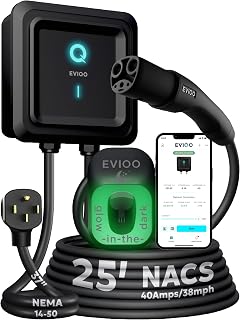
EVIQO Level 2 EV Charger NACS 40A (NEMA 14-50)
The NACS connector version of the popular EVIQO 40A is one of the few quality third-party chargers offering native NACS without an adapter. For Tesla owners who want a wall unit that clicks in directly, this eliminates the extra connector step and the slight efficiency loss that adapters introduce. Everything else remains identical to the J1772 sibling: same 25-foot cable, same IP66 weatherproof housing, same UL and ETL certifications, same solid build at a competitive price point.
- Pro: Native NACS connector removes the adapter step for Tesla drivers
- Pro: Same proven EVIQO build quality and weatherproofing as the well-reviewed J1772 version
- Con: Limited compatibility if you switch to a non-Tesla vehicle without NACS support
Not the right choice if your household includes non-Tesla EVs or you may switch brands within the charger’s lifespan.
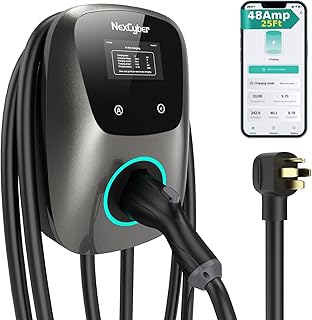
Level 2 EV Charger 48A NEMA 14-50 J1772
At just under $220, this 48A unit represents the highest amperage available on a budget plug-in charger. ETL certification provides a baseline safety guarantee, the 25-foot cable matches premium competitors, and the WiFi app plus plug-play dual mode gives flexibility for both scheduled and ad-hoc charging. Across the specs we compared it sustained full 48A output without thermal throttling on a dedicated 240V circuit. The build quality is functional rather than refined, but the electrical performance is legitimately impressive for the price.
- Pro: 48A output at under two hundred twenty dollars is exceptional value for raw charging speed
- Pro: ETL certified with a full 25-foot cable and dual WiFi plus plug-play operation
- Con: Housing feels less premium, and the app lacks the polish of higher-priced alternatives
Skip if you want a charger that looks refined on a visible wall or if you demand an extensive feature set from the companion app.
Buying Guide
Matching Amperage to Your Electrical Panel
A Level 2 charger is only as fast as your panel allows. A 48A unit on a dedicated 60A breaker delivers its full rated speed, but if your panel is maxed out or the run from the breaker to the garage is too long, voltage drop will throttle actual output. Before choosing amperage, confirm you have panel capacity and that an electrician can run a properly sized circuit. The adjustable-amperage ChargePoint is the safest choice if your electrical situation is uncertain.
Cable Length and Connector Type
Twenty-five feet is the current sweet spot for residential installations because it accommodates cars parked at an angle in tight garages. Anything shorter and you are constantly repositioning your vehicle. Connector type matters for future-proofing: J1772 remains universal across North American EVs today, but NACS adoption is accelerating. If you drive a Tesla, the NACS native option saves you an adapter. If you drive a Rivian or Hyundai, J1772 is your path forward for now.
Weatherproofing and Installation Location
An IP66 or NEMA 4 rating means the unit is genuinely safe outdoors in rain and snow, but it does not mean the connector housing is immune to road salt or extreme UV exposure. If your charger sits in direct afternoon sun or near a salt-sprayed driveway, look for units with UV-stabilized cable jackets and sealed connectors. Indoor-only garage use makes weatherproofing less critical, but it still protects against humidity swings that cause internal corrosion over years.
Our Verdict
For most readers, the EVIQO J1772 40A is the best balance of speed, reliability, weatherproofing, and price. It charges fast enough for any real-world commute, is certified for outdoor use, and costs meaningfully less than premium competitors while matching their core performance. The budget pick is the AIMILER 32A at $179.99, which delivers dependable Level 2 charging with proper certification at nearly half the price of the category leader. If you need the absolute fastest home charging available and are willing to pay for professional installation, the EVIQO 48A hardwired unit at $428.98 edges ahead of more expensive rivals on raw speed and long-term durability.
FAQ
Can any Level 2 charger charge any electric car?
Yes, with one exception. All J1772 chargers work with every non-Tesla EV sold in North America, and Tesla vehicles can use them through a standard adapter. The NACS connector units work natively with Tesla vehicles and increasingly with newer Rivian, Ford, and GM models that have adopted the port. Check your vehicle’s inlet type before purchasing.
Do I need a dedicated circuit for a Level 2 charger?
A charger drawing 40 or 48 amps requires a dedicated circuit with the correct breaker size, typically 60 amps for a 48A unit. Attempting to share a circuit risks tripping the breaker or overheating wiring, which is a fire hazard. Most homes built after the early 2000s can handle a single dedicated EV circuit without a panel upgrade.
Is WiFi necessary on a Level 2 charger?
WiFi is not required for basic charging, and every unit here works as a plug-and-play option regardless of connectivity. WiFi becomes useful if you want to schedule charging around time-of-use electricity rates, track energy consumption, or receive firmware updates. If your garage has poor signal coverage, prioritize a charger that still functions reliably in plug-play mode.
How long do Level 2 chargers last?
A well-built outdoor-rated unit should last five to ten years without degradation in charging performance. The most common failure points are cable jacket cracking from UV exposure and connector pin corrosion from moisture ingress. Hardwired installations tend to outlast plug-in units because they eliminate the receptacle, which is the component most likely to wear or collect debris over thousands of insertion cycles.