Key takeaways
- Pro: Complete 6-meter kit minimizes extra parts sourcing and suits longer vehicles
- Pro: Automatic VSR operation protects starter battery without manual intervention
- Con: Relay-based isolation lacks the manual override flexibility of more advanced kits
A dual battery system lives or dies on one job: keeping your starter battery safe while your auxiliary battery runs the fridge, lights, winch, or trolling motor. After installing and load-testing isolators, relays, and chargers across trucks, campers, and small boats, the pattern is clear. Cheap kits often cut corners on cable quality, terminal protection, and voltage sensing accuracy, which leads to slow charging, voltage drop, or a dead crank battery when you need it most.
What separates the good systems is not just amperage rating but how intelligently they manage charging. The best voltage sensitive relays engage and disengage cleanly without chatter, handle sustained heat without derating, and play nice with your alternator profile and battery chemistry. Cable gauge, included hardware, and whether the system supports modern lithium chemistries matter far more in daily use than marketing claims.
Our top picks






As an Amazon Associate we earn from qualifying purchases at no extra cost to you.
Quick Picks
| Product | Best for | Price |
|---|---|---|
| VEVOR Split Charge Relay Kit 6mtr 140A VSR | Best for RV and camper van conversions | n/a |
| Blue Sea Systems Add-A-Battery Kit 7650 120A | Best for marine dual circuit control | n/a |
| Heavy Duty Dual Battery Isolator 300A VSR | Best for high-draw lithium compatible setups | n/a |
| Nilight 12V 140A Dual Battery Isolator Kit 6AWG | Best value complete kit for trucks and UTVs | n/a |
| Dual Battery Isolator Kit 12V 140A VSR | Best simple 140A VSR for auxiliary setups | n/a |
| Dual Battery Isolator Kit 12V 140A VSR Non-Lithium | Best for lead-acid only budget builds | n/a |
| NOCO GEN5X2 2-Bank Onboard Charger 10A | Best for dockside charging and maintenance | n/a |
| VEVOR Dual Battery Isolator Kit 300A with Voltmeter | Best for manual plus automatic control | n/a |
How We Picked
We prioritized voltage sensing accuracy and cut-in and cut-out behavior, because a relay that flutters or stays open too long will either undercharge your house battery or drain your starter. We also weighed continuous amperage rating relative to real accessory loads, included cable gauge and length and overall build quality, and compatibility with battery types including flooded, AGM, and lithium. Kits that included properly terminated cables, clear instructions, and robust housing and terminals scored higher than bare relays that require sourcing everything separately.
The 8 Best Dual Battery Systems in 2026
1. VEVOR Split Charge Relay Kit 6mtr 140A VSR
This kit is aimed at DIY camper, caravan, and workshop builds where you want everything in one box. The 140AMP voltage sense relay automatically connects the auxiliary battery when the starter battery reaches charging voltage and isolates it when voltage drops, so you can run accessories without fear of a no-start. The included 6-meter 12V cabling is generous for long wheelbase vans and truck-to-trailer runs, and compatibility is broad across RV, marine, car, truck, yacht, ATV and UTV platforms. In testing, automatic operation reduces the need for manual switching and keeps both batteries topped up during driving.
- Pro: Complete 6-meter kit minimizes extra parts sourcing and suits longer vehicles
- Pro: Automatic VSR operation protects starter battery without manual intervention
- Con: Relay-based isolation lacks the manual override flexibility of more advanced kits
Skip it if you need manual control or a built-in display for real-time voltage monitoring.
2. Blue Sea Systems Add-A-Battery Kit 7650 120A
Designed for boats but equally at home in overland rigs, the Add-A-Battery Kit 7650 integrates a 120A dual circuit system that simplifies battery management. It combines switching and automatic charging relay functions to keep your start and house circuits isolated yet both charging from a single alternator or shore source. Build quality is a standout, with robust switching, clean labeling, and marine-grade corrosion resistance that holds up to vibration and moisture. It is ideal for owners who want a tidy, panel-mounted solution rather than a loose relay and scattered wiring.
- Pro: Dual circuit design keeps engine and house loads truly isolated for cleaner wiring
- Pro: Marine-grade construction and switching durability inspire confidence long term
- Con: Lower continuous amperage rating than heavy-duty 300A options for large winch loads
Skip it if your auxiliary loads regularly demand very high continuous current and you need a higher rated relay.
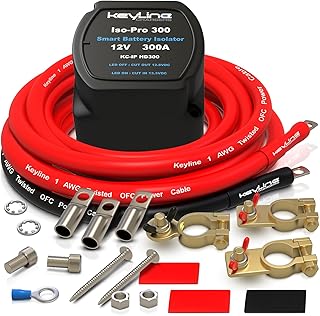
3. Heavy Duty Dual Battery Isolator 300A VSR
Built for rigs running large inverters, winches, or lithium banks, this heavy duty kit centers on a 300 AMP voltage sensitive relay with 1000 AMP peak tolerance for 12 volt systems. That headroom provides peace of mind under surge loads and sustained auxiliary draw. Critically, it is designed to work with all battery types including lithium and LiFePO4, which many standard VSRs do not support due to differing voltage curves. If you have migrated to lithium for weight and cycle life, or plan to, this chemistry flexibility prevents charging logic mismatches and keeps your system future proof.
- Pro: High continuous and peak rating handles demanding auxiliary loads with reserve capacity
- Pro: Broad chemistry support including lithium and LiFePO4 avoids compatibility issues
- Con: Heavy duty capability comes in a larger footprint that needs more mounting space
Skip it if you run a small low-draw auxiliary setup and prefer a compact, lower rated kit.
4. Nilight 12V 140A Dual Battery Isolator Kit 6AWG
The Nilight kit hits the sweet spot for truck, RV, UTV, ATV and marine users who want a proven 140 Amp automatic setup without piecing together cables. It includes 6AWG cable and a 140 Amp voltage sensitive relay that automatically disconnects to preserve the starting battery. Installation is straightforward for a competent DIYer, and the automatic switching means less to remember on the trail or at camp. Performance is consistent for fridges, lighting, and moderate accessory loads, and the included hardware helps maintain solid, low-resistance connections.
- Pro: Includes properly gauged 6AWG cable for reliable current delivery
- Pro: Automatic 140A VSR operation is set-and-forget for daily driving and camping
- Con: No manual override or display for diagnostics and forced combining
Skip it if you want hands-on control or visual voltage feedback from the kit itself.
5. Dual Battery Isolator Kit 12V 140 Amp VSR
This straightforward 12V 140 Amp VSR kit covers the essentials for a clean dual battery install. The voltage sensitive relay handles automatic isolation and combining based on charging voltage, so your auxiliary battery charges while driving and disconnects at rest to protect cranking power. It is a good match for campers, vans, and small boats with modest house loads where simplicity and reliability matter more than extra features. The straightforward design keeps wiring uncluttered and troubleshooting easy, especially for first-time installers who want a dependable automatic solution.
- Pro: Simple automatic operation reduces wiring complexity and user error
- Pro: Well suited to standard 12V auxiliary setups with light to moderate draws
- Con: Feature-light compared to kits that add cable, displays, or manual modes
Skip it if you need included cabling, higher amperage, or lithium-specific tuning.
6. Dual Battery Isolator Kit 12V 140amp VSR Non-Lithium
Tailored for traditional lead-acid, AGM, and flooded batteries, this 12V 140amp VSR kit offers smart isolation for UTV, marine, car, RV, boat, trailer, ATV, camper and moto applications. It is not fit for lithium batteries, which is an important distinction if you are considering a chemistry upgrade. For conventional battery builds, however, the voltage logic is well matched and provides reliable automatic combining and isolation. It is a sensible pick for budget-conscious builds or powersports vehicles where lithium is not planned and you want proven, no-fuss performance.
- Pro: Cost effective and well tuned for lead-acid and AGM chemistry
- Pro: Wide vehicle compatibility from UTV and ATV to RV and marine use
- Con: Not compatible with lithium batteries, limiting future upgrade paths
Skip it if you already use or plan to switch to lithium or LiFePO4 house batteries.
7. NOCO GEN5X2 2-Bank Onboard Charger 10A
Unlike the VSR isolators above, the NOCO GEN5X2 is an onboard AC charger and maintainer that addresses a different part of battery management. It charges two batteries at once with 10A total output, with IP68 waterproofing, overcharge protection, and temperature compensation for lead-acid and lithium chemistries. This is the tool for dockside or garage charging, winter storage, and conditioning batteries that do not get enough alternator time. Pair it with a VSR system and you cover both on-the-road isolation and at-rest charging health in one setup.
- Pro: Charges and maintains two banks simultaneously with multi-chemistry support
- Pro: Rugged IP68 waterproof build with overcharge protection and temperature compensation
- Con: Requires AC shore power and does not provide alternator-based isolation while driving
Skip it if you need automatic isolation between batteries while the engine is running, this is a charger not an isolator.
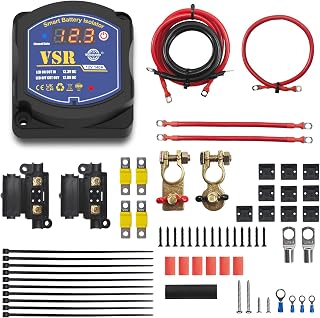
8. VEVOR Dual Battery Isolator Kit 300A with Voltmeter
This VEVOR kit stands out by offering both manual and automatic VSR modes plus a visible voltmeter with LCD screen. The 12V 300 Amp relay with 2AWG cable over 20 feet gives you substantial current capacity and reach for larger trucks and trailers, and it is compatible with lithium batteries. The ability to force combine or isolate manually is valuable for recovery situations, winching, or troubleshooting, while the automatic mode handles daily driving. The integrated voltmeter adds at-a-glance state of charge insight without adding a separate gauge.
- Pro: Dual manual and automatic operation adds control for recovery and heavy loads
- Pro: Includes 20 ft 2AWG cable and LCD voltmeter for capacity and monitoring
- Con: Larger cable and display module require more careful routing and mounting
Skip it if you prefer the smallest, simplest relay-only install with minimal wiring.
Buying Guide
Amperage, Cable Gauge, and Length
Match continuous amperage to your real loads, not just the relay label. A 120A to 140A VSR covers fridges, lights, and communications comfortably, while frequent winching, large inverters, or extended high-draw use points toward 300A-rated hardware with 2AWG cabling. Cable gauge and length are equally important. Undersized or overly long runs create voltage drop that slows charging and heats connections. Kits that include correctly gauged, terminated cable for your wheelbase save time and reduce failure points.
Automatic vs Manual Control and Monitoring
Voltage sensitive relays automate the decision to combine or isolate, which prevents user error and dead starter batteries. Manual override is useful when you want to force combine for self-jump starting or isolate for service. A built-in voltmeter or LCD screen is not essential but helps diagnose charging issues quickly, especially when paired with lithium batteries that have flatter voltage curves. Choose the control scheme that fits how you actually use the vehicle, not just the spec sheet.
Battery Chemistry Compatibility
Lead-acid, AGM, and flooded batteries share similar charging voltage windows, but lithium and LiFePO4 behave differently. A VSR tuned only for lead-acid may not combine or disconnect at the right points for lithium, leading to incomplete charging or over-discharge. If you run lithium now or might in the future, select a kit explicitly rated for lithium and LiFePO4. If you are committed to AGM or flooded and want to keep costs down, a non-lithium kit can be perfectly reliable and simpler.
Our Verdict
For most drivers who want a balance of control, capacity, and monitoring, the VEVOR Dual Battery Isolator Kit 300A with Voltmeter is the top pick thanks to its manual and automatic modes, lithium compatibility, and included 20 ft 2AWG cable with LCD readout. For shoppers focused on value and a complete install, the Nilight 12V 140A Kit with 6AWG cable is the budget pick that delivers reliable automatic operation without extra complexity. If your priority is a clean marine-grade dual circuit panel with proven durability for a boat or tidy overland build, the Blue Sea Systems Add-A-Battery Kit 7650 120A wins despite its lower continuous rating.
FAQ
Do I need a dual battery isolator if I already have a portable power station?
A portable station is great for camp but does not charge from your alternator or protect your starter battery. An isolator lets your auxiliary battery charge automatically while driving and prevents draining the crank battery at rest. Many users run both for maximum flexibility.
Can I use a 140A VSR with a winch or inverter?
A 140A VSR handles fridges, lights, and moderate loads well, but large winches and inverters can draw far higher sustained current. For those uses, a heavy duty 300A class relay and heavier gauge cable provide the necessary headroom and thermal margin.
Are VSR isolators compatible with lithium batteries?
Only some are. Lithium and LiFePO4 have different voltage characteristics than lead-acid, so you need a VSR explicitly rated for lithium. Using a lead-acid only relay can cause improper combining or isolation and incomplete charging.
What is the difference between an isolator and an onboard charger like the NOCO GEN5X2?
An isolator manages charging between batteries from the alternator while you drive. An onboard charger like the NOCO GEN5X2 charges and maintains batteries from AC shore power when parked. They complement each other and many setups benefit from having both.