Key takeaways
- Blade Count and Range: Look for a tool with at least 32 blades spanning a wide range of thicknesses. More blades mean finer increments, so you can hit an exact spec like 0.044″ without stacking or estimating between sizes.
- Material Quality: Stainless steel blades resist corrosion and hold their thickness accuracy over time, while aluminum tool bodies keep weight down without sacrificing durability. Avoid carbon steel blades if you work in humid garage environments.
- Thread Size Compatibility: Confirm the tool explicitly lists support for your plug thread sizes. Most quality options cover 10mm, 12mm, 14mm, and 16mm, but it’s worth verifying before buying so the gapper seats correctly on the plug shell.
- Measurement Markings: Dual SAE and metric markings on each blade save time and reduce conversion errors. If your spec sheet is in millimeters but your gauge only reads in inches, you’re adding unnecessary math to a precision task.
- Blade Style — Straight vs. Angled: Straight blades work for most standard plugs, but angled blades help reach recessed or side-gapped plugs in tight engine bays. Some sets include both, which is ideal if you work on multiple vehicles.
What's inside
Getting the spark plug gap exactly right can make or break engine performance, fuel economy, and idle quality. Yet many DIYers and even experienced wrenches struggle to find a gapping tool that holds up to repeated use, offers the right blade thicknesses, and fits the thread sizes their engine actually calls for. Cheap wire-style gauges bend, rust, or lose their markings after a few months in a toolbox, and a tool that only covers a narrow range leaves you guessing on non-standard plugs.
This guide cuts through the noise and focuses on blade-style spark plug gap tools that deliver precise, repeatable measurements across the most common thread sizes (10mm, 12mm, 14mm, and 16mm). We’ve selected tools that pair a sturdy gapping adjustment ring with a quality feeler gauge set, so you can measure, adjust, and verify gap width without switching between multiple instruments. Whether you’re tuning a performance build or doing routine maintenance, these picks cover every budget and feature set worth considering.
As an Amazon Associate we earn from qualifying purchases.




🛒 Best Price Today on Amazon
Prime members get fast, free shipping on everything above, plus member-only deals. New members get a 30-day free trial — cancel anytime.
How to Choose a Spark Plug Gap Tool for Precision Tuning
- Blade Count and Range: Look for a tool with at least 32 blades spanning a wide range of thicknesses. More blades mean finer increments, so you can hit an exact spec like 0.044″ without stacking or estimating between sizes.
- Material Quality: Stainless steel blades resist corrosion and hold their thickness accuracy over time, while aluminum tool bodies keep weight down without sacrificing durability. Avoid carbon steel blades if you work in humid garage environments.
- Thread Size Compatibility: Confirm the tool explicitly lists support for your plug thread sizes. Most quality options cover 10mm, 12mm, 14mm, and 16mm, but it’s worth verifying before buying so the gapper seats correctly on the plug shell.
- Measurement Markings: Dual SAE and metric markings on each blade save time and reduce conversion errors. If your spec sheet is in millimeters but your gauge only reads in inches, you’re adding unnecessary math to a precision task.
- Blade Style — Straight vs. Angled: Straight blades work for most standard plugs, but angled blades help reach recessed or side-gapped plugs in tight engine bays. Some sets include both, which is ideal if you work on multiple vehicles.
The Best Spark Plug Gap Tools for Precision Tuning Reviewed
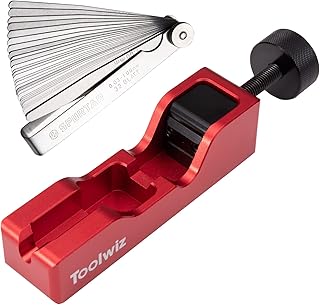
Universal 32-Blade Feeler Gauge Gapping Tool (Red)
This aluminum-bodied gapper pairs a solid adjuster ring with a 32-blade stainless steel feeler gauge covering the full range of common thread sizes. It’s a reliable, no-frills option that covers 10mm through 16mm plugs and holds up well to regular garage use.
Toolwiz 32-Blade Spark Plug Gap Tool
Toolwiz includes a tapered feeler gauge ranging from 0.001″ to 0.04″, which is especially handy for getting into tight gaps without scuffing the electrode. The red anodized body feels well-built, and the blade range covers most tuning specs you’ll encounter.
CZC AUTO Universal 32-Blade Gap Tool (Black)
CZC AUTO’s black variant offers the same 32-blade coverage with a slightly different body finish. It’s a dependable choice for anyone who wants a straightforward, clearly marked tool that handles standard 10–16mm thread plugs without issue.
Hoiny 2-Piece Feeler Gauge Set
Hoiny’s set stands out by including two gauges — 32 straight blades and 16 angled blades — with dual SAE/metric markings. It’s the most versatile pick here, covering spark plugs, valves, and even guitar truss rods, making it ideal for multi-purpose wrenches.
LokoCar Universal 32-Blade Gap Tool
LokoCar delivers a compact red gapping tool with the standard 32-blade steel feeler gauge and 10–16mm thread support. It’s lightweight, easy to stash in a glove box or roll cabinet, and covers the essentials for routine plug maintenance.
Frequently Asked Questions
How often should I check my spark plug gap?
Check the gap every time you install new plugs, and recheck during major tune-ups or if you notice rough idle, misfires, or drops in fuel economy. Even new plugs can be out of spec straight from the box.
What’s the difference between wire-type and blade-type gap tools?
Wire-type gauges use round wire fingers and are less accurate for precision tuning because the contact point is narrow. Blade-style tools use flat feeler strips that seat more consistently against the electrode, giving a more reliable measurement.
Can I use a spark plug gap tool for valve clearance checks?
Yes, the feeler gauge portion works for valve lash adjustments. However, dedicated feeler gauge sets often include angled blades and a wider range that may be better suited for that specific task.
Do all spark plugs need gapping before installation?
Most standard copper and platinum plugs require gapping to match your engine’s spec. Some iridium plugs come pre-gapped and shouldn’t be adjusted, as bending the fine electrode can damage it — always check the manufacturer’s guidance.
Final Thoughts
For most mechanics and DIYers, the Universal 32-Blade Gapping Tool and the Toolwiz 32-Blade option strike the best balance of build quality, range, and value. If you want maximum versatility across automotive and non-automotive tasks, the Hoiny 2-piece set with straight and angled blades is hard to beat. Any of these will give you the precision you need for proper spark plug tuning.