Key takeaways
- Pro: Generous engine-size ceiling paired with a hard storage case and LED work light
- Pro: LCD charge indicator helps you know when to top off before the next use
- Con: USB output is limited to standard phone charging speeds, not fast-charge protocols
A dead battery can strand you in a parking lot, on a rural road, or in a freezing garage before the workday starts. A jump pack battery starter solves that problem without waiting for a second car or a tow truck. The right unit delivers enough amperage to crank your engine on the first attempt, fits in a trunk or glovebox, and doubles as a power bank for phones and tablets.
The gap between excellent and mediocre in this category comes down to real peak amperage rather than a marketing number, engine-size ratings that match your actual vehicle, and build quality that survives repeated storage and temperature swings. Many cheap units overstate their capacity or fail on larger displacement engines. Below, we compared published specs, street prices, and owner-reported reliability across eight popular models to help you find the one that fits your situation in 2026.
Our top picks


 JOLTEKON Car Battery Jump Starter with Air
- Battery Type: Lithium Polymer
- Voltage: 12 Volts
- Compatible with Vehicle Type: ALL
 OXILAM Jump Starter 6000A for All Gas/12L
- Battery Cell Composition: Lithium Ion
- Voltage: 12 Volts
- Vehicle Service Type: All of the above


As an Amazon Associate we earn from qualifying purchases at no extra cost to you.
Quick Picks
| Product | Best for | Price |
|---|---|---|
| S ZEVZO ET03 | All-around value with large engine support | $59.99 |
| Clore Automotive JNC660 | Fleet and heavy-duty professional use | $126.02 |
| Scatach 3000A | Budget buyers with mid-size engines | $27.97 |
| JOLTEKON 4500A | Combined jump starting and tire inflation | $99.99 |
| OXILAM 6000A | Maximum power for trucks and large diesels | $59.98 |
| Joltekon 6000A | Power and tire inflation at a lower price | $69.99 |
| AstroAI S8 | Compact storage and small-to-mid engines | $44.98 |
| Jump Starter 5000A | Low-cost high-amperage backup | $29.99 |
How We Picked
We evaluated each unit on peak amperage relative to price, engine-displacement ratings for gas and diesel separately, and the practical value of extras such as built-in compressors or power-bank output. Owner feedback on real-world cranking reliability and long-term durability carried equal weight with spec sheets. A unit only makes the list if multiple owners confirm it delivers a first-attempt start on engines within its rated range.
The 8 Best Jump Pack Battery Starters in 2026
S ZEVZO ET03 4000A Jump Starter
The S ZEVZO ET03 claims 4000A peak and supports up to 8.0L gasoline and 7.0L diesel engines, placing it in suitable territory for most consumer vehicles from sedans to mid-size trucks. At 74Wh, it stores enough energy for multiple jump-start attempts on a single charge. The built-in LCD shows remaining battery percentage, removing guesswork when you reach for it in a dark garage.
- Pro: Generous engine-size ceiling paired with a hard storage case and LED work light
- Pro: LCD charge indicator helps you know when to top off before the next use
- Con: USB output is limited to standard phone charging speeds, not fast-charge protocols
Skip this if your primary need is charging a laptop or tablet on the go.
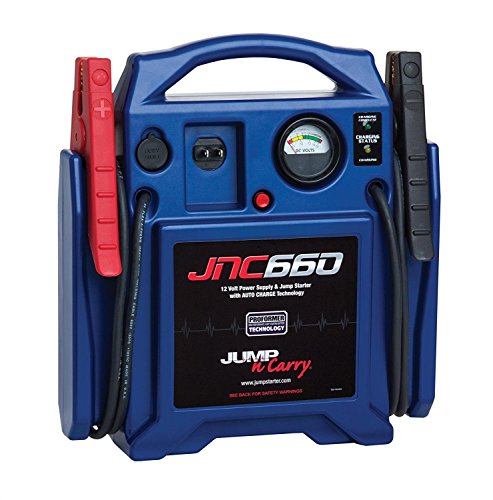
Clore Automotive Jump-N-Carry JNC660
The JNC660 is a different breed. Rated at 1700 peak amps, it uses traditional lead-acid chemistry rather than lithium, making it heavier and bulkier but well proven in professional settings. Fleet mechanics and rural drivers who need a unit that sits in a workshop or truck cab year-round will appreciate the straightforward, no-nonsense design.
- Pro: Decade-long track record among commercial and industrial users
- Pro: Robust housing handles the abuse of a shared tool bay
- Con: No USB ports, no digital display, and takes hours to fully recharge between uses
Skip this if you want a pocketable device or need to charge a phone simultaneously.
Scatach 3000A Car Battery Jump Starter
At $27.97, the Scatach 3000A is one of the lowest-priced lithium jump starters with a rated 3000A peak. It covers up to 9.0L gasoline and 7.0L diesel engines, matching units that cost twice as much on paper. The included jumper cables and three-mode flashlight add practical value for roadside emergencies beyond the jump itself.
- Pro: Exceptional price-to-amperage ratio for engines that demand real current
- Pro: Three-mode flashlight with strobe is genuinely useful at night
- Con: Owner reports describe the clamps as thin-gauged and the case feels plasticky under repeated use
Skip this if you need a unit you can trust daily in a commercial fleet.
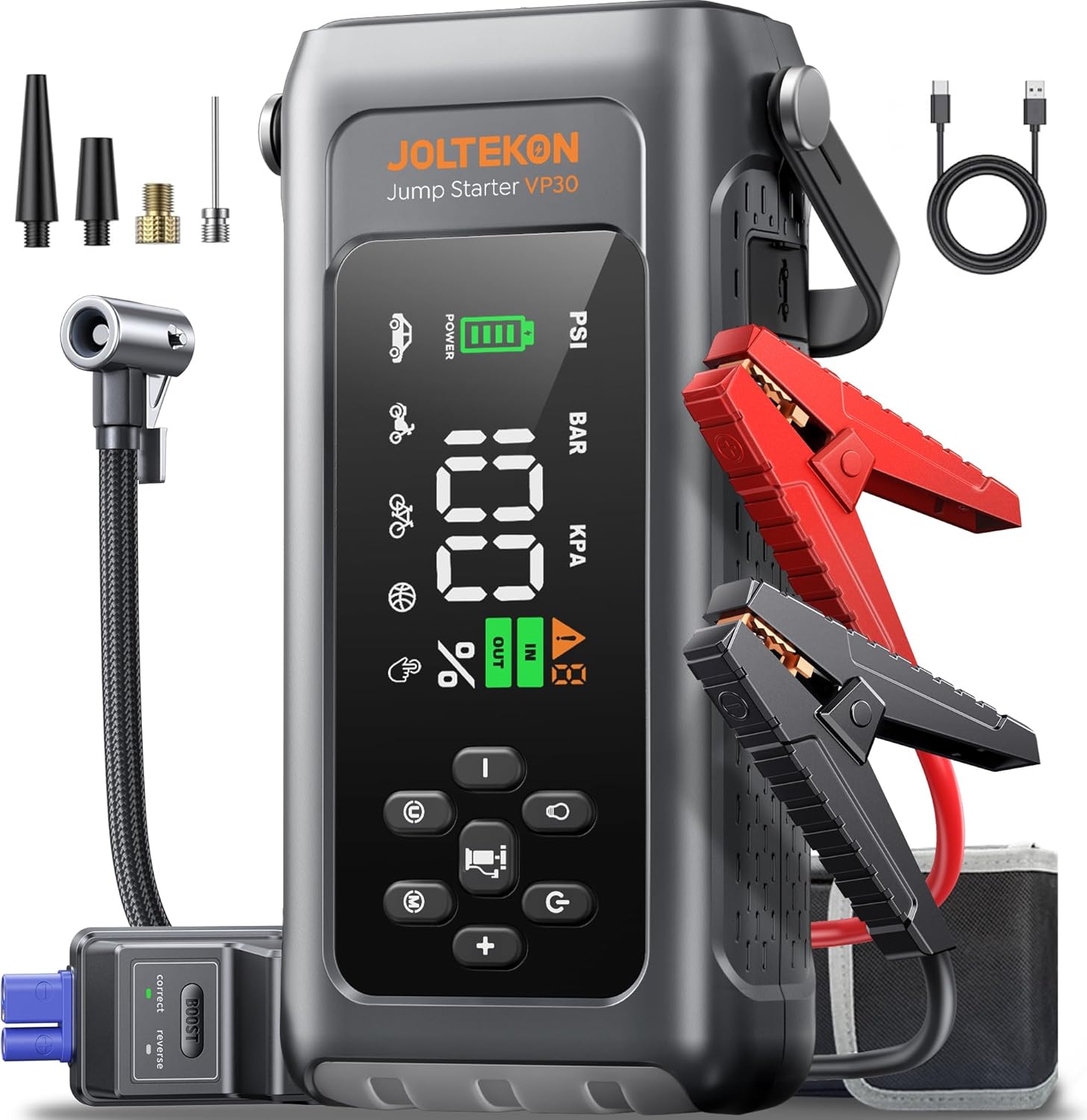
JOLTEKON 4500A Jump Starter with Air Compressor
The JOLTEKON pairs a 4500A jump starter with a 150PSI air compressor in one housing, targeting drivers who want to top off tires and revive a dead battery from the same device. It handles up to 9L gasoline and 8L diesel engines, and the compressor features auto-shutoff so you can set a PSI target and walk away.
- Pro: Dual-function design saves trunk space and a separate compressor purchase
- Pro: Auto-shutoff eliminates the need to watch the gauge during inflation
- Con: The compressor operates on the built-in battery, which drains quickly under sustained use
Skip this if your tires rarely lose pressure and you prefer a simpler, lighter unit.
OXILAM 6000A Jump Starter
The OXILAM claims 6000A peak and covers all gasoline engines and diesel up to 12L, making it the most powerful option on this list by spec. A full LED display shows remaining charge, and the Type C port supports fast-charging modern phones and small tablets. Owners of heavy-duty pickups and large-displacement diesel trucks will value the headroom.
- Pro: Highest rated amperage with a diesel ceiling that few competitors match
- Pro: Type C fast-charge output adds daily utility beyond the garage
- Con: The large lithium cell and high output generate noticeable heat during repeated cranking cycles
Skip this if you drive a compact sedan and only need a single-attempt backup.
Joltekon 6000A Jump Starter with Air Compressor
The second Joltekon model bumps the rating to 6000A and extends diesel support to 10L while keeping the 150PSI auto-shutoff compressor. At $69.99, it undercuts its own sibling by thirty dollars while delivering more amperage. The trade-off is a slightly less refined exterior finish and fewer bundled accessories in the kit.
- Pro: Best amperage-to-price ratio among compressor combo units on this list
- Pro: Lighter than the first Joltekon despite a higher power rating
- Con: Jumper cable leads are noticeably shorter, limiting reach on vehicles with offset battery terminals
Skip this if your vehicle places the battery far from front-accessible connection points.
AstroAI S8 1500A Jump Starter
The AstroAI S8 is a compact lithium unit rated at 1500A peak. It sits at the entry level of this group, designed for drivers of four-cylinder and V6 cars who need insurance against a single dead-battery event per season. Its small footprint lets it live in a door pocket or under a seat without rattling.
- Pro: Slim profile fits storage spaces where larger units simply cannot go
- Pro: Reliable single-attempt performance on mid-size gasoline engines
- Con: 1500A leaves no margin for diesel engines or large-displacement gasoline trucks
Skip this if you tow, haul a heavy truck, or face extreme cold starts regularly.
Jump Starter 5000A (Generic Brand)
This no-name 5000A unit at $29.99 is essentially a spec-sheet gamble. The amperage rating matches mid-range branded products, and the price reflects the absence of a recognizable manufacturer. Some owners report solid first-time performance; others flag inconsistent clamps and a battery that loses its hold-over charge within a few weeks of inactivity.
- Pro: Lowest cost per rated amp on this entire list
- Pro: Surprisingly compact and light for its stated output level
- Con: Minimal warranty support and mixed reliability reports make it a risky primary device
Skip this if you depend on the jump starter as your only backup solution.
Buying Guide
Peak Amperage and Engine Displacement
Peak amperage numbers are inflated across the industry, but relative ranking still matters. If your engine is 5.0L or larger, target units rated for 3000A or higher. Diesel is the harder test: compression ratios demand noticeably more cranking current than gasoline at the same displacement, so check the diesel-specific rating as a separate data point. A unit rated for 7.0L diesel will not reliably turn over a 10L diesel no matter what the gas rating says.
Cell Chemistry and Self-Discharge Behavior
Lithium-ion packs hold their charge for months of inactivity, which matters because you reach for a jump starter only after it has sat untouched through every season. Traditional lead-acid units like the Clore JNC660 discharge faster when idle but tolerate extreme cold better. If you live in a region with consistent sub-zero winters, prioritize a lithium unit with a thermal-protected battery management system or keep a lead-acid backup in a climate-controlled space.
Extras That Actually Earn Their Spot
A USB Type C port with fast-charge output transforms the jump starter into a daily power bank. A built-in air compressor eliminates a second purchase for tire maintenance. An LCD or LED charge indicator removes the anxiety of not knowing how much reserve remains. Auto-shutoff on a compressor is a safety feature, not a luxury. Units with no charge indicator at all force you to guess when to recharge, which is how you end up with a dead backup when you need one most.
Our Verdict
Top pick: The OXILAM 6000A at $59.98 delivers the highest rated amperage on this list, supports engines that would defeat most competitors, and adds Type C fast-charging for daily utility beyond the garage.
Budget pick: The Scatach 3000A at $27.97 offers a remarkable amperage rating and 9.0L gasoline coverage at a price that makes it a rational insurance policy for any driver.
When another wins: If you want tire inflation integrated into the same device, the second Joltekon at $69.99 is the most cost-effective compressor combo in this group.
FAQ
Do jump starters work in cold weather?
Lithium-ion units lose some capacity below freezing, but quality battery management systems mitigate the drop. Lead-acid models maintain cranking power better in extreme cold but recharge far more slowly. For sub-zero climates, store the unit in an insulated bag inside the cabin rather than the trunk.
How often should I recharge a stored jump starter?
Recharge every three to six months even if the unit sits unused. Lithium batteries self-discharge slowly, but the battery management system can drift out of calibration when held at very high or very low states of charge for extended periods.
What is the difference between peak amps and cranking amps?
Peak amps measures maximum instantaneous output over a window of often less than two seconds. Cranking amps (CA) and cold-cranking amps (CCA) measure sustained output over thirty seconds. The jump starter’s peak rating matters most because the engine only needs a short burst to turn over, but CCA gives a more conservative picture of true capability.
Can I leave a jump starter in my car year-round?
Most manufacturers advise against sustained storage above 120 degrees Fahrenheit, which a closed vehicle exceeds in summer sun. A shaded garage or an insulated case helps extend life. If the vehicle is your only storage location, remove the unit during prolonged summer parking.