Key takeaways
- Shorter 12-16 ft cables lose less current but demand the cars be parked close together.
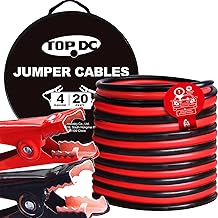
- Longer 20-25 ft cables, like the Cartman 4-gauge 20 ft or TOPDC 4-gauge 20 ft sets, add reach for awkward positions where you cannot line up the vehicles.
- Longer cables should use a thicker gauge to offset the added resistance over distance.
What's inside
A dead battery always seems to happen at the worst time, and when it does, the quality of your jumper cables decides whether you are back on the road in five minutes or standing in a parking lot watching cables barely deliver a spark. Not all cables are equal; gauge, length, clamp quality, and conductor material make an enormous difference in how much current actually reaches your battery when you need it most.
This buying guide breaks down every spec that matters so you can choose cables that work reliably on your vehicle, whether you drive a compact car or a full-size truck. Below we cover the essentials and highlight several sets worth keeping in your trunk in 2026.
As an Amazon Associate we earn from qualifying purchases.




⚡ Save on Your Next PC — Amazon Prime
Prime members get fast free shipping on the systems above, plus early access to Prime Day & Black Friday PC deals. New members get a 30-day free trial.
Watch: Buying Guide: Choosing the Right Car Jumper Cables — Video Review
Understand Gauge: The Most Important Spec
Gauge measures cable thickness, and confusingly, a lower number means a thicker cable that carries more current. For small and mid-size cars, 6 or 4 gauge is adequate. For SUVs, trucks, and diesels, step up to 2 or 1 gauge, like the heavy-duty A ABIGAIL 1-gauge 800A set, so enough amperage flows to crank a large engine. Thin 10- or 8-gauge cables are the most common source of failed jumps.
Match Length to How You Will Use Them
- Shorter 12-16 ft cables lose less current but demand the cars be parked close together.
- Longer 20-25 ft cables, like the Cartman 4-gauge 20 ft or TOPDC 4-gauge 20 ft sets, add reach for awkward positions where you cannot line up the vehicles.
- Longer cables should use a thicker gauge to offset the added resistance over distance.
Check Conductor Material and Amperage
Pure copper conductors carry current best but cost more; copper-clad aluminum (CCA) is lighter and cheaper with slightly higher resistance. For reliable cold-weather starts, look at the amperage rating, higher-amp sets like the 1-gauge 900A cables deliver more cranking power. If you live somewhere cold or drive a big engine, prioritize amperage and copper content.
Inspect the Clamps and Insulation
Clamps are where many cheap sets fail. You want heavy, fully insulated clamps with strong springs and plenty of copper teeth that bite firmly onto the battery terminal for a solid connection. Rubber-insulated clamps, as on the Cartman set, resist cold-weather cracking and prevent accidental shorts. A weak clamp ruins even a thick cable.
Tips
- Connect in the correct order: positive to dead, positive to donor, negative to donor, then negative to an unpainted metal ground on the dead car.
- Never let the clamps touch each other while connected to a battery.
- Store cables in a carry bag so they stay untangled and clean in the trunk.
- Consider a portable jump starter as a backup so you are not dependent on a second vehicle.
Frequently Asked Questions
What gauge jumper cables do I need?
For most cars, 4 or 6 gauge works well. For trucks, SUVs, and diesel engines, choose 2 or 1 gauge so enough current reaches the battery to crank a large engine. Thicker (lower-number) gauge is always safer if you are unsure.
How long should jumper cables be?
Around 20 feet is the sweet spot, long enough to reach between awkwardly parked cars without needing to line them up perfectly, while still delivering strong current if the gauge is thick enough to match the length.
Are copper cables worth the extra cost?
Pure copper conducts better and performs more reliably in cold weather, so it is worth it if you live in a harsh climate or drive a large engine. Copper-clad aluminum is a fine budget choice for occasional use on smaller cars.
What is the correct order to connect jumper cables?
Positive clamp to the dead battery’s positive terminal, the other positive to the donor’s positive, then negative to the donor’s negative, and finally the last negative to an unpainted metal surface on the dead car, not its battery, to reduce spark risk.
Conclusion
The right jumper cables come down to matching gauge and length to your vehicle, then insisting on quality clamps and good conductor material. Compact cars do fine with a 4-gauge set, while trucks and cold climates call for heavy-duty 1- or 2-gauge cables with high amperage. Keep a properly sized set in the trunk, learn the connection order, and a dead battery becomes a minor delay instead of a crisis.