Our Short List of 3

- View on Amazon: https://www.amazon.com/dp/B0DW6CNNJJ
- View on Amazon: https://www.amazon.com/dp/B0D2HDJ2TM
All 4 Picks at a Glance
| Product | Specs | Action |
|---|---|---|
| NOCO Boost Air AX65 |
| Check price on Amazon |
| AstroAI S8 Air 3000A |
| Check price on Amazon |
 STANLEY J5C09D |
| Check price on Amazon |
 DEWALT DXAEJ14 |
| Check price on Amazon |
Our Top Picks
A flat tire and a flat battery rarely send a warning letter first. They tend to arrive together with bad weather, a dark shoulder, and a phone that is also running low. That is exactly the situation a tire inflator battery jumpercharger combo is built for: one self-contained unit that can restart a 12-volt vehicle and put air back into a tire, without a second car, without a separate compressor, and without mains power. This guide explains how these combination units work, which specifications actually matter, and four verified options that cover everything from a compact daily driver to a work truck that needs a heavier reserve of starting power.
As an Amazon Associate we earn from qualifying purchases.
What a jump starter and inflator combo actually is
A combination unit packs three things into a single case. The first is a battery pack, either lithium-ion or sealed lead-acid, sized to deliver a short burst of high current through a pair of clamps. The second is a small electric air compressor with a hose that threads or clips onto a tire valve. The third is the supporting hardware around those two jobs: a pressure gauge or digital display, an LED work light, USB ports for charging phones, and the safety electronics that stop the clamps from sparking or causing damage when they are connected the wrong way round.
The appeal is obvious. Two of the most common roadside failures share one box, one charging cable, and one spot in the trunk. The trade-off is equally real. A combo unit is a compromise on both sides of its job description. Its compressor will almost always be slower and have a lower duty cycle than a dedicated 12-volt inflator, and its jump pack will usually carry less reserve capacity than a same-sized jump-only unit, because some of the internal volume went to the pump, the hose, and the display. Understanding that compromise is the key to buying the right one: you are choosing convenience and coverage, and the goal is to make sure neither half of the tool is undersized for your vehicle.
The two specifications that decide everything
On the jump-starting side, ignore the biggest number on the box until you have found the engine rating. Peak amps describe a momentary maximum, not sustained cranking power, and brands measure them differently. The figure that translates into real life is the manufacturer’s engine rating, stated as the largest petrol and diesel engine sizes the unit is listed to start. Match that rating to your vehicle with some headroom. A four-cylinder commuter car asks very little of a jump pack. A large petrol V8 or a diesel pickup asks a great deal more, especially in cold weather, when a battery delivers less of its stored energy and engine oil resists cranking. Diesel ratings are always lower than petrol ratings for the same unit, because diesel engines use higher compression and glow plugs that draw current before the starter even turns.
On the inflator side, the headline figure is maximum pressure, but the working figures are airflow and duty cycle. Maximum pressure tells you the ceiling the pump can reach; a unit listed at 100 PSI still covers car, SUV, and most light truck tire pressures with room to spare, while 120 or 150 PSI listings add margin for higher-pressure applications. Airflow, expressed in litres per minute, decides how long you stand at the roadside. A high-airflow compressor can take a car tire from flat to working pressure in a few minutes; a low-airflow one can take several times longer on a large truck tire. Duty cycle is the quiet limit behind both numbers: small compressors heat up as they run, and many listings specify a maximum continuous run time followed by a cooling rest. Topping up one low tire is well within any of these units. Airing four large tires back up from low pressures is where the limits show.
Safety features worth insisting on
Modern lithium jump packs earn their keep with protection electronics. Look for reverse polarity protection, which prevents damage if the clamps are swapped, and spark-proof connections, which keep the clamps from arcing when they touch the battery terminals. A boost or override function matters more than most buyers realise: when a battery is drained so deeply that the pack cannot detect it, many smart clamps will refuse to deliver power, and a manual boost mode is what lets the unit start the vehicle anyway. Over-charge, over-discharge, short-circuit, and temperature protections are the background list that separates a considered design from a generic one.
Lead-acid power stations take a different approach to the same problem. They are bigger and heavier, they hold their charge through a different chemistry, and they typically add household-style convenience features such as larger USB output and an alternator check function. What they ask in return is routine maintenance charging. A sealed lead-acid unit that sits forgotten in a trunk for a year will not be ready when it is needed, so the ownership habit matters as much as the specification sheet.
The four verified picks
NOCO Boost Air AX65
The AX65 is the lithium combo built around inflator speed. Its listing rates it at 2,000 peak amps, for petrol engines up to 8.0 litres and diesel engines up to 6.0 litres, which covers the large majority of cars, SUVs, and half-ton trucks on the road. The compressor is the headline: a maximum of 100 PSI with airflow listed at 67 litres per minute, digital pressure control from 15 to 100 PSI with automatic shut-off at the set pressure, and a manufacturer fill claim of 0 to 40 PSI in about two minutes on a standard car tire size. A 100-lumen LED light, USB-C power delivery listed up to 60 watts in both directions, and spark-proof, reverse-polarity-protected clamps round out the package. The honest limitation is endurance per charge: the maker publishes timed fills and a manual-mode duty cycle of five minutes on and thirty minutes off, so this is a fast unit for one or two tires rather than an all-afternoon air station.
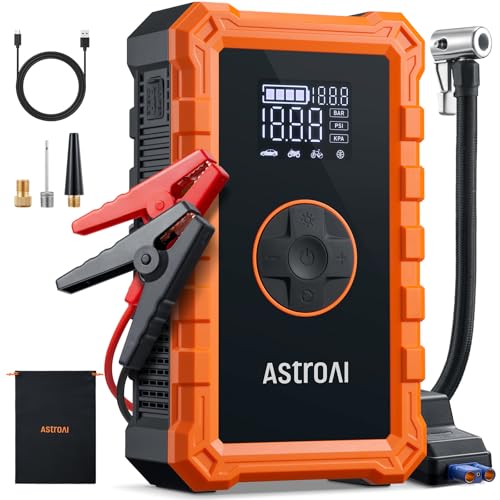
AstroAI S8 Air 3000A
The S8 Air is the compact lithium option with the widest engine rating in this group. The listing states 3,000 peak amps, petrol engines up to 9.0 litres and diesel engines up to 6.5 litres, and up to 20 jump starts on a single charge. Its compressor is listed at 150 PSI maximum with automatic shut-off, five preset modes for common inflation jobs, selectable PSI, kPa, and bar units, and a 2.4-inch screen that shows pressure, battery level, and jump status in one place. A boost button handles the deeply drained battery case described above, and the air hose and nozzles store inside the unit, which keeps the kit together in a glovebox or seat pocket. The listed trade-off is compressor stamina: the pump needs a rest period after around ten minutes of continuous running, so plan large inflation jobs in stages.
STANLEY J5C09D
The J5C09D represents the lead-acid power station school of design. It is listed at 1,200 peak amps with a built-in 120 PSI air compressor that uses a digital display and autostop function, so the pump stops at the pressure you set rather than relying on you watching a gauge. Around those two core jobs it adds USB power and a 12-volt outlet, which makes it as much a small portable power source as a rescue tool. The format suits drivers who keep their emergency kit in a garage or a truck bed box and bring it along deliberately, rather than drivers who want the smallest possible box in a hatchback. Remember the lead-acid ownership rule with this one: recharge it on a schedule, including after every use, so the battery inside stays healthy.
DEWALT DXAEJ14
The DXAEJ14 is the other power station in this guide, listed at 1,600 peak amps with a digital 120 PSI compressor and automatic shut-off. It adds 15-watt USB-A and 25-watt USB-C output, an alternator check function that helps you judge whether a no-start problem is the battery or the charging system, and reverse polarity protection with an audible alarm. The built-in AC charging cube means the unit recharges from a wall outlet without hunting for a separate adapter. As with the Stanley, the size and weight place it in the garage-and-truck category rather than the glovebox category, and the same scheduled-recharge habit applies. For a work vehicle that also needs device charging on site, that bulk buys genuinely useful extra functions.
Lithium pack or lead-acid power station
The choice between the two families comes down to where the unit will live and how it will be maintained. A lithium combo is small, light, and holds its charge for months with minimal attention, which makes it the natural choice for a daily driver where trunk space is shared with everything else. It recharges over USB, often quickly, and the same ports can charge a phone during the emergency. A lead-acid power station is larger and heavier, generally offers stronger continuous accessory power, and tolerates being a small workshop power source, but it demands a recharge routine to stay ready. Neither family is better in the abstract. The right answer is the one whose maintenance pattern matches your habits, because the best jump starter is the one that is charged on the day you need it.
How to use a combo unit well
Start with the jump, then the air, because a running engine and a charged vehicle battery change every other calculation. Connect the clamps in the order the unit’s instructions specify, keep the pack itself on a stable surface rather than balanced on the engine, and give a deeply drained battery a minute connected before cranking. Once the engine runs, let it idle while you work on the tire rather than switching it straight off. For inflation, set the target pressure from the driver-side door placard rather than the maximum printed on the tire sidewall, connect the hose before starting the pump, and stay within the compressor’s listed duty cycle, resting it between tires on a big job. Check the finished pressure with the unit’s gauge and, when you can, confirm it later with a standalone gauge, since small digital gauges are convenient rather than laboratory instruments.
Storage habits decide whether any of this works in six months. Keep the unit out of extreme heat where possible, top up a lithium pack every few months, recharge a lead-acid station on the maker’s schedule, and inspect the clamps and hose whenever you check the charge. A combo unit that is part of a routine survives; one that is bought, used once, and forgotten under cargo is a lottery ticket.
Buying checklist
Before choosing, confirm five things. First, the engine rating covers your largest vehicle, using the diesel figure if you drive a diesel. Second, the compressor ceiling and airflow suit your tire sizes, with realistic expectations for large truck tires. Third, the safety list includes reverse polarity and spark-proof protection, plus a boost mode if you want insurance against a fully drained battery. Fourth, the charging method fits your life, whether that is fast USB-C input or a built-in AC cube. Fifth, you know where the unit will live in the vehicle, because a tool that does not fit the space does not get carried. Work through those five points and the four picks above sort themselves quickly: the NOCO for inflation speed, the AstroAI for compact size and engine coverage, and the two power stations for drivers who want a larger, garage-based unit with accessory power to spare.
Frequently asked questions
Can one of these units start a diesel truck? Yes, provided the diesel engine is within the unit’s listed diesel rating. Check that figure specifically, since it is always lower than the petrol rating, and expect cold weather to eat into the margin.
Will the compressor handle truck tires? It will inflate them, but airflow and duty cycle decide how long it takes. Topping up is easy for every unit here; filling several large tires from very low pressure is slow work for any combo compressor and should be done in stages with cooling rests.
How often should the unit be recharged? Lithium packs should be topped up every few months and after every use. Lead-acid power stations need the same after-use recharge plus a regular scheduled charge even when unused, as their makers specify.
Is a combo unit a replacement for a dedicated inflator? For emergency and maintenance top-ups, yes. For regular airing up and down on large tires, a dedicated high-airflow inflator remains the better tool, and the combo becomes the backup that also starts the engine.
More from Amazon
Programs that pair well with the guide above. Offers and eligibility are set by Amazon and may change.
Free shipping on eligible items, Prime Video and more. Eligible new members can start with a free trial.
Start a Prime free trialA Prime membership for ages 18-24 with a trial period. Eligibility is set by Amazon.
See Prime for Young AdultsAudiobooks and podcasts to listen to on the go. Eligible new members can start with a free trial.
Try Audible freeAd-free music streaming. Eligible new subscribers can start with a free trial.
Try Music Unlimited freeAs an Amazon Associate we earn from qualifying purchases.