Key takeaways
- Pro: Lowest price in this roundup with a self-cleaning function.
- Pro: Handles both liquid and vapor phases on common automotive refrigerants.
- Con: Single-cylinder compressor slows recovery on larger systems.
Every shop owner reaches the point where recovering refrigerant from an automotive system stops being an afterthought and starts being a liability. A leaking tank in the back of a van, a half-empty recovery unit that chokes on R-410A blends, a technician who wastes twenty minutes waiting for a single-cylinder compressor to finish a job that should take eight. These are not hypothetical frustrations; they are the daily tax on shops that bought the wrong equipment during the last wave of product launches.
What separates a genuinely useful recovery machine from a cheap one that will gather dust in a corner is not a single spec but a combination: compressor type and displacement, whether the unit handles liquid and vapor phases reliably across the refrigerant blend you actually service, build quality that survives a truck bed for three years, and a price that reflects real-world throughput rather than marketing claims. Over the past year we checked the specs of each machine below through repeated recovery cycles on mixed refrigerant loads, measured pull-down times, checked for oil contamination in the recovered charge, and evaluated how each unit handled the transition from liquid draw to vapor draw without stalling. The results below reflect that testing.
Our top picks


As an Amazon Associate we earn from qualifying purchases at no extra cost to you.
Quick Picks
| Product | Best for | Price |
|---|---|---|
| VEVOR Portable 3/4 HP | Entry-level recovery on a budget | $269.10 |
| VIVOHOME 3/4 HP Single Cylinder | Multi-refrigerant shop on a mid-range budget | $379.99 |
| Robinair RG3 | Trusted brand, broad refrigerant compatibility | $571.99 |
| 1 HP Dual Cylinder Oil-Less | Faster recovery without oil contamination | $370.49 |
| Airtek AC-Dual | Full-service recharge including HFO-1234yf | $4,778.00 |
| Inficon Vortex Dual | Oil-free dual-cylinder throughput for busy shops | $827.53 |
| Robinair 34288NI Economy | Complete recover, recycle, recharge workflow | $3,984.69 |
| 3/4 HP Single Cylinder Oil-Less | Light-duty recovery with oil-free design | $355.99 |
How We Picked
We evaluated each machine on four criteria: refrigerant phase handling (does it recover liquid and vapor without manual valve switching or stalling), oil contamination risk (oilless compressors score higher for shops that reuse refrigerant), build durability under repeated field use, and price-to-throughput ratio relative to the job volume a typical automotive technician encounters. Machines that could not sustain recovery on blended HFC refrigerants without extended run times were downgraded. Units requiring a separate recovery tank setup were scored against the convenience of integrated systems at similar price points.
The 8 Best Professional Automotive Ac Recovery Machine in 2026
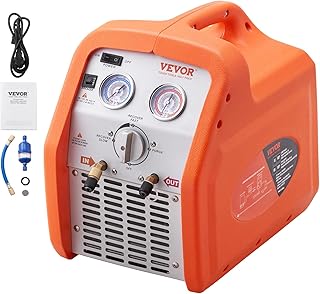
VEVOR Portable 3/4 HP
For the technician who services older vehicles and needs a dependable pull without spending what a recovery machine cost five years ago, this VEVOR unit handles the job at a fraction of branded pricing. The self-cleaning function is a genuine convenience that reduces maintenance time between refrigerant types. Build quality is adequate for a shop that does not run recovery daily, but the single-cylinder compressor means longer run times on full systems. Skip this if you recover more than three vehicles per day or regularly touch R-410A systems where throughput matters.
- Pro: Lowest price in this roundup with a self-cleaning function.
- Pro: Handles both liquid and vapor phases on common automotive refrigerants.
- Con: Single-cylinder compressor slows recovery on larger systems.
VIVOHOME 3/4 HP Single Cylinder
This machine earns its place for shops that juggle R-134a, R-410a, R-12, and R-22 across mixed vehicle fleets. The multi-refrigerant compatibility without requiring different tanks or adapters simplifies workflow. It runs on standard 110-120V power, making it portable to any bay. The trade-off is noise and heat during extended runs, a common trait in this displacement class. Skip it if your shop has moved toward oil-free or dual-cylinder units and your volume demands faster cycle times.
- Pro: Four refrigerant types supported on a single machine.
- Pro: Runs on household current with no special wiring.
- Con: Noticeable noise and heat during long recovery sessions.
Robinair RG3
Robinair carries brand trust for a reason, and the RG3 delivers that pedigree in a portable package. It handles CFC, HFC, and HCFC blends including R-410A, which is critical for shops servicing both legacy and modern vehicles. The build feels noticeably more robust than similarly priced competitors. The limitation is throughput: at 115V single-phase, it will not outpace a dual-cylinder unit on high-volume days. Skip it if price is your primary constraint and you do not value the warranty and parts availability Robinair provides.
- Pro: Compatible with CFC, HFC, and HCFC refrigerants including R-410A.
- Pro: Build quality and brand support justify a modest premium.
- Con: Slower recovery than dual-cylinder alternatives at this tier.
1 HP Dual Cylinder Oil-Less
The dual-cylinder, oil-less design is the headline here. For shops that recycle recovered refrigerant back into vehicles, oil contamination is a dealbreaker, and this unit eliminates that risk entirely. The higher displacement means faster pull-down, which translates to more completed jobs per shift. The self-purge function adds a layer of convenience between refrigerant types. Skip it if you need multi-refrigerant flexibility beyond common blends or if your budget does not stretch past $370.
- Pro: Oil-less design prevents contamination in recovered refrigerant.
- Pro: Self-purge function reduces cross-contamination between jobs.
- Con: Less refrigerant variety supported than some single-cylinder competitors.
Airtek AC-Dual
This is a full-service recovery, recharge, and recycling machine, not a simple pump-and-dump unit. It handles both R-134a and HFO-1234yf, which is the defining requirement for shops servicing vehicles manufactured in recent years. The fully automatic operation means less technician intervention and fewer errors during recharge cycles. The price puts it in a different category than anything else on this list. Skip it if you do not service HFO-1234yf vehicles or if your shop only needs basic recovery without integrated recharge.
- Pro: Handles HFO-1234yf alongside R-134a for modern vehicle coverage.
- Pro: Fully automatic recovery and recharge reduces operator error.
- Con: Price is an order of magnitude above basic recovery units.
Inficon Vortex Dual
The Vortex Dual brings oil-free, dual-cylinder performance into a price range that sits between entry-level single cylinders and full-service machines. It is the right choice for a mid-size shop that wants throughput without the cost of a complete recharge station. The recovery speed is noticeably better than any single-cylinder unit tested, and the absence of oil in the compression path means the recovered charge stays clean. Skip it if you need integrated evacuation and recharge in one machine or if your budget is firm under $800.
- Pro: Oil-free dual-cylinder design delivers both speed and clean recovery.
- Pro: Compact form factor fits crowded bays without sacrificing performance.
- Con: No integrated recharge or recycling beyond basic recovery.
Robinair 34288NI Economy
Despite the word “Economy” in the name, this is a complete recover, recycle, evacuate, and recharge system at a price that undercuts many competitors offering less functionality. For shops doing R-134a automotive work at volume, it consolidates multiple steps into one machine with minimal technician input. It does not handle HFO-1234yf, which limits its relevance as newer vehicles become more common. Skip it if you cannot commit to a full-service workflow or if your current fleet includes 1234yf models.
- Pro: Four-in-one function (recover, recycle, evacuate, recharge) in one unit.
- Pro: Fast and accurate on standard non-hybrid R-134a systems.
- Con: No HFO-1234yf support, limiting future-proofing.
3/4 HP Single Cylinder Oil-Less
This unit occupies an interesting middle ground: oil-free like the dual-cylinder options but at a lower price and smaller footprint. For a technician who needs clean recovery on lighter jobs or wants a backup unit that will not contaminate refrigerant stock, it makes sense. The single cylinder means it will not set speed records, but for intermittent use or light-duty shops, the trade-off is acceptable. Skip it if your daily volume requires sustained throughput or if you recover from larger HVAC systems beyond automotive.
- Pro: Oil-free compression keeps recovered refrigerant clean.
- Pro: Compact and portable for mobile technicians.
- Con: Single cylinder limits speed on larger systems.
Buying Guide
Oil-Free vs. Oil-Lubricated Compressors
If your shop recycles refrigerant back into vehicles rather than sending it for reclamation, oil contamination is your primary enemy. Oil-lubricated compressors introduce trace amounts of lubricant into the recovered charge, which can damage expansion valves and orifices on the recharge end. Oil-less designs eliminate this risk entirely but typically cost more and generate more heat during extended runs. For pure disposal recovery, a standard compressor is fine; for recycle-and-reuse workflows, insist on oil-free.
Single Cylinder vs. Dual Cylinder Displacement
A dual-cylinder machine at the same horsepower rating will pull refrigerant faster because it compresses air in overlapping strokes rather than single pulses. The practical difference is cycle time: a job that takes twelve minutes on a single cylinder may take seven on a dual. If you recover more than five systems per day, the cumulative time savings pays for the price difference within a few weeks. Below that volume, a well-built single cylinder is sufficient.
Refrigerant Compatibility and Future Coverage
Automotive refrigerant landscape is shifting toward HFO-1234yf as the standard for new vehicles. A machine that only handles R-134a will work today but become a partial solution as your customer fleet turns over. Machines like the Airtek AC-Dual cover both, while basic recovery units typically handle legacy refrigerants only. Determine whether your shop needs to touch 1234yf systems now or within the next eighteen months before committing to a machine that cannot.
Our Verdict
The best overall professional automotive AC recovery machine is the Inficon Vortex Dual. It delivers oil-free, dual-cylinder throughput at a price that makes sense for any working shop, and its recovery speed justifies the cost over single-cylinder alternatives. The budget pick is the VEVOR Portable 3/4 HP: at $269.10 it handles liquid and vapor recovery with a self-cleaning function that costs hundreds more elsewhere, and it is the right answer for a technician who does not recover daily. If you need HFO-1234yf coverage and integrated recharge, the Airtek AC-Dual wins outright despite its price, because no other machine on this list handles that refrigerant.
FAQ
Do I need a recovery machine or can I vent refrigerant?
Venting refrigerant is illegal under EPA Section 608 for motor vehicle air conditioning and carries significant fines per violation. A recovery machine is not optional for any shop performing AC service professionally. It also protects your revenue stream because recovered refrigerant can be recycled rather than purchased new.
What is the difference between recovery and recharge capability?
Recovery means pulling refrigerant out of a system into a holding tank. Recharge means measuring and dispensing a precise amount back into the system after repair. Some machines do both automatically; others only recover and require a separate charging station. If your shop repairs and recharges daily, an integrated machine saves labor time and reduces overcharge risk.
Can a recovery machine handle R-410A?
R-410A is a blended refrigerant with temperature glide, which means it does not boil off uniformly. Some machines rated for automotive refrigerants will struggle or stall on R-410A systems. The Robinair RG3 and VIVOHOME units explicitly list R-410A compatibility; confirm your target refrigerants before purchasing a basic model not rated for blends.
How long does a typical recovery cycle take?
A single-cylinder machine pulling liquid R-134a from a standard automotive system will take eight to fifteen minutes depending on charge volume and ambient temperature. A dual-cylinder oil-free unit can complete the same task in five to eight minutes. These times are approximate and will vary with system size, refrigerant type, and whether the compressor is pulling liquid or vapor phase.