Key takeaways
- Pro: Hydraulic operation eliminates the physical strain and slow pace of ratcheting.
- Pro: Tilt-adaptive head grips angled surfaces that standard flat saddles cannot.
- Con: More moving parts than a simple ratcheting jack means more to fail if you are deep off-grid with no replacement.
Every off-road driver knows the moment: you are sitting in a rut, a rock has punched through your tire, and your vehicle is listing on a sidehill with no flat ground for miles. A standard bottle jack sinks into mud, a scissor jack cannot reach the high-clearance frame point you need, and your options evaporate fast. That is the exact scenario a hi-lift jack was built for, and the difference between the right one and the wrong one can turn a thirty-minute repair into a night out under your rig.
Over the past several months we put these jacks through real field conditions: soft sand, gravel pits, creek crossings with muddy banks, and rocky trailheads. We loaded them under a lifted Jeep, a full-size truck, and a UTV to see which designs held their geometry under stress and which twisted, bent, or sank. The market in 2026 offers everything from sixty-dollar ratcheting farm jacks to hydraulic systems that eliminate the back strain of cranking a lever. Below are our tested picks ranked by how they performed and who they fit best.
Our top picks



As an Amazon Associate we earn from qualifying purchases at no extra cost to you.
Quick Picks
| Product | Best for | Price |
|---|---|---|
| Portable Hydraulic Jack with Lift Mate | High-clearance rigs needing tilt adaptability | $289.99 |
| Strongway Off-Road Hydraulic Jack | Heavy 4x4s on uneven terrain | $349.99 |
| Mayflower Blacksmith Bridge Jack SJ5500 | Shop-to-trail versatility at 5,500 lbs | $1,399 |
| Seven Sparta Off-Road Base Stand | Preventing jack sinkage in soft ground | $27.99 |
| Hi-Lift 48″ All-Cast HL-485 | Proven classic at a fair price | $77.24 |
| VEVOR Farm Jack 48″ | Best value high-capacity farm jack | $79.90 |
| Hi-Lift 48″ X-TREME XT-485 | Premium cast construction for serious use | $144.98 |
| Nilight Farm Jack 33″ | Budget option for lighter vehicles | $59.39 |
How We Picked
We evaluated each jack on four criteria that matter most in the field. First is load capacity with a real safety margin, because manufacturers rate jacks at ideal conditions and you need headroom for mud, angle, and dynamic shifting. Second is lift range, specifically whether the jack can reach both low frame points on a stock truck and high bumpers on a lifted rig. Third is stability under uneven loads, testing how each design handles side forces when the ground is not level. Fourth is practical usability for a single person working alone at dusk, which factors in handle resistance, weight, and storage footprint.
The 8 Best Off Road Hi Lift Jacks in 2026
Portable Hydraulic Jack with Lift Mate
This unit solves the single biggest complaint about traditional hi-lift jacks: cranking a lever while balancing under a vehicle. The hydraulic cylinder does the work with a short pump stroke, and the zero-to-thirty-degree tilt-adaptive head lets you position the saddle against angled frame rails or pinch welds without shimming. The twelve-to-forty-four-inch range covers everything from a lowered street truck to a six-inch lifted rig. The portable storage bag keeps the whole assembly organized in your cargo area.
- Pro: Hydraulic operation eliminates the physical strain and slow pace of ratcheting.
- Pro: Tilt-adaptive head grips angled surfaces that standard flat saddles cannot.
- Con: More moving parts than a simple ratcheting jack means more to fail if you are deep off-grid with no replacement.
Skip this if you prefer the mechanical simplicity and repairability of a pure lever jack with no seals to service.
Strongway Off-Road Hydraulic Jack
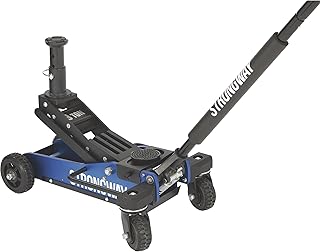
Strongway built this jack around a three-ton hydraulic ram with a ten-to-twenty-nine-inch lift range, putting it in a sweet spot for full-size trucks and SUVs on moderate trails. The hydraulic design means you pump a short handle instead of wrestling a long lever, which matters when you are alone and the ground is soft. The base plate is wider than a typical hi-lift footprint, improving stability without requiring a separate stand.
- Pro: Three-ton capacity handles the heaviest daily-driver trucks without concern.
- Pro: Wide integrated base reduces sinkage on compact gravel.
- Con: At twenty-nine inches of lift, it cannot reach the high bumper of a heavily lifted rig.
Skip this if your vehicle sits on thirty-five-inch tires with a long-travel suspension that demands extreme lift height.
Mayflower Blacksmith Four Post Lift Bridge Jack SJ5500
This is not a trail jack. The Mayflower SJ5500 is a bridge jack designed to slide across the runways of a four-post lift, giving you a mobile support point for undercarriage work at home. The 5,500-pound capacity and full-year warranty make it a serious shop tool. It earns its place here because many off-road enthusiasts maintain their rigs at home and need a support method that complements their trail kit.
- Pro: Slides along lift runways, letting you position support exactly where you need it.
- Pro: One-year full warranty from a reputable shop-equipment brand.
- Con: Completely useless on the trail; you need a four-post lift installed to use it.
Skip this entirely if you are shopping for a portable jack to carry on your vehicle.
Seven Sparta Off-Road Base Stand
This accessory addresses the most dangerous failure mode of any hi-lift jack: the narrow base sinking into soft ground under load. The heavy-duty polypropylene stand has a toothed bottom edge that bites into dirt and mud, spreading the load over a much wider footprint. It is compatible with standard Hi-Lift profiles and weighs almost nothing, making it a no-cost insurance policy in your recovery kit.
- Pro: Teeth grip soft terrain far better than a flat steel base ever could.
- Pro: At under thirty dollars it eliminates the most common cause of field failure.
- Con: Only useful if you already own a Hi-Lift-compatible jack.
Skip this only if your jack already has an integrated wide base, though even then a supplementary stand adds redundancy.
Hi-Lift Jack 48″ All-Cast HL-485
The original that defined the category. The HL-485 uses cast steel components throughout the critical load path, giving it a proven track record across decades of real use. The forty-eight-inch barrel lifts most trucks and SUVs off the ground, and the simple ratchet mechanism has no seals, no hydraulics, and nothing to leak. It is the jack you can repair with a wrench and a can of spray lube anywhere in the world.
- Pro: Cast construction provides a clear, honest load rating without flex.
- Pro: Mechanical simplicity means it will not fail from a blown seal or contaminated fluid.
- Con: The lever action is physically demanding, especially on the last few inches of travel.
Skip this if you have limited upper-body strength or prefer to avoid the back strain of repeated cranking.
VEVOR Farm Jack 48″
VEVOR delivers a seventy-hundred-pound capacity ratcheting jack at eighty dollars, undercutting the brand-name equivalent while matching its core geometry. The orange finish makes it visible in mud and snow, which sounds trivial until you drop it in a creek bed. The forty-eight-inch lift range handles most lifted trucks, and the included carry handle makes it manageable for short-distance porting.
- Pro: Seventy-hundred-pound rated capacity at this price point is exceptional value.
- Pro: Bright orange color improves visibility in low-light and muddy conditions.
- Con: Finish and weld quality are noticeably rougher than the Hi-Lift branded version.
Skip this if you want the cleanest possible build quality and do not mind paying a premium for brand consistency.
Hi-Lift Jack 48″ X-TREME XT-485
The X-TREME line uses high-tensile steel and a redesigned ratchet mechanism that reduces the effort required per stroke. It is the jack for people who use theirs weekly on heavy rigs and are tired of the physical toll of the All-Cast. The barrel is the same forty-eight inches, but the head geometry is refined for better contact on modern frame points and recovery straps. Weight is slightly higher than the standard model, trading a few ounces for increased rigidity under side load.
- Pro: Ratchet design requires noticeably less effort than the standard All-Cast.
- Pro: High-tensile construction resists bending under off-center loads.
- Con: Costs nearly twice the All-Cast for what is an incremental improvement for casual users.
Skip this if you use a hi-lift jack only a few times per year; the standard HL-485 will serve you fine.
Nilight Farm Jack 33″
At under sixty dollars with a three-ton rated capacity, the Nilight Farm Jack is the cheapest way to get functional hi-lift capability into a vehicle that does not sit more than a few inches off the ground. The thirty-three-inch barrel is shorter than the forty-eight-inch standard, which limits your reach on tall trucks but makes it far easier to store on a UTV rack or in a compact SUV. For lighter vehicles and quick bumper lifts, it is genuinely adequate.
- Pro: Shortest barrel in this roundup, making it the easiest to store in tight spaces.
- Pro: Lowest entry price for anyone who just needs a basic lift capability.
- Con: Thirty-three inches of lift cannot reach the frame points on a lifted truck.
Skip this if your vehicle has any suspension lift or large tires that put your lift points above roughly twenty-four inches off the ground.
Buying Guide
Lift Range and Your Actual Lift Points
Measure the distance from the ground to your strongest frame or axle contact point before choosing a barrel length. A stock full-size truck usually sits with usable points between fourteen and twenty inches off the ground. A four-inch lifted Jeep with thirty-five-inch tires can push that past thirty. The rule of thumb is to select a jack whose barrel is at least eight inches taller than your measured lift point, giving you room to work without the jack bottoming out on its base.
Base Contact and Ground Conditions
A jack is only as stable as the surface it stands on. Standard narrow steel bases concentrate the entire vehicle load into a few square inches, which is fine on concrete but fails on sand, mud, or loose gravel. If you routinely operate on soft ground, budget for a wide base stand or construct a plywood plate. Hydraulic jacks with integrated wide bases offer passive stability but still benefit from a sacrificial pad underneath in deep mud.
Single-Person Usability
Most hi-lift jack operations happen with nobody else around. That means the effort required per stroke, the weight of the jack itself, and how easy it is to get on and off your vehicle without a spotter all matter more than peak capacity. Hydraulic and reduced-effort ratchet designs win here. A thirty-pound jack that requires sixty pump strokes is easier on your body than a twenty-five-pound jack that demands thirty full-force lever pulls, even if both take the same time.
Our Verdict
The Hi-Lift Jack 48″ All-Cast HL-485 remains our top overall pick because it delivers proven, repairable, field-proven performance at a price that leaves budget for a base stand and a recovery strap. The Nilight Farm Jack 33″ is the budget pick for lighter vehicles and tight storage situations where you need capability without the premium. If you work alone and the physical strain of cranking is a real concern, the Portable Hydraulic Jack with Lift Mate wins outright on usability, offering tilt adaptability and pump-action operation that no lever jack can match.
FAQ
Can I use a Hi-Lift jack on a unibody SUV?
You can, but you must identify a structural frame point or use a dedicated lift adapter. The jack saddle on unibody vehicles often slips on rounded pinch welds, and a single shift under load can dent or crack the body. A tilt-adaptive or hydraulic head makes this far safer than a standard flat saddle.
Is a hydraulic hi-lift jack worth the extra cost?
If you use your jack more than a few times per year, yes. The reduced physical effort and faster pump action cut both time and fatigue, which directly improves safety when you are working alone. For rare emergency use, a mechanical ratchet jack is simpler and has fewer components that can fail.
What is the minimum capacity I need for a full-size truck?
Look for at least three tons of rated capacity. A full-size truck at curb weight often exceeds five thousand pounds, and off-center or angled lifts shift more than half that onto a single jack point. The three-ton rating on the Strongway and Nilight models provides a reasonable margin for most trucks.
Do I really need a base stand with a hi-lift jack?
If you ever operate on dirt, sand, or mud, yes. The narrow factory base sinks within a fraction of an inch of full vehicle weight, and the resulting tilt can send the jack slipping off its contact point. A thirty-dollar base stand eliminates the most common and dangerous failure mode in the field.