Key takeaways
- Pro: Generous 4000A rating covers large gasoline and diesel engines at an aggressive price point.
- Pro: Includes a storage case, LED light, and LCD battery readout at no extra cost.
- Con: 74Wh is on the lower end, so it will not charge a laptop or multiple phones to full capacity.
A dead battery is one of the most universally frustrating things that can happen to a driver. You are in a parking lot, in a driveway, on the side of a road, and the engine simply refuses to crank. The old solution was to find a willing stranger with running vehicle and a set of jumper cables. The modern solution is a portable jump starter: a compact lithium-powered device that delivers enough current to turn over a stalled engine without depending on another car.
The jump starters available in 2026 vary enormously in peak amperage, engine-size compatibility, capacity, and extra features. A device rated for small gasoline engines will fail on a large diesel. A unit with barely enough stored energy to jump your car will not double as a power bank for your phone and laptop. Owners consistently report that the gap between the best and worst options in this category comes down to whether the amperage and engine-size claims are honest, and whether the safety protections actually prevent sparks or reverse-polarity damage.
Our top picks

 OXILAM Jump Starter 6000A for All Gas/12L
- Battery Cell Composition: Lithium Ion
- Voltage: 12 Volts
- Vehicle Service Type: All of the above
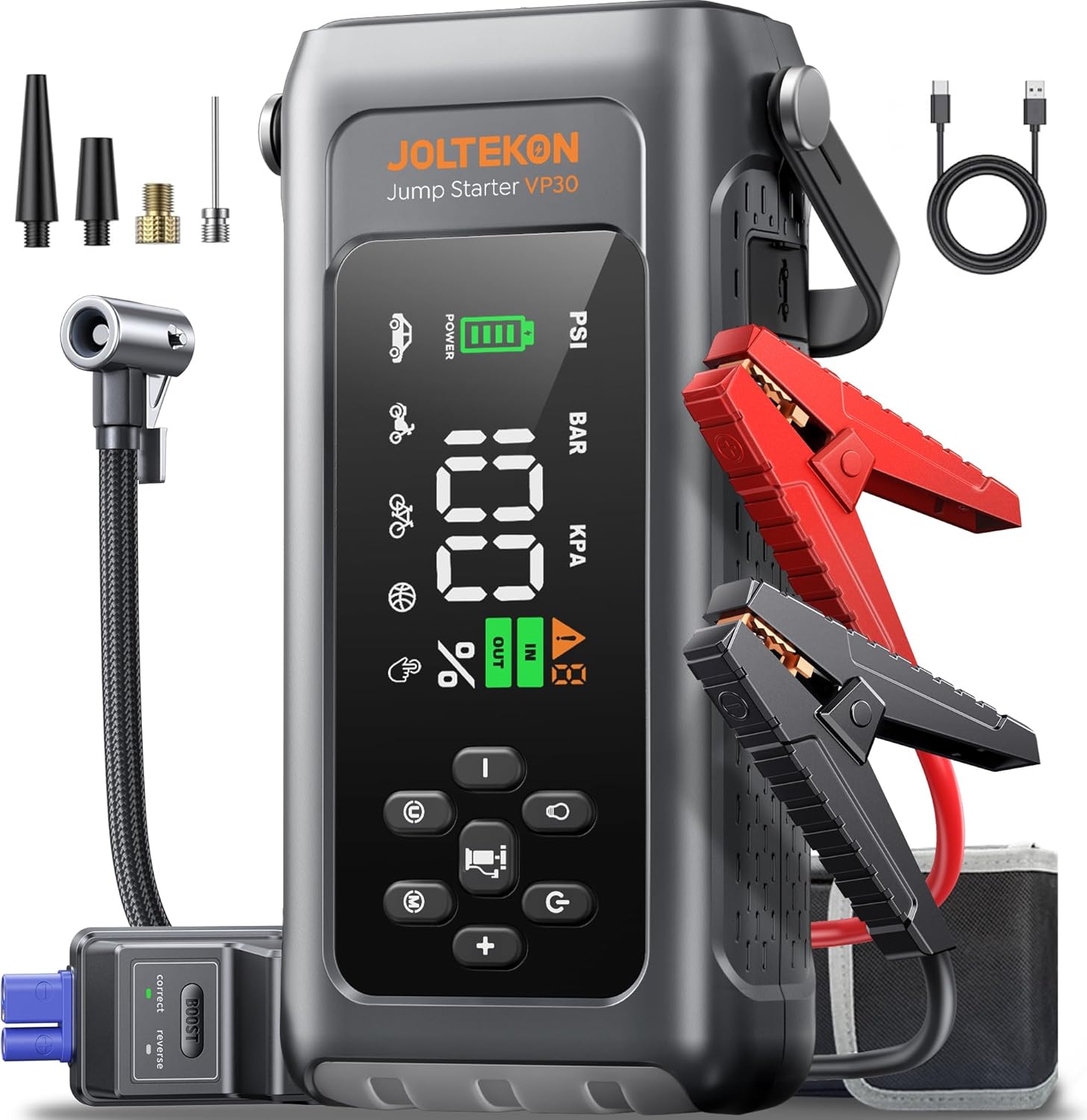 JOLTEKON Car Battery Jump Starter with Air
- Battery Type: Lithium Polymer
- Voltage: 12 Volts
- Compatible with Vehicle Type: ALL
 NOCO Boost GB20 500A UltraSafe Jump Starter
- Instantly start dead batteries with 500 amps of…
- Engineered with patented spark-proof and reverse polarity protection…
- Integrated power bank delivers emergency power to smartphones,…


As an Amazon Associate we earn from qualifying purchases at no extra cost to you.
Quick Picks
| Product | Best for | Price |
|---|---|---|
| S ZEVZO ET03 | Budget buyers with midsize engines | $59.99 |
| OXILAM 6000A | Highest amperage at the lowest price | $59.98 |
| JOLTEKON with Air Compressor | Drivers who want tire inflation included | $99.99 |
| Clore Automotive JNC660 | Traditional lead-acid reliability | $126.02 |
| NOCO Boost GB50 | Premium safety and brand trust | $149.95 |
| NOCO Boost GB20 | Compact size for smaller cars | $79.95 |
| YaberAuto 6000A | Drivers who also want OBD2 diagnostics | $89.99 |
| WOLFBOX MV24 | Large-engine coverage with fast device charging | $107.99 |
How We Picked
Three criteria separate a jump starter worth buying from one that will leave you stranded: peak amperage matched to your engine displacement, real-world capacity measured in watt-hours, and the quality of the built-in safety electronics (reverse-polarity protection, spark prevention, auto-shutoff). We also weighed secondary features like integrated LED lighting, USB output for device charging, and whether the manufacturer publishes honest engine-size limits rather than aspirational marketing claims.
The 8 Best Jump Starters 2026
S ZEVZO ET03
The ET03 delivers 4000A of peak current and is rated for gasoline engines up to 8.0 liters and diesel engines up to 7.0 liters, putting it well within reach of most trucks and SUVs. At 74Wh of stored energy, it can jump a midsize car several times on a single charge or serve as a moderate-capacity power bank via its USB ports. The LCD display shows remaining battery percentage, which owners find helpful for knowing when to recharge before a trip.
- Pro: Generous 4000A rating covers large gasoline and diesel engines at an aggressive price point.
- Pro: Includes a storage case, LED light, and LCD battery readout at no extra cost.
- Con: 74Wh is on the lower end, so it will not charge a laptop or multiple phones to full capacity.
Skip this one if your vehicle has an engine larger than 8.0L gas or 7.0L diesel, or if you need a jump starter that doubles as a serious power bank for electronics.
OXILAM 6000A
The OXILAM claims 6000A of peak output and compatibility with all gasoline engines and diesel engines up to 12 liters, making it one of the highest-rated units in this roundup at under $60. It uses a 12V lithium cell, includes Type-C and USB outputs, and features an LED display. Owners with large diesel trucks report successful jump starts where lesser units failed, though some note the 6000A figure may represent a theoretical peak rather than sustained delivery.
- Pro: Highest amperage rating in this group at the lowest price, ideal for large-displacement diesel owners.
- Pro: Type-C input and output plus USB make it a versatile power bank alongside its jump-starting role.
- Con: The 6000A and 12L diesel claims are aggressive for a sub-$60 unit, and a minority of owner reports suggest real-world results may trail the spec sheet.
Skip this one if you prioritize proven brand-name safety electronics over peak amperage numbers, or if you want a unit whose specs are backed by extensive third-party validation.
JOLTEKON with Air Compressor
The JOLTEKON bundles a 4500A jump starter rated for 9L gasoline and 8L diesel engines with a built-in 150PSI air compressor. The tire inflator features auto-shutoff, so you can set a target PSI and let the unit stop itself. This combination appeals to drivers who want a single device in the trunk to handle both a dead battery and a slow leak. The LED light doubles as a work lamp and an emergency beacon.
- Pro: Integrated 150PSI tire inflator with auto-shutoff eliminates the need for a separate compressor.
- Pro: 4500A output comfortably covers large gasoline engines up to 9 liters.
- Con: The added compressor increases size and weight, making it bulkier to store than dedicated jump starters.
Skip this one if you already own a quality tire inflator or if trunk space is limited and you prefer a slim profile.
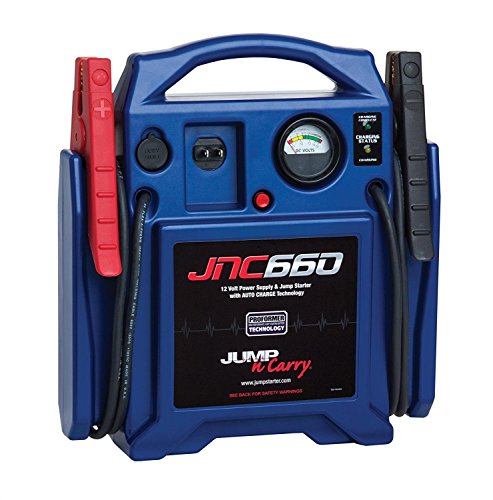
Clore Automotive JNC660
The JNC660 uses traditional lead-acid technology rather than lithium, delivering 1700 peak amps. Clore Automotive is a brand long trusted in professional auto shops, and the JNC660 reflects that heritage with rugged construction and straightforward operation. Its lower amperage rating compared to lithium units is offset by consistent, predictable power delivery that does not degrade in cold weather the way some lithium cells can.
- Pro: Lead-acid construction from a brand trusted by professional technicians, with reliable cold-weather performance.
- Pro: Simple operation with no firmware, no display confusion, and no proprietary charging cables.
- Con: Significantly heavier and bulkier than lithium alternatives, and it requires periodic maintenance charging to avoid sulfation.
Skip this one if portability matters to you or if you want USB charging for phones and tablets, since the JNC660 is a dedicated jump starter without power-bank features.
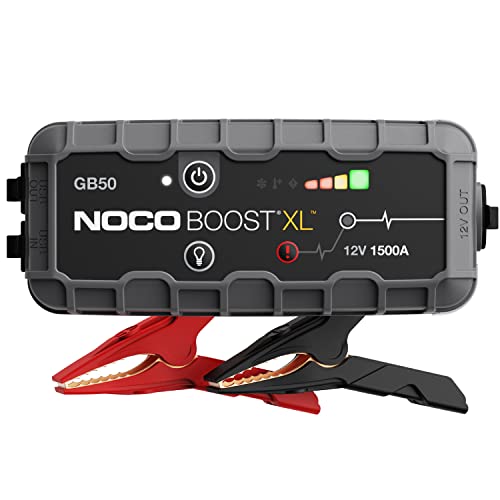
NOCO Boost GB50
NOCO’s GB50 is the gold standard for those who prioritize safety. Its UltraSafe technology includes reverse-polarity protection, spark-proof connections, and overcharge safeguards that have earned strong owner loyalty. Rated at 1500A peak, it handles typical gasoline and smaller diesel engines. The 12V lithium cell charges devices via USB, and NOCO’s build quality consistently earns high marks from long-term owners.
- Pro: Best-in-class safety electronics with proven long-term reliability and strong resale value.
- Pro: Compact for its output level and backed by NOCO’s established warranty and support.
- Con: At $149.95, it is the most expensive option here despite 1500A being lower than several competitors at half the price.
Skip this one if your engine is larger than what 1500A reliably covers, or if budget is a primary constraint.
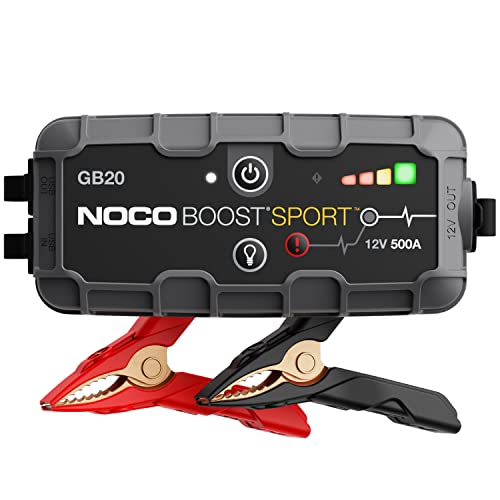
NOCO Boost GB20
The GB20 is NOCO’s smallest UltraSafe jump starter, rated at 500A peak. It is designed for compact cars, motorcycles, ATVs, and small four-cylinder engines. Owners in northern climates appreciate its compact size and the fact that it holds a charge for extended periods between uses, making it a reliable trunk staple. The build quality and safety features match its larger sibling, the GB50.
- Pro: Smallest and lightest option here, ideal for daily drivers with four-cylinder engines.
- Pro: Same UltraSafe protection as the GB50 at nearly half the price.
- Con: 500A will not revive a large V8 or any diesel engine, limiting it to smaller vehicles.
Skip this one if you own a truck, SUV with a V6 or V8, or any diesel vehicle.
YaberAuto 6000A
The YaberAuto combines a 6000A jump starter with a built-in OBD2 scanner and code reader. This appeals to drivers who want diagnostic capability alongside emergency starting. You can clear a check-engine light or pull fault codes without a separate tool, then jump the battery if the underlying issue has drained it. The price sits comfortably below $100.
- Pro: Integrated OBD2 code reader adds diagnostic value without a second device.
- Pro: 6000A rating places it among the highest-amperage options in this roundup.
- Con: The OBD2 feature may not support all protocols or newer vehicle models, limiting its diagnostic utility for some owners.
Skip this one if you already own a dedicated OBD2 tool or if you want a brand with an established automotive-electronics reputation.
WOLFBOX MV24
The WOLFBOX MV24 outputs 4000A and covers engines up to 10 liters in both gasoline and diesel. Its 88.8Wh capacity is the largest in this group, and the 65W quick charger can top off a laptop through USB-C. The 88.8Wh figure means it can recharge a smartphone multiple times or provide meaningful runtime for a tablet. An LCD display and LED light round out the package.
- Pro: Largest capacity at 88.8Wh with 65W fast charging, making it a genuine laptop-class power bank.
- Pro: 10L gas and diesel rating covers virtually every consumer vehicle on the road.
- Con: At $107.99, it costs more than the OXILAM and ZEVZO while offering similar amperage, so the premium is tied to capacity rather than starting power.
Skip this one if you only need jump-starting capability and do not care about fast device charging, since cheaper units cover the same engine range.
Buying Guide
Match Amperage to Your Engine
Peak amperage ratings are marketing figures, but they indicate relative headroom. A four-cylinder sedan needs far less current than a 6.7-liter diesel truck. Use the manufacturer’s stated engine-size limit as a ceiling, not a target. If your vehicle sits near the top of a unit’s rated range, step up to a model with greater margin or higher watt-hour capacity to ensure multiple jump attempts remain possible.
Lithium vs. Lead-Acid Trade-offs
Lithium units are lighter, hold charge longer between uses, and include modern safety electronics. Lead-acid units like the Clore JNC660 are heavier and require periodic maintenance charging, but they deliver consistent current in extreme cold and have a decades-long track record in professional shops. For most consumer buyers, lithium is the practical default. Choose lead-acid only if you live in a very cold climate and store the unit in an unheated garage for months at a time.
Capacity and Secondary Functions
Watt-hours determine how many jump attempts you get on one charge and how useful the unit is as a power bank. A 74Wh device will jump a small car a handful of times and charge a phone once or twice. An 88.8Wh device extends that range and may power a laptop briefly. Integrated features like air compressors and OBD2 scanners add convenience but also add weight, complexity, and cost. Buy those extras only if you will genuinely use them.
Our Verdict
The WOLFBOX MV24 is our top overall pick: its 88.8Wh capacity, 65W quick charging, and 10-liter engine coverage make it the most versatile unit here for a fair price. For budget buyers, the S ZEVZO ET03 at $59.99 offers honest 4000A output and useful included accessories without compromise. If trunk space is your hard constraint and your engine is small, the NOCO Boost GB20 wins on size and safety despite its lower amperage.
FAQ
Can a jump starter damage my car’s electronics?
Older units without protection circuits could send voltage spikes into sensitive modules, which is why built-in safety electronics matter. Modern lithium jump starters with spark-proof and reverse-polarity protection, like the NOCO models, greatly reduce this risk. Always follow the connection sequence printed on the clamp housing to minimize any chance of damage.
How often should I recharge a lithium jump starter?
Lithium cells self-discharge slowly, so most owners recharge every three to six months if the unit sits unused. Some brands recommend a top-up charge before winter to ensure full cranking power when cold reduces battery output. Units that sit below their minimum voltage threshold for extended periods can suffer permanent cell damage.
Is higher amperage always better?
Higher amperage means more headroom for difficult cold-weather starts on large engines, but it also means a physically larger and heavier unit. If your vehicle is a compact four-cylinder, 500A is sufficient. Matching amperage to engine size keeps the device manageable without sacrificing reliability.
Do I still need traditional jumper cables?
A portable jump starter eliminates the need for another vehicle, which is the primary advantage. However, some drivers keep cables in the trunk as a backup for situations where the jump starter’s own battery has run low or failed. The two are complementary rather than redundant.