Key takeaways
- Panel efficiency: Premium residential modules commonly reach roughly 21.5% to 23.5% efficiency. This matters when roof area is limited, although a slightly less efficient panel can be the better value on a large roof.
- Temperature performance: A lower temperature coefficient generally reduces output losses on hot roofs. Look for a power temperature coefficient near -0.29% to -0.35% per degree Celsius.
- N-type cell construction: TOPCon and heterojunction panels generally offer strong degradation performance and reduced susceptibility to light-induced degradation compared with older P-type designs.
- Inverter architecture: Microinverters suit shaded or complicated roofs; string inverters with optimizers can be more economical on uniform roofs; hybrid inverters are useful when batteries are part of the initial design.
- Battery power, not just capacity: A 13.5 kWh battery may store substantial energy but still be unable to start multiple large motors if its continuous and peak output are inadequate.
Best High-End Residential Solar Panel Kits for Home Energy
The best high end residential solar panel kits for home energy are usually built around high-efficiency N-type panels, a properly sized hybrid inverter, and a modular battery system—not simply the highest-wattage panels available.
For most serious home-energy projects in 2026, the strongest choices are a premium Enphase microinverter system for difficult roofs, a SolarEdge Home system for centralized control and storage integration, or a high-output panel package paired with a Tesla Powerwall 3 when whole-home backup is the priority. Your roof shape, annual electricity use, and backup expectations should determine the kit size.
Our top picks

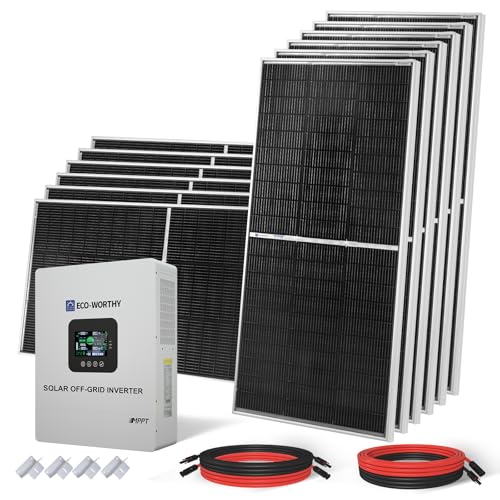


As an Amazon Associate we earn from qualifying purchases at no extra cost to you. Ratings are shown as listed on Amazon.
Quick recommendations by situation
| Home-energy situation | Best-fit system type | Typical capacity | Why it makes sense |
|---|---|---|---|
| Complex roof with multiple orientations | High-efficiency panels with Enphase IQ8 microinverters | 6–12 kW solar; 10–30 kWh storage | Independent panel-level optimization and easier expansion |
| Large, mostly south-facing roof | Premium panels with SolarEdge power optimizers and Home Hub inverter | 8–16 kW solar; 10–30 kWh storage | Efficient centralized conversion with detailed monitoring |
| Frequent outages or whole-home backup | High-output panels with Tesla Powerwall 3 or comparable batteries | 10–20 kW solar; 13.5–40.5 kWh storage | Strong battery output and a relatively simple backup architecture |
| Small roof but high electricity consumption | Panels rated around 440–470 W with a high-efficiency N-type design | 5–10 kW solar | More generation from each square metre of roof |
What separates a premium kit from a basic package?
A basic package may list panels, an inverter, mounting hardware, and cables. A high-end residential kit needs to be evaluated as an electrical system. The important questions are whether the inverter can accept the planned array, whether the battery can deliver enough continuous power, whether the roof has sufficient usable area, and whether the equipment will remain serviceable for 20 or more years.
- Panel efficiency: Premium residential modules commonly reach roughly 21.5% to 23.5% efficiency. This matters when roof area is limited, although a slightly less efficient panel can be the better value on a large roof.
- Temperature performance: A lower temperature coefficient generally reduces output losses on hot roofs. Look for a power temperature coefficient near -0.29% to -0.35% per degree Celsius.
- N-type cell construction: TOPCon and heterojunction panels generally offer strong degradation performance and reduced susceptibility to light-induced degradation compared with older P-type designs.
- Inverter architecture: Microinverters suit shaded or complicated roofs; string inverters with optimizers can be more economical on uniform roofs; hybrid inverters are useful when batteries are part of the initial design.
- Battery power, not just capacity: A 13.5 kWh battery may store substantial energy but still be unable to start multiple large motors if its continuous and peak output are inadequate.
High-end panel and inverter combinations compared
| System approach | Representative equipment | Panel or battery figures | Roof-space and design implications |
|---|---|---|---|
| Panel-level conversion | REC Alpha Pure-RX or Maxeon panels with Enphase IQ8 microinverters | Approximately 440–470 W per panel; IQ8 models vary by electrical design | Uses more rooftop electronics but handles shade and mixed roof planes well |
| Optimizer plus string inverter | Qcells Q.TRON or Canadian Solar TOPHiKu6 panels with SolarEdge Home Hub | Approximately 430–470 W per panel; storage commonly around 10–30 kWh | Requires careful string design and compatible optimizers; efficient on large uniform arrays |
| Integrated battery-backup ecosystem | High-efficiency N-type panels with Tesla Powerwall 3 | Powerwall 3: 13.5 kWh usable energy and up to 11.5 kW continuous power, subject to system configuration | Requires wall or floor space, clearances, and backup-load planning |
| Hybrid inverter system | Premium panels with a compatible hybrid inverter and modular lithium iron phosphate battery | Common battery modules are roughly 5–15 kWh each | Flexible storage growth, but compatibility and commissioning are installer-dependent |
Product specifications change by model, region, and electrical configuration. Confirm the current datasheet before ordering, particularly maximum continuous output, operating voltage, rapid-shutdown compatibility, and battery expansion limits.
How much solar capacity do you actually need?
Start with annual electricity consumption rather than the size of the battery. A home using 12,000 kWh per year needs about 32.9 kWh per day on average. If a local solar array produces an average of 1,400 kWh per installed kilowatt each year, a theoretical 8.6 kW array would cover that consumption:
12,000 kWh ÷ 1,400 kWh per kW = 8.6 kW.
In practice, roof orientation, snow, shading, inverter clipping, utility rules, and seasonal consumption justify a design around 9–10 kW rather than exactly 8.6 kW. With 450 W panels, a 9.0 kW array requires 20 modules. At approximately 2.0 square metres per panel, the modules alone occupy about 40 square metres, or 430 square feet. Add setbacks, access pathways, roof obstructions, and spacing around vents before deciding that the roof is large enough.
Battery sizing is a separate calculation. If essential loads average 1.5 kW overnight for 10 hours, they require approximately 15 kWh before reserve losses. A battery with 13.5 kWh usable capacity may cover that load only if the home avoids electric heating, water heating, vehicle charging, and other large overnight demands. Whole-home backup often requires multiple batteries, load management, or a backed-up subpanel.
Which inverter design is best?
Enphase microinverters
Microinverters convert power at each panel. They are particularly attractive when a roof has east-, west-, south-, and north-facing sections, partial shade, or different roof pitches. One shaded module does not reduce the output of an entire string. The trade-off is a higher number of rooftop electronic components and potentially more complex service access.
SolarEdge optimizers and Home Hub
SolarEdge systems use panel-level optimizers with a centralized inverter. They offer detailed monitoring and can provide a clean path to compatible battery storage. This architecture can be efficient and cost-effective on a large, mostly uniform roof. It depends heavily on correct string sizing, optimizer compatibility, and installer expertise.
Tesla Powerwall 3-based systems
Powerwall 3 combines battery storage and an integrated solar inverter. Its high output makes it appealing for backup systems with substantial loads, but the design still needs to account for service-panel capacity, main-breaker limits, local interconnection rules, and the starting current of pumps or compressors. One battery is not automatically equivalent to whole-home backup.
Installation requirements that buyers often underestimate
- Roof condition: Do not install a 25-year solar system over shingles that need replacement soon. Re-roofing beneath an array can cost more than expected and may require temporary removal.
- Structural review: The installer may need to verify rafter spacing, attachment points, wind uplift, snow loads, and the roof covering’s condition.
- Electrical upgrades: A larger system may require a load calculation, service-panel upgrade, energy-management device, or supply-side connection.
- Rapid shutdown: Modern rooftop systems generally require code-compliant rapid-shutdown equipment and clearly labeled disconnects.
- Battery location: Batteries need manufacturer-specified clearances, temperature limits, ventilation or enclosure requirements, and protection from flooding or vehicle impact.
- Permitting and interconnection: The installer normally handles building permits, utility approval, inspection, and commissioning. Timelines vary considerably by jurisdiction.
Ownership realities: what wears first?
Solar modules usually require little routine maintenance, but dirt, pollen, bird debris, and snow can reduce production. Cleaning is most useful when rainfall cannot remove buildup and when the array has a shallow pitch. Avoid abrasive tools and high-pressure washing that can damage seals or coatings.
Inverters and batteries are more likely than panels to require service during ownership. Rooftop microinverters can be difficult to access, while a centralized inverter is easier to replace but represents a single point of failure. Battery warranties commonly specify both a calendar period and a throughput or retained-capacity limit. Read the warranty’s permitted operating temperature, cycling assumptions, labor coverage, and transfer terms—not just the headline number of years.
Common mistakes include oversizing the array without checking the inverter’s input limits, buying a battery without identifying essential loads, placing panels over a roof nearing replacement, and assuming a grid-connected system will operate during an outage. Most standard grid-tied systems shut down when the grid fails unless approved backup equipment and islanding controls are installed.
Bottom line
Choose Enphase when roof complexity and panel-level resilience matter most. Choose SolarEdge when a large, consistent roof benefits from a centralized inverter and optimizer ecosystem. Choose a Powerwall 3-based design when high-output backup and an integrated battery system are the priority. For any of these options, specify the annual energy target first, reserve roof area for setbacks and future service, and have a qualified installer verify structural, electrical, fire-code, and utility requirements before purchasing a kit.