Key takeaways
- Compare the best business sheet-fed scanners for record archiving with key specs, pros, cons, and buying guidance. See verified Amazon US picks with ASINs.
As an Amazon Associate we earn from qualifying purchases.
Disclosure: This article contains affiliate links. If you buy through links on this page, we may earn a commission at no extra cost to you. Product availability on Amazon US can change; check the product page for current details before ordering.
Our top pick: Brother ADS-3100. Runner-up: Epson WorkForce ES-400 II.
Not every archiving project needs a shared network station. Many records teams work from a single workstation, scanning case files into records software with indexing and quality checks at the same desk. Business sheet-fed scanners fit that pattern: compact duplex units that connect directly to the archiving PC and integrate with document applications through standard drivers.
This guide covers five business sheet-fed models for single-workstation record archiving. Four connect by USB only, and one adds Ethernet for teams that may share the unit later. The key factors are driver support, duplex throughput, feeder size, and mixed-original handling.
Quick Picks
| Product | Best For | Key Spec | ASIN |
|---|---|---|---|
| Brother ADS-3100 | Best Single-Workstation Archiving | 40 ppm / 80 ipm, 60-sheet ADF | B09TRVPPZR |
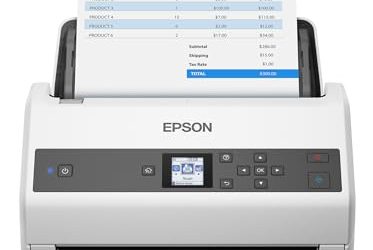
| Epson WorkForce ES-400 II | Best Compact Desk Unit | 35 ppm / 70 ipm, 50-sheet ADF | B08P3YVH3X |
| Epson DS-530 II | Best Records-Software Integration | 35 ppm / 70 ipm, 50-sheet ADF | B08P41Q9SS |
| Canon imageFORMULA R40 | Best Mixed Media | 40 ppm B&W simplex, 60-sheet ADF | B07YNK4S9Y |
| RICOH fi-8040 | Best with Ethernet Option | 40 ppm / 80 ipm, 50-sheet ADF | B0C8WG9F2H |
How We Selected These Picks
We focused on business sheet-fed scanners suited to a records workstation rather than a shared network hub. That meant duplex scanning, feeder capacities for case-file batches, and driver support that records applications can use. TWAIN and ISIS support were weighted because archiving software often captures through those interfaces.
Within that group, we compared speed ratings, feeder size, and daily volume against typical archiving sessions at one desk. Mixed-media handling also mattered, since records often include cards, receipts, and long documents. One Ethernet-capable model is included for teams that may share the scanner later.
1. Brother ADS-3100 – Best For Single-Workstation Archiving

ASIN: B09TRVPPZR
Amazon US: https://www.amazon.com/dp/B09TRVPPZR
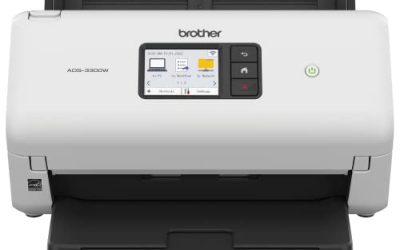
The Brother ADS-3100 is a straightforward workstation archiving scanner. It scans at 40 ppm and 80 ipm duplex, holds 60 sheets, and is rated for a maximum of 6,000 sheets per day. Connection is by USB 3.0 only, with TWAIN and ISIS support for records applications.
The operator prepares a file, scans it into the records application, and indexes it without leaving the workstation. The 60-sheet feeder handles typical case-file batches, and the daily maximum supports a full day of conversion at one desk. The limitation is USB-only connection: the unit cannot be network-shared. For a dedicated archiving desk, that is often the intended setup.
Pros
– TWAIN and ISIS support for records software
– 40 ppm / 80 ipm duplex with 6,000-sheet daily maximum
– 60-sheet feeder for case-file batches
Cons
– USB 3.0 only; no network sharing
– Tied to a single workstation
2. Epson WorkForce ES-400 II – Best For Compact Desk Archiving

ASIN: B08P3YVH3X
Amazon US: https://www.amazon.com/dp/B08P3YVH3X
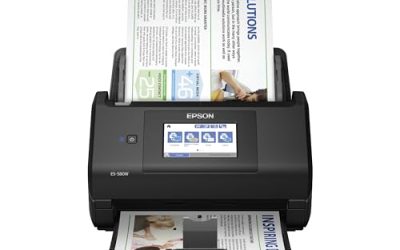
The Epson WorkForce ES-400 II suits archiving desks where space is limited. It scans at 35 ppm and 70 ipm with single-pass duplex, holds 50 sheets, and carries a peak rating of 4,000 pages per day. Connection is by USB only, with TWAIN support.
Compact size is the main reason to choose it. Records workstations share a desk with monitors and file trays, so a smaller footprint leaves room to stage originals. Single-pass duplex keeps two-sided records in order. The trade-offs are feeder size and daily rating: a 50-sheet feeder needs reloading on longer files, and the peak rating suits moderate totals.
Pros
– Compact footprint for crowded desks
– Single-pass duplex at 35 ppm / 70 ipm
– TWAIN support for document applications
Cons
– USB only; no network connection
– 50-sheet feeder suits moderate volume
3. Epson DS-530 II – Best For Records-Software Integration

ASIN: B08P41Q9SS
Amazon US: https://www.amazon.com/dp/B08P41Q9SS
The Epson DS-530 II is aimed at workstations where the records application drives the workflow. It scans at 35 ppm and 70 ipm duplex, holds 50 sheets, and carries a peak rating of 4,000 pages per day. Connection is by USB 3.0 only, with TWAIN and ISIS support.
When the records system controls capture and indexing, the scanner must respond reliably inside that application. The DS-530 II is built around that pattern, with duplex speed adequate for file batches. Like the ES-400 II, the limits are volume and connectivity: the feeder and rating suit steady desk archiving, and USB-only connection keeps the unit at one workstation.
Pros
– TWAIN and ISIS support for records capture
– 35 ppm / 70 ipm duplex for file batches
– USB 3.0 workstation connection
Cons
– USB only; no network sharing
– 50-sheet feeder suits moderate batches
4. Canon imageFORMULA R40 – Best For Mixed Media Records

ASIN: B07YNK4S9Y
Amazon US: https://www.amazon.com/dp/B07YNK4S9Y
The Canon imageFORMULA R40 stands out for mixed originals. It scans simplex at 40 ppm in black and white and 30 ppm in color, with duplex at 80 ipm black and white and 60 ipm color. The feeder holds 60 sheets, the suggested volume is 4,000 pages per day, and connection is by USB 2.0 with TWAIN support. It handles cards, receipts, and long documents.
Records are rarely uniform. A file may contain standard pages, a receipt, and a long form. A scanner that accepts that mix without manual feeding keeps the session moving and keeps the file together. The compromises are color speed at 30 ppm simplex and USB-only connection. For archives with frequent mixed media, the handling benefit usually outweighs those limits.
Pros
– Handles cards, receipts, and long documents
– 60-sheet feeder with duplex up to 80 ipm black and white
– TWAIN support for document applications
Cons
– Color simplex speed of 30 ppm
– USB 2.0 only; no network connection
5. RICOH fi-8040 – Best For Archiving with an Ethernet Option

ASIN: B0C8WG9F2H
Amazon US: https://www.amazon.com/dp/B0C8WG9F2H
The RICOH fi-8040 bridges workstation archiving and shared use. It scans at 40 ppm and 80 ipm duplex, holds 50 sheets, and carries an expected daily volume of 6,000 sheets. USB 3.2 and Ethernet are included, and DirectScan supports PC-less scanning to folders and email.
The unit can start as a USB-attached archiving scanner and later serve walk-up scanning to archive folders. The 6,000-sheet expected daily volume supports full archiving days. The feeder is the smallest here at 50 sheets, and there is no Wi-Fi. If the desk has an Ethernet drop, those limits are manageable.
Pros
– USB 3.2 and Ethernet for workstation or shared use
– DirectScan touchscreen to folders and email
– 6,000-sheet expected daily volume
Cons
– 50-sheet feeder is small for long files
– No Wi-Fi connection
Buying Guide: What to Look For
Driver Support for Records Software
Confirm how your records application captures scans. Many systems use TWAIN, and some use ISIS. The ADS-3100 and DS-530 II include both, while other models should be checked against your application before ordering. Test capture and indexing with a sample file during setup.
Batch Size, Speed, and Daily Volume
Match feeder capacity to your typical file size. A 60-sheet feeder covers many case files in one load, while a 50-sheet feeder suits shorter files. A 6,000-sheet rating supports sustained desk work; a 4,000-page rating fits moderate daily totals.
Mixed Originals and Document Preparation
If files contain cards, receipts, or long documents, the R40 mixed-media handling reduces manual feeding. For uniform files, standard preparation applies: remove staples, unfold corners, and keep pages in order. Decide how fragile items will be handled so the workflow stays consistent.
Compatibility and Setup Notes
Place the scanner where preparation, scanning, and indexing happen in one flow. Confirm the workstation has the right USB connection, or an Ethernet drop for the fi-8040. Set duplex and blank-page handling with a test file, then keep a batch log tying physical files to digital records.
Comparison Table
| Product | Speed (ppm / ipm) | ADF Capacity | Daily Volume | Connectivity | ASIN |
|---|---|---|---|---|---|
| Brother ADS-3100 | 40 / 80 | 60 sheets | Max 6,000 sheets/day | USB 3.0 only | B09TRVPPZR |
| Epson WorkForce ES-400 II | 35 / 70 | 50 sheets | Peak 4,000 pages/day | USB only | B08P3YVH3X |
| Epson DS-530 II | 35 / 70 | 50 sheets | Peak 4,000 pages/day | USB 3.0 only | B08P41Q9SS |
| Canon imageFORMULA R40 | 40 B&W / 80 duplex ipm | 60 sheets | Suggested 4,000 pages/day | USB 2.0 only | B07YNK4S9Y |
| RICOH fi-8040 | 40 / 80 | 50 sheets | 6,000 sheets expected | USB 3.2, Ethernet | B0C8WG9F2H |
FAQ
Do I need TWAIN or ISIS for record archiving?
It depends on your records application. Many systems capture through TWAIN, and some use ISIS. Check your software requirements and choose a scanner with the matching driver, such as the ADS-3100 or DS-530 II for both.
Is a USB-only scanner suitable for archiving?
Yes, for single-workstation archiving where the records application runs on that PC. USB-only models keep the workflow at one desk. If several people need walk-up access, choose a network model or the Ethernet-capable fi-8040.
What daily volume suits a records desk?
A desk archiving through the day benefits from a 6,000-sheet rating, while moderate daily file work fits a 4,000-page rating. Estimate your busiest day, including re-scans, and choose a rating above that total.
Final Verdict
For single-workstation record archiving, the Brother ADS-3100 is the balanced choice with 40 ppm duplex speed, a 60-sheet feeder, a 6,000-sheet daily maximum, and TWAIN and ISIS support. The Epson DS-530 II is the alternative when records-software integration is the priority.
Choose the Epson WorkForce ES-400 II for the smallest footprint, the Canon imageFORMULA R40 for mixed cards, receipts, and long documents, and the RICOH fi-8040 when an Ethernet option for later sharing matters. Matching driver support and daily volume to your workflow keeps archiving consistent.
FAQ
Do I need TWAIN or ISIS for record archiving?
Is a USB-only scanner suitable for archiving?
What daily volume suits a records desk?
More from Amazon
Programs that pair well with the guide above. Offers and eligibility are set by Amazon and may change.
Free shipping on eligible items, Prime Video and more. Eligible new members can start with a free trial.
Start a Prime free trialA Prime membership for ages 18-24 with a trial period. Eligibility is set by Amazon.
See Prime for Young AdultsAudiobooks and podcasts to listen to on the go. Eligible new members can start with a free trial.
Try Audible freeAd-free music streaming. Eligible new subscribers can start with a free trial.
Try Music Unlimited freeAs an Amazon Associate we earn from qualifying purchases.