Our Top Picks
 Fiskars 9" SoftGrip Pinking Shears for Fabric Cutting8 Inch1.03 x 4.75 x 12 inches0.36 poundsCheck on Amazon
 Hui Tong Professional Scalloped Pinking Shears for FabricScalloped 7mm9.5 x 3.5 x 0.1 inches0.3 poundsCheck on Amazon
 Long Ying Pinking Shears for Fabric Cutting SoftSerrated 5mm9 x 3 x 0.1 inches0.4 poundsCheck on Amazon

Pinking shears look like ordinary fabric scissors until you see the blades. Instead of two straight edges, the blades are cut into a row of teeth, so every cut leaves a zigzag or scalloped edge instead of a straight one. That shaped edge is the whole point: on woven fabric, a pinked seam allowance resists fraying far better than a straight-cut one, because the threads along the edge are cut short at an angle and have less length to work loose. Dressmakers have used the cut for generations to finish seams inside garments, and crafters use the same teeth to give felt, paper and ribbon a decorative edge.
The five pairs in this guide cover the main choices a buyer faces. There are fine 5 mm zigzag teeth for a classic seam finish, a wide 7 mm scallop for a bold decorative edge, soft grip handles for long cutting sessions, and full-size 9 inch frames for cutting across wide fabric. Each pick is a pair of pinking shears first, and the specifications come from that product’s own listing, so tooth size, length and weight can be compared directly.
As an Amazon Associate, I earn from qualifying purchases.
What to look for in pinking shears
Tooth pattern. Zigzag teeth are the standard seam finish: a row of small triangles that trims the edge and limits fraying. Scallop teeth cut a line of half-circles, which reads as decoration as much as finish, and suits craft projects, bunting and visible edges. The pattern is fixed in the blade, so one pair cuts one pattern; if you want both, you need two pairs.
Tooth size. Listings state tooth spacing in millimetres. A 5 mm tooth is the common dressmaking size: fine enough to look neat on garment seams, coarse enough to cut cleanly. A 7 mm tooth makes a bolder, more visible edge and is easier to see on craft work. Very small teeth, around 3 mm, can struggle to show on fabric and are better kept for paper.
Blade material. Every pair here uses stainless steel blades. Stainless resists the rust that plain carbon steel can pick up in a sewing room, and it holds a usable edge through long runs of cotton and blends. What matters most is that the teeth are sharp from the first tooth to the last: a dull spot chews fabric instead of cutting it, which undoes the fray protection the edge is meant to give.
Length and weight. Pinking shears run from about 8 inches to just over 9 inches overall. Longer shears take a longer bite per cut and suit wide fabric laid flat on a table. Heavier forged-style pairs feel steady on thick cloth but tire the hand on long runs; lighter pairs around 5 to 6 ounces are easier to use for a full afternoon of cutting.
Handle. Bent handles keep the lower blade flat on the table while you cut, which keeps the fabric from lifting. Soft grip and rubber-lined handles spread pressure across the fingers and help during long sessions. Several pairs here are listed as ambidextrous, with handles shaped to work in either hand.
How to pink an edge well
Lay the fabric flat and cut with long, full strokes, closing the blades completely on each cut so the teeth meet cleanly. Short snips leave mismatched teeth where the strokes overlap, so open the shears wide and let each stroke finish the pattern before starting the next. Keep the lower blade against the table and slide the shears forward rather than lifting the fabric. Pinked edges work best on woven fabrics; loosely woven cloth still frays less with a pinked edge than a straight one, but very slippery or stretchy fabrics gain little. Wipe the blades after use, since lint packs between the teeth, and store the shears closed so the teeth are not knocked.
1. Fiskars SoftGrip Pinking Shears
The Fiskars SoftGrip is the comfort pick in this group. It is the 8 inch Fiskars pinking shear fitted with the cushioned SoftGrip handle, which Fiskars says helps reduce hand fatigue on big jobs. The blades cut the standard zigzag edge that keeps woven fabric from fraying, and Fiskars describes the shears as cutting through multiple layers of heavy material. At 163 grams the pair sits in the middle of this group for weight: steady enough for layered cutting, light enough for a long run of seam allowances.
The listing backs the shears with a full lifetime warranty, the strongest coverage stated for any pick here. If most of your pinking is garment work and your hands complain after a cutting session, this is the pair aimed at you. The trade-off is pattern choice: like the other Fiskars pinking models, it cuts zigzag only, so decorative scallop work needs a second pair.
Specs
- Brand: Fiskars
- Size: 8 inches
- Blade material: Stainless steel
- Edge pattern: Zigzag
- Handle: SoftGrip cushioned handle
- Item weight: 163 grams
- Warranty: Full lifetime warranty per the listing
- ASIN: B000B7OSSW
2. SINGER 9 Inch Pinking Shears
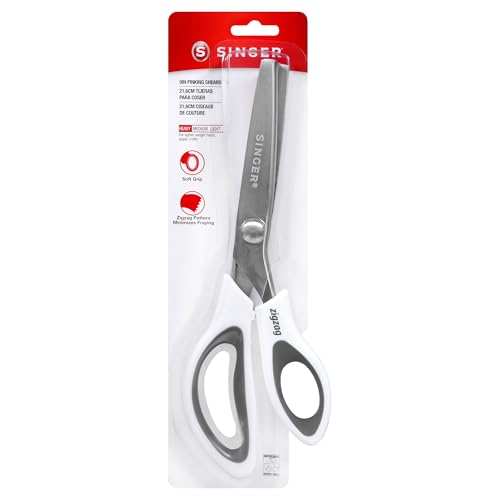
The SINGER 9 inch pair is the straightforward full-size zigzag shear. The blades are heavy-duty stainless steel cut in a sawtooth pattern, and the listing describes them as built to stay sharp and durable over time. The 9 inch frame gives a longer bite per stroke than the 8 inch Fiskars, which helps when you are pinking long seam allowances or cutting across the width of a fabric bolt. The handle is a soft grip design, white with grey accents, shaped for comfortable handling during recurring sewing work.
At 5.6 ounces this is one of the lighter full-size pairs here, and the design is ambidextrous, so it works in the left hand as well as the right. The sawtooth edge is made for woven fabric seams and gives the edge a finished look inside a garment. If you want one classic pair from a long-running sewing brand, with no extra features to think about, this is it.
Specs
- Brand: SINGER
- Model: 00488
- Size: 9 inches
- Blade material: Stainless steel, heavy-duty
- Edge pattern: Zigzag sawtooth
- Handle: Soft grip, white with grey accents
- Hand orientation: Ambidextrous
- Item weight: 5.6 ounces
- ASIN: B08N2PQP4X
3. Hui Tong Strong & Sharpe Pinking Shears, Scalloped 7 mm
The Hui Tong pair is the decorative option: instead of triangular zigzag teeth it cuts a scalloped edge with a 7 mm tooth size and a 2 mm tooth height, across 10 teeth on a 3.5 inch blade. A scallop that size reads clearly from a distance, which makes it the pick for bunting, garlands, gift wrap trim, felt shapes and any edge that will be seen rather than hidden inside a seam. The blades are stainless steel with a polished finish, and the listing gives an overall length of 23.5 cm, just over 9 inches.
The listing also sells the same shears with serrated zigzag teeth in 3 mm, 5 mm and 7 mm, so check the selected pattern before ordering; this pick is the scalloped 7 mm version. The maker notes that the shears are sharp from the first tooth to the last and are built to cut fabric up to three layers thick. At 0.15 kilograms they match the heavier pairs here, which suits the slower, deliberate cutting that decorative work usually involves.
Specs
- Brand: Hui Tong
- Size: 23.5 cm overall (about 9.25 inches)
- Blade material: Stainless steel, polished finish
- Edge pattern: Scalloped, 7 mm teeth, 2 mm tooth height, 10 teeth
- Blade length: 3.5 inches
- Hand orientation: Ambidextrous
- Color: Black
- Item weight: 0.15 kilograms
- ASIN: B06Y4ZJQS6
4. Long Ying Pinking Shears, Serrated 5 mm
The Long Ying shears are the fine-tooth zigzag option, with a 5 mm tooth spacing, a 2 mm tooth height and 15 teeth along the blade. That 5 mm spacing is the classic dressmaking pitch: it leaves a neat, tight zigzag that finishes garment seams without drawing attention to itself. The listing states the shears are sharp from the first serration to the last, and that they cut two layers of fabric. The overall length is given as 22.5 cm in the listing description, with listed dimensions of 9 by 3 inches.
The handle is the other half of the design. It is a soft, non-slip grip listed for both right and left handed use, and the maker says it is shaped to avoid fatigue over long use. The colour is listed as grey purple, which makes the pair easy to spot in a shared sewing box. At 0.17 kilograms this is the heaviest pair in the group, so it suits table work on steady fabric more than quick trimming held in the air.
Specs
- Brand: Long Ying
- Model: YING3330
- Size: 9.2 inches
- Blade material: Stainless steel, polished finish
- Edge pattern: Serrated zigzag, 5 mm tooth spacing, 2 mm tooth height, 15 teeth
- Handle: Soft grip, non-slip
- Hand orientation: Ambidextrous, right and left handed
- Color: Grey purple
- Item weight: 0.17 kilograms
- ASIN: B07B7P52B6
5. Ohtomber Pinking Shears, 9 Inch
The Ohtomber pair is a general-purpose zigzag shear built around comfort grips. The blades are stainless steel with a brushed finish and a serrated zigzag edge, and the handles are rubber with a redesigned ergonomic shape that the listing describes as non-slip and soft, made for easy control during cutting. The listed dimensions are 9.25 by 3.54 inches, and the description puts the shears at 9.4 inches overall, so this is a full-size pair for table cutting.
The listing aims the shears at fabric cutting for sewing and scrapbook craft work, and the ambidextrous handle means the same pair serves left and right handed users. At 0.15 kilograms it matches the Hui Tong on weight. The red handles are easy to find in a craft drawer. For a beginner putting together a first sewing kit, or a crafter who wants one pair that covers both fabric and paper edging, this is the flexible pick of the five.
Specs
- Brand: Ohtomber
- Size: 9.25 x 3.54 inches
- Blade material: Stainless steel, brushed finish
- Edge pattern: Zigzag, serrated
- Handle: Rubber comfort grips, ergonomic, non-slip
- Hand orientation: Ambidextrous
- Color: Red
- Item weight: 0.15 kilograms
- ASIN: B0BX31XHVQ
Frequently asked questions
Do pinked edges stop fabric from fraying completely?
No. A pinked edge limits fraying rather than eliminating it. The zigzag cuts the threads along the edge short and at an angle, so loose threads have less length to unravel, and a pinked seam allowance inside a garment holds up well through normal wear and washing. On loosely woven fabric, or on an edge that will be handled a lot, pinking works best alongside another finish such as a stitched seam or an overcast edge.
What is the difference between zigzag and scallop pinking shears?
The teeth are shaped differently. Zigzag shears carry triangular teeth and leave a sawtooth edge; that is the standard finish for seam allowances, because it is neat, small and mostly hidden. Scallop shears carry rounded teeth and leave a line of half-circles, which is a decorative edge meant to be seen on crafts, bunting and trims. The pattern is built into the blade, so a pair cuts only its own pattern.
Which tooth size should a beginner choose?
A 5 mm zigzag is the safe starting point. It is the common dressmaking size, fine enough for garment seams and coarse enough to cut cleanly without tearing at the fabric. The 5 mm Long Ying and the standard zigzag pairs here all sit in that range. Move to a 7 mm scallop when the edge is decorative and meant to be seen, and leave very fine 3 mm teeth for paper work.
How should pinking shears be cared for?
Wipe the blades after each session, because lint and fibre pack between the teeth and dull the cut. Keep the shears for fabric and paper only; cutting card, wire or plastic blunts the fine teeth. A drop of oil on the pivot keeps the action smooth, and storing the shears closed, in a case or sleeve, protects the teeth from knocks. When a pair starts chewing fabric instead of cutting it, the teeth have dulled and the pair should be replaced or professionally sharpened.
FAQ
Do pinked edges stop fabric from fraying completely?
What is the difference between zigzag and scallop pinking shears?
Which tooth size should a beginner choose?
How should pinking shears be cared for?
More from Amazon
Programs that pair well with the guide above. Offers and eligibility are set by Amazon and may change.
Free shipping on eligible items, Prime Video and more. Eligible new members can start with a free trial.
Start a Prime free trialA Prime membership for ages 18-24 with a trial period. Eligibility is set by Amazon.
See Prime for Young AdultsAudiobooks and podcasts to listen to on the go. Eligible new members can start with a free trial.
Try Audible freeAd-free music streaming. Eligible new subscribers can start with a free trial.
Try Music Unlimited freeAs an Amazon Associate we earn from qualifying purchases.