Key takeaways
- Compare the best bike work lights for workshop jobs: magnetic inspection lights, a light bar and tripod floods, with output figures each listing states.
A bike on a repair stand puts its hardest jobs in shadow. The barrel adjuster, the pad bolts, the limit screws and the inside of the chainstay all sit where ceiling light never reaches, and a riding headlight is the wrong tool, built to throw a beam down a road rather than flood a drivetrain from half a metre away. A work light solves it differently: a wide, even flood you can park beside the stand, stick to a steel surface, or stretch across the work area on a bar or tripod.


As an Amazon Associate, I earn from qualifying purchases.
The five lights below cover the shapes that earn their keep around a repair stand: a magnetic inspection light, a long light bar that spans the bike, a compact COB flood for bench light, and two tripod lights that raise the source above the bike and kill the shadows your own body casts. Every output and runtime figure below is the figure its listing states, a listing claim rather than a measurement.
What To Look For In A Workshop Work Light
Mounting decides where the light can go. A magnetic base sticks to a steel repair stand or a tool cabinet and points exactly at the cassette; a hook hangs the light from a stand arm or a shelf edge; a tripod lifts the light over the bike so the whole machine sits in one pool of light. The closer the job, the more a small magnetic light earns its place; the bigger the job, the more height matters.
Beam shape matters as much as brightness. A flood beam spreads light across the whole bike for general work. A focused front light or a narrow bar concentrates output on one component, which suits brake and derailleur work, for reading small markings and checking pad alignment. Listings state output in lumens, and the figures below range from a few hundred for inspection lights to five figures for the big corded tripod; treat the number as a guide to class rather than a promise, because listings state output their own way.
Power source shapes the routine. USB-rechargeable lights are grab-and-go and cheap to run, but their runtime is fixed by a small built-in cell. Tool-platform lights run on a workshop’s existing cordless-tool batteries and swap in seconds, though they are sold as bare tools. A corded tripod never runs flat mid-job, at the cost of a cable across the floor.
Modes and durability round out the choice. Two or three brightness steps let you trade output for runtime; a red mode preserves night vision and doubles as a warning light in a dark garage doorway. Ingress protection such as IP65 matters in a workshop where degreaser, spray lube and wash water are always nearby.
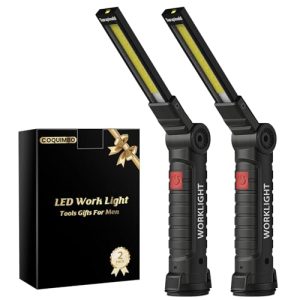
1. Coquimbo Rechargeable LED Work Light, 2 Pack (GZD-001)
The Coquimbo is the inspection light of this group: a folding hand light built around a magnetic base and a hanging hook, sold as a pair so one can live on the stand and one in the toolbox. The listing states 800 lumens and five modes — high brightness, medium brightness, a focused front light, a red light and a red strobe — cycled from one switch, with the red modes reached by a long press.
The head rotates 360 degrees against the base, so the magnet can grip the post of a steel repair stand while the beam turns horizontal onto the rear derailleur. The hook covers the spots a magnet cannot: a stand arm, a shelf lip, a spoke. The built-in battery recharges over USB with the cables included in the box. For close work — reading a worn chain, finding a frayed cable end, lighting the inside of a rim — this is the light that gets aimed most often.
Specs
- Brand: Coquimbo
- Model: GZD-001
- Pack: 2 lights
- Brightness: 800 lumens (per listing)
- Modes: 5 (high, medium, front light, red, red strobe)
- Mounting: Magnetic base and hanging hook
- Head: 360-degree rotation
- Power: Built-in rechargeable battery, USB charging
2. NEIKO 40447A Rechargeable Cordless Underhood Work Light
The NEIKO 40447A is a light bar: 202 SMD LEDs spread along a bar that spans the work area instead of lighting it from a single point. Bars of this pattern were designed to hang under a car bonnet, and the same geometry suits a bike on a stand — hang it above or behind the machine and the whole drivetrain side sits in even light with no single hot spot.
NEIKO states a maximum of 1,200 lumens with two brightness modes, run from a built-in rechargeable lithium-ion battery, so there is no cable to drag across the stand. The bar format also travels well to the bench: laid or hung over a wheel-building or truing area, it lights the full width of the rim at once, which suits spoke and nipple work better than a point source. Choose the bar when the job covers the whole bike rather than one bolt.
Specs
- Brand: NEIKO
- Model: 40447A
- Light source: 202 SMD LEDs
- Brightness: Up to 1,200 lumens (per listing)
- Modes: 2 brightness modes
- Format: Cordless light bar with end hooks
- Power: Built-in rechargeable lithium-ion battery
3. NEIKO 40339A Cordless COB LED Work Light
The second NEIKO is the general-purpose flood: a compact COB LED work light that stands on its own base and fills the bench area around the bike. COB emitters pack their diodes into one panel, which gives a broad, even wash rather than a dotted beam, and NEIKO states a maximum of 1,000 lumens for this model.
Its listing leads on runtime: a rechargeable 4,400 mAh lithium-ion battery with up to 11.5 hours of run time per charge, the longest figure in this group. That makes it the set-and-forget option for a full day of workshop jobs — morning wheel work, afternoon brake bleeds — without a mid-session recharge or a cable. It is the plainest light here, and for a bench with decent ceiling light it is the simple top-up that removes the shadows inside the frame triangle.
Specs
- Brand: NEIKO
- Model: 40339A
- Light source: COB LED
- Brightness: Up to 1,000 lumens (per listing)
- Battery: 4,400 mAh rechargeable lithium-ion
- Runtime: Up to 11.5 hours (per listing)
- Format: Portable flood light with stand base
4. DEWALT 20V MAX Cordless Tripod Light (DCL079B)

The DEWALT DCL079B raises the light source above the bike on a tripod that extends to seven feet, which changes the geometry of a workshop session: with the light high and behind you, the whole machine is lit and your hands stop shadowing the exact bolt you are turning. The listing states 3,000 lumens of brightness across three modes, so output steps down for close work and up for full-bike jobs.
It runs on DEWALT’s 20V MAX battery platform and is sold as a bare tool, with no battery or charger in the box — the right buy for a workshop already holding 20V MAX batteries, and an incomplete one for anyone else. The listing describes a water-resistant build for jobsite conditions, which in a bike workshop means splash tolerance around wash buckets. Of the five, this is the one that most changes how a dark corner of a garage works: park it once, and the stand area stays lit for the whole session.
Specs
- Brand: DEWALT
- Model: DCL079B
- Brightness: 3,000 lumens (per listing)
- Modes: 3 brightness modes
- Stand: Tripod, extends to 7 ft
- Power: DEWALT 20V MAX battery platform
- Included: Tool only, battery and charger not included
5. LUTEC Dual Head LED Work Light With Telescoping Tripod

The LUTEC is the heavy artillery: a corded, dual-head tripod light whose listing states 25,000 lumens — the largest figure in this group by far, and one to read as a maker figure for a twin-head mains light rather than a number comparable with the battery lights above. Two heads on one telescoping tripod let you split the light, one head on the bike and one on the bench, or cross both onto a full overhaul.
The heads are dimmable through six brightness levels, so the same unit turns down for ordinary evening work, and the listing gives an IP65 waterproof construction. Power comes from an 8.2 ft three-prong cord, which ends the runtime question and starts a cable-management one instead. Pick it for a fixed workshop corner where the stand lives permanently.
Specs
- Brand: LUTEC
- Model: Dual head tripod work light
- Brightness: 25,000 lumens (per listing)
- Heads: 2, rotating
- Brightness levels: 6, dimmable
- Sealing: IP65 waterproof (per listing)
- Stand: Telescoping tripod
- Power: Corded, 8.2 ft 3-prong power cord
How To Choose Between These Five
Start with the job, not the lumen figure. Close inspection work — derailleur setup, brake pads, spoke tension — wants the Coquimbo’s magnetic head an inch from the part. Whole-bike jobs want height or span: the NEIKO bar for an even wash across the machine, the DEWALT tripod for light over your shoulder, the LUTEC for a permanent corner. The NEIKO COB flood is the middle path, a bench light with the longest stated runtime.
Then check the power you already own. A workshop holding DEWALT 20V MAX batteries gets the tripod light cheaply as a bare tool; a workshop without them should count the battery and charger as part of the decision or stay with the USB and corded options. One directed light at the stand plus one broad light for the area covers nearly every job a home workshop sees.
FAQ
Can a work light replace a bike headlight in the workshop?
No, and the two are built for opposite jobs. A riding headlight throws a narrow beam a long way down the road and clamps to a handlebar; a work light floods a wide area a short distance and mounts to a stand, a magnet or a tripod. A headlight leaves most of the bike in shadow, and its mount points the beam where the bar points, not where the job is.
How many lumens does a bike workshop light need?
For close work at the stand, a few hundred lumens aimed well beats a large figure aimed badly, which is why the 800-lumen magnetic light here handles most component jobs. For lighting the whole bike and the floor around it, listings in the 1,000 to 3,000 lumen range are the working band. Read every figure as the maker’s listing claim, and judge beam shape and mounting alongside the number.
Is a magnetic work light safe around a bike frame?
The magnet grips steel — a steel repair stand, a tool cabinet, a steel frame tube — and holds the light, not the bike up. Keep magnetic bases off carbon frames and aluminium tubes, where they will not hold anyway, and off painted surfaces if the base is uncoated. On the stand post, where these lights mostly live, the magnet is the fastest mount in the workshop.
Tripod light or light bar for a bike on a stand?
A light bar spans the bike and gives the most even coverage of the drivetrain side, with no single shadow source. A tripod light stands clear of the bike, lights the whole machine and the work area, and doubles as general garage light, but takes floor space beside the stand. Workshops that do whole-bike work lean tripod; workshops that service the drivetrain lean bar.
Conclusion
Workshop light is a mounting problem before it is a brightness problem. The Coquimbo pair puts a magnetic beam exactly on the component, the NEIKO bar spans the whole bike in even light, the NEIKO COB flood runs all day beside the bench, the DEWALT tripod lifts its stated 3,000 lumens over the stand, and the corded LUTEC floods a permanent corner. Match the mount to the job, and the shadows go away.
FAQ
Can a work light replace a bike headlight in the workshop?
How many lumens does a bike workshop light need?
Is a magnetic work light safe around a bike frame?
Tripod light or light bar for a bike on a stand?
More from Amazon
Programs that pair well with the guide above. Offers and eligibility are set by Amazon and may change.
Free shipping on eligible items, Prime Video and more. Eligible new members can start with a free trial.
Start a Prime free trialA Prime membership for ages 18-24 with a trial period. Eligibility is set by Amazon.
See Prime for Young AdultsAudiobooks and podcasts to listen to on the go. Eligible new members can start with a free trial.
Try Audible freeAd-free music streaming. Eligible new subscribers can start with a free trial.
Try Music Unlimited freeAs an Amazon Associate we earn from qualifying purchases.