Key takeaways
- The best bike massage balls for post-ride legs: firm foam singles, a peanut roller, a vibrating ball and spiky options for glutes, calves and feet.
Cycling loads the same handful of muscles on every ride. The glutes drive the downstroke, the calves stabilise the ankle through the bottom of the pedal circle, and the soles of the feet take hours of pressure inside stiff shoes. A foam roller covers broad areas well, but it cannot reach the deep pocket of a glute, the inner calf, or the arch of a foot with any precision. That gap is where massage balls earn their place in a rider’s kit bag.
A massage ball concentrates body weight onto a small contact patch, so a rider can work a tight spot slowly and back off the moment the pressure feels like too much. The five tools below cover the main shapes sold for the job: a firm single foam ball, a peanut-shaped double ball, a vibrating ball, a graded set of spiky balls, and a single dense spiky ball. Each one is a general recovery product framed here for the spots cyclists load most, and every performance claim in this guide is the maker’s own listing claim, attributed as such.
As an Amazon Associate, I earn from qualifying purchases.
What To Look For In A Massage Ball
Size decides where a ball can work. Balls around 2.5 to 3 inches across suit the glutes, calves and feet, because they sit deep enough to reach the muscle without spreading pressure over the whole area. A larger ball spreads the load and feels gentler on bigger muscles such as the quads and hamstrings, while a small textured ball fits the arch of the foot and the palm of the hand.
Firmness decides how the pressure feels. Dense foam and hard rubber barely deform under body weight, so they hold a focused point of pressure. Softer foam and inflatable-style balls give more, which many riders prefer when they are starting out or working a sensitive area. Several makers sell the same shape in graded densities, and the listings below note where a firmer or softer sibling exists.
Shape matters most along the spine and the calf. A peanut double ball has a groove in the middle, so it can sit either side of the spine or cradle a calf without rolling away. A single round ball is simpler and easier to pin against a wall. Texture is the last variable: a smooth surface slides and glides, while spikes and bumps grip the skin and add a surface-stimulation effect that the makers describe as part of the design.
TriggerPoint MB1 Massage Ball

The MB1 is the reference single ball in this group. TriggerPoint builds it from EVA foam in a layered construction that the listing describes as designed to mimic the feel of a therapist’s thumbs. At 2.6 inches across, it is close to lacrosse-ball size, but the foam surface has more grip than a lacrosse ball’s rubber shell, so it stays put against a wall or floor instead of skating away when a rider leans into it.
For cyclists, the natural targets are the ones the maker lists: hips and glutes, the lower and middle back, and the feet. Sitting on the MB1 lets a rider roll the deep glute muscles that a flat roller bridges over, and standing on it gives a controlled way to work the sole of the foot after a long ride in stiff shoes. The listing states the foam is slip resistant, washable and built not to break down or lose shape with repeated use, and it carries a one-year manufacturer warranty. Riders who want a harder version of the same ball can look at the maker’s extra-firm MBX variant, and the larger 5-inch MB5 covers broader areas such as the shoulder and hip.
Specs
- Diameter: 2.6 inches
- Material: EVA foam
- Part number: 3301
- Item weight: 0.05 kg per listing
- Warranty: 1 year manufacturer warranty
TriggerPoint Universal Double Massage Ball

The Universal Double is the peanut of the group: two foam balls joined into one 8-inch roller with a channel down the middle. TriggerPoint’s listing says the shape is designed to massage up and down the spinal column without uncomfortable pressure on the spine itself, because the bony ridge of the back sits in the groove while the two lobes press into the muscles on either side.
That same groove makes it a practical calf tool. A rider can rest one calf in the channel and roll both heads of the muscle at once, which is awkward to do with a single ball that keeps escaping sideways. The listing also names the glutes, hamstrings and quads as target areas, and at 0.9 pounds the roller is light enough to live in a gym bag or a travel case. The EVA foam body is water resistant and easy to clean according to the maker, and the black finish is the standard colour for this model. Riders who find a full peanut too wide for neck work should note this is the largest tool in the guide, and the single balls below give finer control in small areas.
Specs
- Length: 8 inches
- Material: EVA foam
- Part number: 04445
- Item weight: 0.9 lb
- Warranty: 1 year manufacturer warranty
Hyperice Hypersphere Go

The Hypersphere Go is the powered option. Hyperice renamed its Hypersphere Mini into the Go line, and the listing describes a compact vibrating massage ball with three speed settings. The ball is 3 inches across, roughly lacrosse-ball size, and the maker positions the vibration as a way to work on tight areas without leaning as much body weight into the tool, which suits spots like the calf and the sole of the foot where full body weight on a hard ball can feel severe.
Charging runs through a USB-A to USB-C cable, a change the listing highlights over the older Mini, so the ball tops up from the same chargers a rider already carries for lights and computers. The dual-density exterior pairs a firm core with a textured rubber outer that grips the floor. Because it has a battery and a motor, it is the heaviest and most complex tool here, and it is the one to leave out of a wet kit bag. Riders who already own a massage gun and want ball-shaped pressure in places a gun head cannot settle into are the audience Hyperice aims this design at.
Specs
- Diameter: 3 inches
- Vibration speeds: 3 settings
- Charging: USB-C cable
- Model part number: HISPHEREMINI
- Power source: rechargeable battery
OCTOROX Spiky Massage Balls, Set Of 3
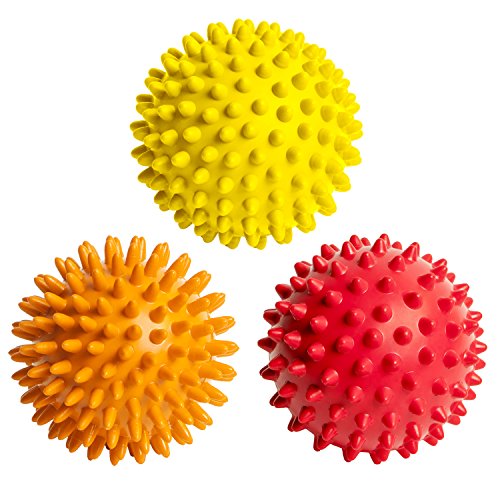
OCTOROX sells its spiky balls as a graded set of three, which solves the most common buying problem with this shape: guessing the right firmness before ordering. The set contains three 3-inch balls in firm, medium and extra-soft densities, colour coded in red, orange and yellow. The listing assigns the soft orange ball to a gentle start, the medium ball to everyday work, and the firm red ball, with shorter and firmer spikes, to the deepest pressure of the three.
The spiked surface is the point of the design. Instead of one smooth contact patch, dozens of short points spread the load and grip the skin, and the maker lists feet, back, hands, neck and shoulders among the intended areas. For a cyclist, the practical routine is the foot: standing and rolling the arch over the medium ball after a ride, then moving to the soft ball on days when the feet feel tender. Having three densities in one box also means a partner or a second rider with different tolerance can share the set. The trade-off is storage, since three balls take more room in a kit bag than one.
Specs
- Quantity: 3 balls
- Diameter: 3 inches each
- Firmness levels: firm, medium, extra soft
- Colours: red, orange, yellow
- Model number: 4333850618
Pro-Tec Athletics Spiky Massage Ball
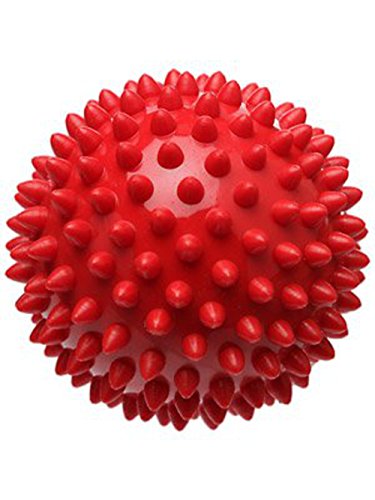
Pro-Tec Athletics takes the opposite approach to the OCTOROX set: one ball, one firmness, no choices to make. Its spiky ball is 2.75 inches across and built in a high-density construction, with a spiky outer layer over the whole surface. The listing leads with foot work, describing the ball as a tool for the arch and heel, and the smaller diameter compared with the 3-inch set above helps it sit into the arch of the foot.
The dense build matters for riders who rest a lot of weight through one foot. A soft spiky ball flattens and the spikes fold; a high-density ball keeps its shape, so the points keep working as the rider leans in. Pro-Tec is a running and sports-medicine brand, and this ball sits in the same foot-care line as its braces and supports, which is why the listing concentrates on the foot rather than the whole body. It still works against a wall for shoulders and glutes, but buyers should treat it as the foot-first pick of this guide and choose one of the smooth balls above if back and glute work is the priority.
Specs
- Diameter: 2.75 inches
- Construction: high density with spiky outer layer
- Colour: red
- Model: PTSpike
- Part number: PTspike
How Cyclists Use Massage Balls
Glutes respond best to a seated position on the floor. Place a firm single ball under one side, cross that ankle over the opposite knee, and lean toward the ball until the pressure settles into the deep muscle. Small shifts of body weight move the contact point far more than big rolls, and thirty to sixty seconds per spot is the pattern most maker guides describe.
Calves are easier against a wall or on the floor with the other leg crossed on top to add load. The peanut roller earns its keep here, since the groove holds the calf in place. For the feet, stand holding a chair or counter, set the ball under the arch, and roll slowly from heel to toes, pausing where the tissue feels dense. A spiky or textured ball suits this job because the points grip instead of sliding on a hard floor.
Pressure should feel strong but never sharp, and any spot that produces numbness or shooting sensations is a signal to move off it. These are self-massage tools, not medical devices, and persistent pain is a reason to get checked rather than to press harder.
Frequently Asked Questions
Which massage ball is best for cycling glutes?
A firm single ball around 2.5 to 2.6 inches, such as the TriggerPoint MB1, is the usual starting point, because it reaches the deep glute muscles that a flat roller bridges over. Riders who find a hard ball too intense can begin with a softer foam density and progress as the tissue tolerates more pressure.
Can a peanut massage ball be used on calves?
Yes. The groove in a peanut double ball cradles the calf, so both sides of the muscle get pressure at once and the tool does not roll away sideways. The TriggerPoint Universal Double in this guide is the peanut option, and its listing names the hamstrings and quads as target areas alongside the back.
Are vibrating massage balls worth it for riders?
A vibrating ball such as the Hyperice Hypersphere Go lets a rider apply pressure without leaning full body weight into the tool, which helps on tender calves and feet. The maker lists three speed settings, so the intensity can start low. The trade-offs are charging, extra weight and a higher complexity than a plain foam ball.
How often should cyclists use a massage ball?
Maker guides generally describe short sessions of a few minutes per area after rides or on rest days, working each tight spot for roughly thirty to sixty seconds at a time. Daily light use is the pattern most brands describe; pressing as hard as possible as often as possible is not, and sore or bruised tissue needs a break.
FAQ
Which massage ball is best for cycling glutes?
Can a peanut massage ball be used on calves?
Are vibrating massage balls worth it for riders?
How often should cyclists use a massage ball?
More from Amazon
Programs that pair well with the guide above. Offers and eligibility are set by Amazon and may change.
Free shipping on eligible items, Prime Video and more. Eligible new members can start with a free trial.
Start a Prime free trialA Prime membership for ages 18-24 with a trial period. Eligibility is set by Amazon.
See Prime for Young AdultsAudiobooks and podcasts to listen to on the go. Eligible new members can start with a free trial.
Try Audible freeAd-free music streaming. Eligible new subscribers can start with a free trial.
Try Music Unlimited freeAs an Amazon Associate we earn from qualifying purchases.