Key takeaways
- Find the best bike grip strengtheners for hands that fade on long descents, from adjustable grippers to finger exercisers and extensor bands, with specs.
Ask riders where a long descent hurts and many will point at their hands. Braking, weighting the front wheel, and absorbing trail chatter all run through the fingers and forearms, and when that grip fades, braking gets later and line choices get worse. Off-bike grip training is the direct answer, and the tools are small, cheap to store, and easy to use in short sessions. This guide to the best bike grip strengtheners covers the four shapes that dominate the listings — fixed torsion-spring grippers, adjustable grippers, per-finger piston exercisers, and silicone extensor trainers — and picks out five current listings that suit a rider’s hands. Every resistance figure below is the maker’s own published figure for that listing, so read the numbers as listing claims rather than measurements. As an Amazon Associate, I earn from qualifying purchases.
Why Riders Train Grip Off The Bike
A mountain bike ride asks the hands to do two jobs at once. The fingers work the brake levers in repeated short pulls, while the whole hand holds on against impacts, braking forces, and the pull of the bars on steep ground. Road and gravel riders get a slower version of the same load: hours of hoods pressure and lever work on rough descents. The makers of the tools below position them for building hand, finger, and forearm strength and endurance, and riders use them in short sessions at a desk, in the car, or beside the trainer. Training the squeeze is only half of the picture, which is why this list also includes an extensor trainer: the muscles that open the hand work against the ones that close it, and the listings for extensor bands frame them as the balancing half of a grip routine.
The Main Trainer Types, Explained
Torsion-spring grippers are the classic shape: two handles joined by a coiled steel spring, squeezed until the handles meet. Fixed models carry one resistance each, so progression means owning several. Adjustable grippers use a spring or dial mechanism that moves through a range of settings in one unit, which suits riders who want to work up gradually or share one tool between two hands of different strength. Per-finger exercisers replace the single squeeze with individual spring-loaded pistons, one under each fingertip, so a weak ring or little finger cannot hide behind the stronger fingers. Silicone trainers cover the rest of the shelf: squeeze rings and balls for simple crush work, and finger stretcher or extensor bands that resist the opening motion instead. Kits bundle several of these shapes into one box.
What To Check Before You Buy
Start with the resistance figure and treat it as a rough guide only. Makers measure at different points on the handle, so a figure from one brand does not translate exactly to another; use the number to place a tool within its own line, not to compare across brands. Next, decide between fixed and adjustable. A fixed gripper is simpler and usually the most durable shape, but one resistance will not stay right for long. Check handle size and spread if your hands are small, since a gripper that starts too wide is hard to close with control. For per-finger tools, the tension is listed per finger, so the numbers look small next to whole-hand grippers — that is expected. Finally, think about noise and setting: spring grippers click and creak, while silicone rings and bands are silent, which matters for desk or travel use.
1. IronMind Captains of Crush Hand Gripper, Guide
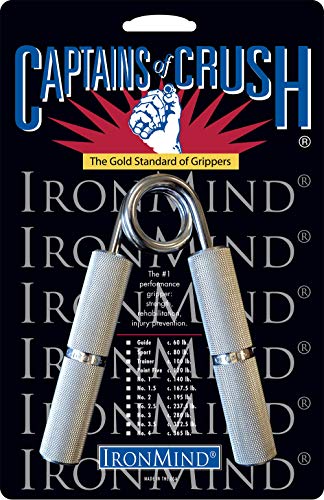
The Captains of Crush line is the reference point of the gripper world, and this listing is the Guide, the lightest of the eleven strengths IronMind sells. It is a fixed torsion-spring gripper with nothing to adjust: two knurled handles machined from aircraft-grade billet aluminum, joined by the maker’s proprietary GR8 spring. IronMind lists the Guide at about 60 pounds of resistance and positions it for novices and warm-up work, which for riders means high-rep sets that mirror the repeated lever pulls of a long descent rather than maximum-effort closes. The knurling is a defining detail — it keeps the handles planted in the palm the way a knurled bar does. Choose this one if you want the simplest, most durable form of the tool and a clear ladder of harder levels in the same line when this one gets easy.
Specs
- Type: Fixed torsion-spring hand gripper
- Resistance: Guide level, listed by the maker at about 60 lb
- Handles: Knurled aircraft-grade billet aluminum
- Spring: Proprietary GR8 steel spring
- Item weight: 7.68 oz, as listed
- Part number: 1401
2. GD Grip Ultra 70 Adjustable Hand Gripper

The GD Grip Ultra 70 takes the opposite approach to the fixed gripper above: one unit covering the range a rider is likely to need for years. The listing gives an adjustable resistance range of 44 to 154 pounds (20 to 70 kg), set by moving the spring, and the handle width adjusts separately from 1.8 to 3.3 inches, so the starting spread can be matched to hand size. That second adjustment is rare in this category and matters for smaller hands, which often struggle more with a wide starting position than with the resistance itself. The body is alloy steel per the listing, and at 420 grams it is a substantial, desk-drawer tool rather than a pocket one. The maker positions it for athletes, and the listed range runs from moderate squeezes for endurance sets up to figures most riders will never close. Pick it if you want one adjustable gripper instead of a growing row of fixed ones.
Specs
- Type: Adjustable torsion-spring hand gripper
- Resistance: Adjustable, listed at 44 to 154 lb (20 to 70 kg)
- Handle width: Adjustable from 1.8 to 3.3 in
- Material: Alloy steel, as listed
- Item weight: 420 g, as listed
- Model: GD Grip Ultra 70
3. FitBeast Grip Strengthener Kit, 5 Pack

FitBeast’s kit is the bundle option, built around an adjustable hand gripper the listing places at 10 to 132 pounds of resistance. Around it the box adds four more tools: a finger exerciser, a finger stretcher for extension work, a grip ring, and a grip ball. That spread covers the whole routine in one purchase — crush work from the gripper, individual finger work, extensor training from the stretcher, and simple squeeze work from the ring and ball. For a rider setting up grip training for the first time, the value of the kit is that no single tool has to do everything, and the light end of the gripper’s listed range suits the high-repetition sets that match braking endurance. The trade-off is that a kit’s individual pieces are generalists; riders who settle on one favourite shape may later replace that piece with a dedicated tool like the ones above.
Specs
- Type: Five-piece grip training kit
- Main gripper: Adjustable resistance, listed at 10 to 132 lb
- Also included: Finger exerciser, finger stretcher, grip ring, grip ball
- Focus: Hand, finger, wrist, and forearm training per the listing
- Part number: WOLIQI001
4. Prohands Gripmaster Hand Exerciser

The Gripmaster works the hand one finger at a time. Four spring-loaded pistons sit under the fingertips, each with its own spring, so every finger presses its own resistance instead of sharing one handle’s load. This listing is the X-Light tension in yellow, listed at 3 pounds per finger. That figure sounds tiny beside a whole-hand gripper, but it is per finger, and isolating the ring and little fingers — the two that do much of the holding on a wide bar — shows why the format exists. The listing describes the system as a way to isolate and exercise each finger for strength and dexterity, and the unit is small enough to live in a jersey pocket or a desk drawer. Riders whose braking finger feels strong while the outer fingers ache on long descents are the audience for this shape.
Specs
- Type: Per-finger spring-piston hand exerciser
- System: Four spring-loaded finger pistons, one per finger
- Tension: 3 lb per finger, X-Light, as listed for this variant
- Colour: Yellow
- Brand: Prohands
5. ALPHA GRIPZ Complete Set

Squeezing is only half of grip training, and the ALPHA GRIPZ set is built around the other half: opening the hand against resistance. The set’s core is three silicone extensor bands in the maker’s listed levels — green at 6 pounds, grey at 9 pounds, and blue at 12 pounds — slipped over the fingertips and worked by spreading the fingers. Alongside the bands, the set includes two of the maker’s Ringz squeeze rings for crush work and a carry bag, so extension and flexion training travel together. Everything is silicone, silent, and washable, which makes this the pick that suits a desk, a car console, or a kit bag. The maker frames the bands as a way to train the underdeveloped extensor side of the forearm and balance out heavy squeezing work, and for riders that balance is the point: the set pairs naturally with any gripper on this page rather than replacing it.
Specs
- Type: Finger extensor band and squeeze ring set
- Extensor bands: 3 silicone bands listed at 6, 9, and 12 lb
- Also included: 2 Ringz squeeze rings and a carry bag
- Material: Silicone, as listed
- Item weight: 6.24 oz, as listed
- Model name: Alpha Gripz – The Complete Set
Building Short Sessions Around Riding
Grip tools reward little and often. A few short sets on rest days or after easy rides suit most riders better than one long weekly session, and hands that are fresh for the bike matter more than hands trained to exhaustion. Keep the day before a big ride light or skip grip work entirely, since fatigued forearms show up on the first descent. Mix the motions across the week: whole-hand squeezes for crush strength, per-finger presses for the weaker fingers, and extensor work to balance the load. Progress slowly — move to a harder setting or level only when the current one can be closed under control for full sets, and stop a session when form breaks down into wrist bending and shoulder help.
Frequently Asked Questions
Are grip strengtheners the same as handlebar grips?
No. Handlebar grips are the rubber or foam sleeves fitted to a bike’s bars, and this site covers those separately. Grip strengtheners are off-bike training tools — grippers, finger exercisers, rings, and bands — used in short sessions to train the hands and forearms that hold those bars.
How often should a rider train with a grip strengthener?
Short sessions a few times a week are the common pattern in the makers’ guidance, with rest days between harder efforts. Keep sessions away from the day before a big ride so your hands arrive fresh, and treat soreness in the fingers or elbows as a sign to back off.
Should I train finger extension as well as squeezing?
The extensor listings make the case for balance: squeezing trains the flexor side, while bands and stretchers train the muscles that open the hand. A routine that includes both directions, like pairing a gripper with the ALPHA GRIPZ bands or the FitBeast kit’s finger stretcher, covers the full motion.
Which resistance should a beginner start with?
Start lighter than you think. Maker figures are not comparable across brands, so use each line’s own ladder: the Captains of Crush Guide is IronMind’s listed starting level, and adjustable tools like the GD Grip Ultra 70 and the FitBeast gripper can be set near the bottom of their listed ranges and moved up over time.
The Bottom Line
Match the tool to the gap in your hands. The Captains of Crush Guide is the simple, fixed benchmark for crush work, the GD Grip Ultra 70 replaces a row of fixed grippers with one wide adjustable range and an adjustable spread, the FitBeast kit covers every motion in one box, the Gripmaster isolates the fingers that whole-hand tools let hide, and the ALPHA GRIPZ set trains the opening half of the grip. Any of the five turns a few spare minutes into steadier hands on the next long descent.
FAQ
Are grip strengtheners the same as handlebar grips?
How often should a rider train with a grip strengthener?
Should I train finger extension as well as squeezing?
Which resistance should a beginner start with?
More from Amazon
Programs that pair well with the guide above. Offers and eligibility are set by Amazon and may change.
Free shipping on eligible items, Prime Video and more. Eligible new members can start with a free trial.
Start a Prime free trialA Prime membership for ages 18-24 with a trial period. Eligibility is set by Amazon.
See Prime for Young AdultsAudiobooks and podcasts to listen to on the go. Eligible new members can start with a free trial.
Try Audible freeAd-free music streaming. Eligible new subscribers can start with a free trial.
Try Music Unlimited freeAs an Amazon Associate we earn from qualifying purchases.